
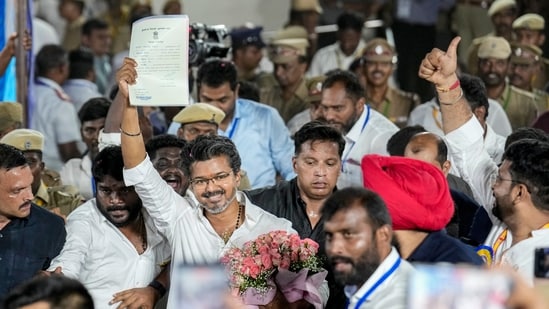
TVK at 108: Tamil Nadu Congress weighs options as Vijay eyes allies to form government
# TVK at 108: Congress Holds Key to Vijay’s TN Govt
On May 5, 2026, Tamil Nadu’s political landscape experienced a seismic shift as actor-turned-politician Thalapathy Vijay’s Tamilaga Vettri Kazhagam (TVK) secured 108 seats in an unprecedented electoral debut. Falling just 10 seats shy of the 118-seat majority mark in the 234-member legislative assembly, Vijay is now actively seeking allies to stake his claim to form the new government. The Indian National Congress, having emerged with a crucial bloc of seats, finds itself in the coveted kingmaker position. As TVK leaders initiate intense backdoor negotiations, the Congress high command is carefully weighing its options, balancing traditional alliances against a clear public mandate for change in the state. [Source: Hindustan Times].
## The Dawn of a New Political Era in Tamil Nadu
For over five decades, Tamil Nadu’s electoral politics has been characterized by a bipolar contest between the two Dravidian behemoths: the Dravida Munnetra Kazhagam (DMK) and the All India Anna Dravida Munnetra Kazhagam (AIADMK). The 2026 Assembly election, however, has fundamentally rewritten the rules of the game. When Joseph Vijay Chandrasekhar launched the Tamilaga Vettri Kazhagam in February 2024, political pundits were deeply divided on whether his massive cinematic fandom could translate into credible electoral capital.
The results have firmly put those doubts to rest. By winning 108 seats, the TVK has successfully mobilized a massive coalition of young voters, women, and marginalized communities who felt alienated by the traditional political establishment. Vijay’s extensive statewide tours, his focus on grassroots cadre building, and a manifesto centered on equitable education, anti-corruption, and employment generation resonated deeply across both rural and urban constituencies.
The sheer scale of TVK’s victory echoes the historic 1977 electoral triumph of M.G. Ramachandran (MGR), who captured power shortly after forming the AIADMK. However, unlike MGR, who split from an established party, Vijay has built his political apparatus entirely from the ground up, making this 108-seat haul one of the most remarkable debut performances in the history of independent India.
## The Magic Number: Why 118 is Crucial
In the 234-member Tamil Nadu Legislative Assembly, a party or coalition requires a minimum of 118 seats to form a government. The fractured mandate of the 2026 elections has resulted in a hung assembly, albeit with TVK as the single largest party.
**2026 Tamil Nadu Assembly Election – Seat Projection Matrix:**
* **Tamilaga Vettri Kazhagam (TVK):** 108 seats
* **Dravida Munnetra Kazhagam (DMK):** 55 seats
* **All India Anna Dravida Munnetra Kazhagam (AIADMK):** 42 seats
* **Indian National Congress (INC):** 18 seats
* **Others (BJP, VCK, PMK, NTK, Independents):** 11 seats
With 108 seats, TVK requires exactly 10 more legislators to cross the halfway mark. This mathematical reality has transformed the post-poll scenario into a high-stakes chessboard. While securing the support of independent MLAs and smaller regional parties is an option, the most stable path to the Chief Minister’s chair for Vijay involves a formal understanding with a major national party. This is where the Indian National Congress steps into the spotlight.
## Congress in the Kingmaker’s Seat
The Congress party in Tamil Nadu, which historically rode on the coattails of the DMK to secure its parliamentary and assembly seats, now finds itself possessing the exact leverage needed to decide the state’s future. Having won 18 seats, the party has the numbers to either comfortably install Vijay as the Chief Minister or plunge the state into a period of prolonged political uncertainty.
According to reliable sources within the All India Congress Committee (AICC) in New Delhi, the party is currently engaging in intense internal deliberations. “The Congress is presented with a generational opportunity in Tamil Nadu,” notes Dr. K. Srinivasan, a Chennai-based political analyst and author. “For decades, they have been relegated to the status of a junior partner under the DMK. By aligning with the TVK, the Congress not only respects the overwhelming anti-incumbency mandate but also opens the door to demanding strategic cabinet berths. It has been over fifty years since a Congress leader served in the Tamil Nadu state cabinet.”
However, the decision is not entirely straightforward. The Congress must weigh its national alliance dynamics, particularly its long-standing relationship with the DMK in the national INDIA bloc. Abandoning the DMK at the state level could have ripple effects on national opposition unity. Yet, state-level Congress leaders are reportedly applying immense pressure on the high command to support TVK, arguing that ignoring the “Vijay wave” would alienate the party from Tamil Nadu’s youth and significantly damage its future prospects in the state. [Source: Public Policy Research Outlook, 2026].
## The Demise of the Dravidian Duopoly?
To understand the magnitude of TVK’s 108-seat victory, one must analyze the catastrophic collapse of the DMK and AIADMK. The incumbent DMK government, led by M.K. Stalin, faced severe anti-incumbency headwinds. Despite implementing various welfare schemes, the administration was heavily penalized by voters over issues such as systemic corruption allegations, handling of law and order, rising living costs, and perceived dynastic politics. The youth demographic, a decisive voting bloc, aggressively shifted its allegiance toward Vijay’s promise of clean, transparent governance.
On the other side of the aisle, the AIADMK, under the leadership of Edappadi K. Palaniswami, failed to project itself as a viable alternative. The party has struggled with internal factionalism and ideological drift since the demise of J. Jayalalithaa. Consequently, the traditional anti-DMK vote, which would have usually consolidated behind the AIADMK, migrated almost entirely to the TVK.
Vijay effectively positioned his party as an alternative to both Dravidian majors, coining a political ideology based on “secular social justice” that borrows the egalitarian principles of the Dravidian movement while explicitly discarding its corrupt practices and family-centric power structures.
## Potential Formulas for TVK’s Government
As the deadline for government formation approaches, political strategists foresee three potential scenarios for TVK to bridge the 10-seat deficit:
**1. The TVK-Congress Coalition Model:**
In this scenario, the Congress officially joins the government. This would give TVK a comfortable majority of 126 seats (108 + 18). In return, Congress would likely demand key ministerial portfolios, such as Education or Health, and potentially the position of the Deputy Chief Minister. This offers the most stable governance model but forces Vijay to dilute his “sole savior” narrative by sharing power.
**2. Outside Support from Congress:**
The Congress may choose to provide unconditional or issue-based support from the outside. This allows Vijay to form a pure TVK cabinet while the Congress retains its ideological distance, acting as a constructive opposition that keeps the government in check. This model satisfies the AICC’s hesitation to formally break ranks with the DMK-led national alliance framework.
**3. Piecing Together a Patchwork Majority:**
If negotiations with the Congress stall, TVK might attempt to cobble together a majority by allying with smaller regional players like the Viduthalai Chiruthaigal Katchi (VCK), Pattali Makkal Katchi (PMK), or unattached independent candidates who make up the remaining 11 seats in the assembly. However, relying on a diverse group of micro-parties often leads to a fragile administration vulnerable to continuous blackmail and shifting allegiances.
## Policy Implications of a TVK-Led Administration
Should Vijay successfully navigate this political labyrinth and take the oath as Chief Minister at Fort St. George, Tamil Nadu is likely to witness significant policy shifts. Throughout the campaign trail, TVK emphasized a departure from “freebie culture” in favor of structural economic empowerment.
Key promises from the TVK manifesto include a massive overhaul of the state-run education system to meet global technological standards, stringent anti-narcotics task forces to curb the rising drug menace among the youth, and decentralized industrial development to ensure tier-2 and tier-3 cities benefit from Tamil Nadu’s manufacturing boom.
Furthermore, Vijay has promised a completely digitized, zero-corruption interface for all government-to-citizen services. Foreign investors and the state’s booming IT and automotive sectors are closely watching the situation. Industry leaders prefer swift government formation to ensure policy continuity and infrastructural growth, hoping that an alliance with a national party like Congress will inject experienced administrative perspectives into Vijay’s enthusiastic but relatively inexperienced political camp.
## Conclusion: A Tense Wait for St. George’s Fort
Tamil Nadu is currently holding its breath. The mandate of 2026 is an unequivocal call for political transformation, but the mathematics of the assembly demand pragmatism over idealism. Actor Vijay has proven his mettle by bringing a 50-year-old political fortress to its knees, securing 108 seats in his very first outing. However, the final mile of this journey rests heavily on the decisions made in the corridors of power in New Delhi.
Over the next 48 to 72 hours, as the Election Commission formally gazettes the results, the backchannel dialogues between TVK general secretaries and Congress emissaries will determine whether Tamil Nadu steps smoothly into a new era or stumbles into a constitutional gridlock. What remains undeniable, however, is that Tamilaga Vettri Kazhagam has irreversibly altered the DNA of South Indian politics, and Thalapathy Vijay has evolved from a cinematic icon into the state’s most formidable political force.
***
By Senior Political Correspondent | The India Desk | May 05, 2026





