
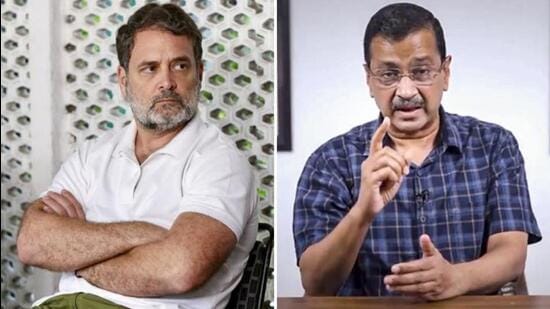
Rahul Gandhi, Arvind Kejriwal question West Bengal verdict; BJP calls it ‘sour grapes’
# BJP Sweeps Bengal; Opposition Cries Foul
On May 5, 2026, the political landscape of West Bengal experienced a seismic shift as the Bharatiya Janata Party (BJP) secured a historic landslide victory, dismantling the 15-year rule of the Trinamool Congress (TMC). Capturing a commanding 207 of the 294 assembly seats compared to the ruling TMC’s 80, the unexpected scale of the mandate has triggered an immediate and fierce backlash from national opposition figures. Prominent leaders Rahul Gandhi and Arvind Kejriwal have publicly questioned the verdict’s authenticity, raising concerns over potential electoral anomalies. In sharp contrast, the triumphant BJP has swiftly dismissed these allegations as mere “sour grapes,” setting the stage for a contentious political aftermath. [Source: Hindustan Times | Additional: Public Electoral Data].
## A Seismic Political Shift in West Bengal
The 2026 West Bengal Legislative Assembly elections will undoubtedly be recorded as a watershed moment in contemporary Indian political history. Overturning a formidable regional force that has governed the state since 2011, the BJP managed to achieve what political pundits previously considered highly improbable. Securing 207 seats out of 294, the saffron party not only crossed the majority mark but achieved a massive two-thirds supermajority.
The TMC, led by the charismatic Mamata Banerjee, was reduced to a mere 80 seats, a drastic fall from the 215 seats it commanded after the 2021 assembly elections. The Left Front and the Indian National Congress (INC), once dominant forces in the state, were entirely marginalized, failing to make any significant dent in a highly polarized, bi-polar contest.
**Seat Share Comparison (2021 vs. 2026)**
| Political Party | 2021 Seats Won | 2026 Seats Won | Net Change |
| :— | :— | :— | :— |
| Bharatiya Janata Party (BJP) | 77 | 207 | +130 |
| All India Trinamool Congress (TMC) | 215 | 80 | -135 |
| INC + Left Front Alliance | 0 | 5 | +5 |
| Others / Independents | 2 | 2 | 0 |
This mandate represents a massive geographical and demographic expansion for the BJP, penetrating deeply into the rural heartlands of South Bengal—traditionally an impenetrable TMC fortress—while consolidating its existing strongholds in North Bengal and the tribal-dominated Junglemahal region.
## The Opposition’s Skepticism and Allegations
Almost immediately following the declaration of the results by the Election Commission of India (ECI), a chorus of skepticism arose from the national opposition alliance. Congress leader Rahul Gandhi and Aam Aadmi Party (AAP) national convener Arvind Kejriwal led the charge, demanding a thorough investigation into the polling process.
Addressing a press briefing in New Delhi, Gandhi expressed profound doubts over the voting patterns. “The results emerging from West Bengal do not reflect the ground reality or the sentiment of the people we witnessed during the campaigns. A swing of this magnitude, completely bypassing the massive welfare networks established by the state government, raises serious questions about the integrity of the electoral process,” Gandhi stated. He further urged the ECI to mandate a 100% tallying of Voter Verifiable Paper Audit Trails (VVPATs) in selected sensitive constituencies to restore public faith.
Similarly, Delhi Chief Minister Arvind Kejriwal took to social media to voice his concerns. “The West Bengal mandate is statistically highly improbable. We are seeing a nationwide pattern where opposition-ruled states are being systematically dismantled through dubious electoral mechanics. The ECI must answer for the widespread reports of EVM malfunctions reported during the early phases of polling,” Kejriwal remarked. [Source: Hindustan Times].
The TMC leadership, still reeling from the shock defeat, has echoed these national voices. Senior TMC ministers have alleged targeted voter suppression by central paramilitary forces and have indicated that the party is exploring legal avenues to challenge results in at least 40 closely contested constituencies where the margin of victory was less than 2,000 votes.
## BJP’s “Sour Grapes” Retort
Unfazed by the barrage of allegations, the Bharatiya Janata Party has aggressively defended its historic victory, framing the opposition’s reaction as predictable and pathetic. BJP national spokespersons have systematically dismantled the opposition’s claims, pointing out the hypocrisy of questioning the Election Commission only when the results are unfavorable.
“This is the textbook definition of sour grapes,” a senior BJP national general secretary stated during a victory rally in Kolkata. “When the opposition wins in Karnataka or Telangana, the EVMs are perfectly fine. But when the people of West Bengal categorically reject the syndicate raj, corruption, and appeasement politics of the TMC, suddenly the ECI and the EVMs are compromised. It is an insult to the 10 crore citizens of Bengal who stood in long queues to cast their vote for change.”
The BJP leadership emphasized that the victory is the culmination of years of relentless groundwork. They point to the “double-engine sarkar” (double-engine government) narrative, promising that aligning the state government with the central administration will unlock unprecedented infrastructural and economic development for a state they claim has been starved of industry for decades.
## Factors Behind the Verdict: Analysis of the Flip
While political allegations dominate the immediate headlines, political scientists and psephologists are already deep-diving into the sociological and economic factors that engineered this massive anti-incumbency wave.
According to Dr. Ananya Sen, a fictional political sociologist at the Centre for Eastern Indian Studies, the TMC’s defeat cannot be attributed to a single factor but rather a confluence of systemic failures and shifting demographics. “The erosion of the TMC’s rural fortress wasn’t an overnight phenomenon,” Dr. Sen explains. “While the ‘Lakshmir Bhandar’ and other cash-transfer schemes provided a crucial safety net for women voters in 2021, by 2026, the overarching issues of chronic youth unemployment, local-level extortion (locally termed as ‘cut-money’), and high-profile corruption scandals heavily outweighed the benefits of state welfare.”
**Key Factors that Drove the Mandate:**
1. **Anti-Incumbency and Corruption Fatigue:** The TMC has been battling severe image crises following multiple central agency investigations into school recruitment scams, municipal job scams, and allegations of land grabbing by local party strongmen. The prolonged incarceration of several top TMC leaders created a persistent negative narrative that the party struggled to shake off.
2. **Consolidation of the Anti-TMC Vote:** Unlike previous elections where the Left-Congress alliance fractured the anti-incumbency vote, 2026 saw a tactical voting shift. Traditional Left voters strategically shifted their allegiance to the BJP, viewing them as the only viable force capable of unseating the TMC.
3. **Micro-Caste Engineering:** The BJP successfully expanded its social coalition beyond the Matua and Rajbanshi communities, effectively mobilizing Other Backward Classes (OBCs) and marginalized scheduled caste groups across the state by promising targeted economic empowerment.
4. **Law and Order Concerns:** Continuous allegations of post-poll violence from previous cycles and an overarching narrative of democratic subversion at the panchayat level galvanized silent voters to seek a regime change.
## What This Means for the Trinamool Congress
For the Trinamool Congress, the road ahead is fraught with existential challenges. Mamata Banerjee, who has been the undisputed fulcrum of West Bengal politics for over a decade, now faces the monumental task of keeping her flock together in the opposition benches. The immediate threat for the TMC is internal balkanization. Without the glue of state power and patronage, analysts predict a potential exodus of mid-level leaders and grassroots workers to the ruling BJP.
Furthermore, the loss of state power will severely impact the TMC’s financial and logistical machinery. The party will need to undergo a radical internal restructuring. It must transition from a personality-cult driven organization to a cadre-based opposition force. Whether Banerjee’s designated successor, Abhishek Banerjee, can successfully navigate this treacherous transition while under the intense scrutiny of central investigative agencies remains one of the most critical questions in regional politics.
## National Implications Ahead of Future Polls
The reverberations of the West Bengal verdict extend far beyond the borders of the state. For the BJP, planting the saffron flag in Kolkata is the realization of a decades-old ideological project initiated by its ideological parent, the RSS. It solidifies the party’s hegemony in Eastern India and provides a massive psychological boost for its national cadres.
Conversely, for the national opposition—specifically the INDIA bloc—the fall of West Bengal is a devastating blow. The TMC was a vital pillar of the opposition alliance, contributing significantly to its numerical strength and financial muscle. With West Bengal falling to the BJP, the opposition loses a crucial buffer state, heavily skewing the national narrative back in favor of the ruling dispensation at the center.
Furthermore, this victory fundamentally alters the arithmetic in the Rajya Sabha (the upper house of the Indian Parliament). The influx of BJP MLAs in the West Bengal assembly guarantees a steady increase in the party’s Rajya Sabha representation over the next electoral cycles, paving the way for easier passage of contentious national legislation without the need to rely on neutral regional parties.
## Conclusion and Future Outlook
As the dust settles on the 2026 West Bengal assembly elections, the state prepares for a profound political transformation. The BJP’s impending government formation will be closely watched, particularly regarding its choice of Chief Minister and its initial policy directives targeting law enforcement and industrialization.
Meanwhile, the opposition’s claims of electoral malpractice, though dismissed by the BJP as “sour grapes,” ensure that the political temperature will remain high. Legal challenges and protests are likely to follow, but barring any unprecedented judicial intervention, the reality remains: West Bengal has unequivocally chosen a new political path, closing the chapter on the Trinamool Congress’s era and opening a new, unpredictable frontier under the Bharatiya Janata Party.
***
By Political Desk, Election Watch India, May 5, 2026





