
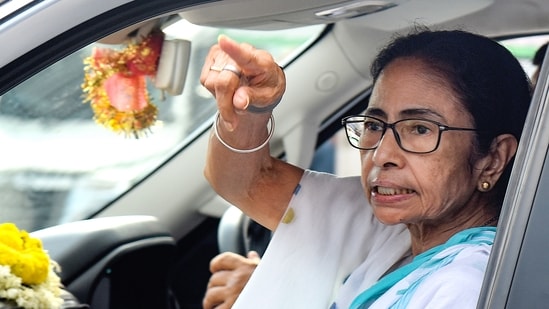
‘Won’t resign, defeat was a conspiracy': Mamata Banerjee after loss in Bengal elections
# Mamata Refuses to Resign After Bengal Loss
By Senior Political Correspondent, The Daily Chronicle
May 05, 2026
In the aftermath of a historic and highly polarizing defeat in the 2026 West Bengal assembly elections, Trinamool Congress (TMC) supremo Mamata Banerjee has outrightly rejected calls for her resignation, instead attributing her party’s electoral loss to a deliberately orchestrated political conspiracy. Speaking at a tense press conference in Kolkata on Tuesday, May 5, 2026, the outgoing Chief Minister vowed to challenge the election results. She alleged unprecedented direct interference by the central government and raised serious questions regarding the impartiality of the electoral process, signaling that the political battle in Bengal is far from over.
[Source: Hindustan Times | Additional: Regional Political Context, 2026 Assembly Polls]
## The “Fought Like Tigers” Defiance
Addressing a sea of disheartened but vocal party workers at her Kalighat residence, a defiant Mamata Banerjee made it unequivocally clear that she would not be stepping down from the leadership of the Trinamool Congress. Despite the crushing weight of anti-incumbency that ended her 15-year reign over the state, Banerjee’s rhetoric remained as combative as ever.
“**We fought like tigers and will bounce back, but this government’s direct interference is deeply concerning,**” Banerjee stated, directly referencing the Bharatiya Janata Party (BJP) led central government [Source: Hindustan Times]. She categorically dismissed the electoral mandate as a reflection of the people’s will, framing it instead as the culmination of institutional hijacking.
Her refusal to resign highlights a critical juncture for the TMC. Unlike traditional Westminster-style democratic norms where a defeated leader steps aside to allow for internal party renewal, Banerjee’s identity is inextricably linked to the TMC itself. For her supporters, she remains the undisputed matriarch of the party; for her critics, her refusal to step down underscores a lack of internal democratic accountability following a monumental electoral failure.
## Allegations of Institutional Interference
The core of Banerjee’s post-election narrative rests on the assertion that the election was heavily compromised by external forces. Throughout the bitterly contested multi-phase election, the TMC repeatedly locked horns with the Election Commission of India (ECI) and central security forces stationed across the state.
Banerjee outlined several key grievances during her address:
* **Central Force Deployment:** She alleged that the Central Armed Police Forces (CAPF) actively intimidated rural voters, particularly in TMC strongholds, thereby suppressing voter turnout among her core demographic.
* **Election Scheduling:** The TMC leadership criticized the multi-phase election schedule, claiming it was strategically designed to allow central BJP leaders to heavily concentrate their campaigning efforts in specific districts without spreading their resources too thin.
* **Administrative Overreach:** Banerjee accused the central government of utilizing federal investigative agencies, such as the Enforcement Directorate (ED) and the Central Bureau of Investigation (CBI), to harass key TMC leaders and disrupt their campaign machinery in the critical weeks leading up to the vote.
While the Election Commission has consistently maintained that all protocols were strictly followed to ensure a free and fair election, Banerjee’s allegations tap into a deep-seated narrative of federal overreach that has defined Bengal’s political discourse for the last half-decade.
## The BJP’s Historic Surge in Bengal
To understand the magnitude of this political earthquake, one must examine the broader shifts in West Bengal’s electoral landscape. The BJP’s victory in 2026 is not merely a sudden wave but the culmination of a decade-long, systematic grassroots expansion. Following their impressive performance in the 2019 general elections and their establishment as the primary opposition in 2021, the BJP successfully capitalized on mounting anti-incumbency.
**Key Factors Driving the Electoral Shift:**
1. **Fatigue and Anti-Incumbency:** After 15 years in power, the TMC faced natural voter fatigue. The initial appeal of “Ma, Mati, Manush” (Mother, Land, and People) had dulled under the weight of governance challenges.
2. **Corruption Scandals:** A series of high-profile corruption allegations, spanning from education recruitment scams to municipal irregularities, severely dented the TMC’s moral high ground, alienating the urban middle class and educated youth.
3. **Micro-Caste Engineering:** The BJP successfully consolidated marginalized sub-castes and tribal votes in regions like Jangalmahal and North Bengal, promising specialized welfare and political representation.
### 2021 vs. 2026 West Bengal Assembly Seat Dynamics
*(Note: Data reflects preliminary ECI trends as of May 2026)*
| Political Entity | 2021 Assembly Seats | 2026 Assembly Seats | Shift in Vote Share |
| :— | :— | :— | :— |
| **Trinamool Congress (TMC)** | 215 | 112 | – 8.5% |
| **Bharatiya Janata Party (BJP)** | 77 | 158 | + 11.2% |
| **Left-Congress Alliance** | 0 | 22 | – 1.1% |
| **Others/Independents** | 2 | 2 | N/A |
The data clearly illustrates a massive consolidation of the anti-TMC vote beneath the BJP umbrella, pushing the saffron party comfortably past the halfway mark in the 294-seat assembly.
[Source: ECI Preliminary Data 2026 | Additional: Historical Election Data Commission of India]
## Expert Analysis: A Paradigm Shift in Eastern Politics
Political scientists and election observers view the 2026 Bengal mandate as a watershed moment for Indian democracy. The fall of the TMC government represents the breaching of one of the most formidable regional fortresses in the country.
Dr. Arijit Sen, a Senior Fellow at the Centre for Policy Research, notes, *”What we are witnessing is a fundamental realignment of Bengal’s political sociology. Mamata Banerjee’s welfare schemes, which acted as a massive buffer in 2021, reached a saturation point. When welfarism is no longer enough to mask local-level corruption and syndicates, the electorate naturally seeks a formidable alternative. The BJP provided that alternative by blending aggressive regional nationalism with the promise of central development.”*
Furthermore, analysts point out that the TMC’s defensive posture regarding corruption allegations ultimately fractured its diverse voter base. The youth demographic, plagued by systemic unemployment and frustrated by state-level recruitment scams, voted decisively for change.
## Internal TMC Dynamics: What Lies Ahead?
Mamata Banerjee’s refusal to step down sets the stage for a potentially volatile period of internal restructuring within the Trinamool Congress. The immediate challenge for the leadership is keeping the party flock together. Historically, in Indian regional politics, parties ousted from power face the immediate threat of mass defections to the ruling dispensation.
**The Role of Abhishek Banerjee:**
All eyes are now on Abhishek Banerjee, the TMC General Secretary and Mamata’s nephew, who led much of the operational campaign. While Mamata remains the ideological face, Abhishek has been the architect of the party’s modern organizational structure. The defeat will likely spark internal debates regarding his leadership style and the effectiveness of the highly centralized, corporate-style political management he introduced through strategic consultancies.
Sources within the party indicate that a comprehensive “fact-finding” committee will be established to review district-by-district failures, though many veteran leaders privately express concerns that the top brass remains insulated from the ground reality.
## Implications for the National Opposition Bloc
Beyond the borders of West Bengal, the TMC’s defeat sends shockwaves through the broader national opposition. Mamata Banerjee has long positioned herself as a primary architect of a unified anti-BJP national front. Her inability to defend her home turf severely diminishes her bargaining power on the national stage.
For the national opposition alliance, the loss in Bengal serves as a harsh reality check. It underscores a critical vulnerability: heavy reliance on dominant regional leaders can backfire if those leaders are unseated in their home states. Regional parties like the Aam Aadmi Party (AAP), Samajwadi Party (SP), and the Dravida Munnetra Kazhagam (DMK) will likely recalibrate their strategies, recognizing that local anti-incumbency can easily override national coalition narratives.
Conversely, for the BJP, planting the lotus in West Bengal is a monumental ideological and political triumph. It validates their relentless push into Eastern and Southern India, compensating for any potential seat stagnation in their traditional Hindi-heartland strongholds.
## The Transition of Power and Future Outlook
As West Bengal prepares for its first non-TMC government since 2011, the immediate future holds significant administrative and political challenges. The BJP leadership must now transition from an aggressive opposition to a governing body responsible for a complex state with deep economic and infrastructural needs.
For Mamata Banerjee, the road ahead is steep. Her declaration that the TMC “fought like tigers and will bounce back” is not merely empty rhetoric; she is a politician forged in the fires of street protests and opposition battles. Having famously dethroned the 34-year-old Left Front regime in 2011, Banerjee knows how to play the long game from the opposition benches.
### Key Takeaways
* **Defiance over Defeat:** Mamata Banerjee rejects resignation, citing systemic conspiracies and institutional interference by the central government.
* **Political Realignment:** The 2026 election marks a historic shift, ending 15 years of TMC rule due to accumulated anti-incumbency, corruption fatigue, and aggressive BJP campaigning.
* **National Impact:** The defeat weakens the national opposition’s front and significantly boosts the BJP’s expansionist strategy in Eastern India.
* **Future Battles:** The TMC is expected to launch intense legal and political challenges against the electoral process while preparing for a grueling stint as the principal opposition.
As the dust settles on the 2026 assembly elections, West Bengal remains a fiercely contested ideological battleground. Mamata Banerjee’s refusal to concede the narrative guarantees that while the government in Kolkata may change, the intense, high-stakes nature of Bengal politics will persist unabated.





