
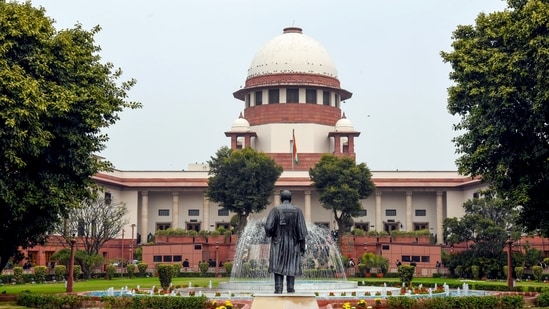
Supreme Court examines validity of excluding CJI from Election Commission selection panel
# SC Reviews CJI Exit from Poll Panel Law
By Staff Correspondent, The Constitutional Chronicle, May 07, 2026
New Delhi, May 7, 2026 — The Supreme Court of India has commenced crucial hearings to examine the constitutional validity of a 2023 parliamentary law that fundamentally altered the appointment process for the nation’s top election officials. Specifically, the constitutional bench is scrutinizing the exclusion of the Chief Justice of India (CJI) from the high-powered selection committee responsible for appointing the Chief Election Commissioner (CEC) and other Election Commissioners (ECs). This legal challenge questions whether the Chief Election Commissioner and Other Election Commissioners (Appointment, Conditions of Service and Term of Office) Act, 2023, compromises the institutional independence of the Election Commission by granting the executive branch a built-in 2-1 majority. The impending verdict carries profound implications for India’s democratic framework and the delicate balance of power between the executive and the judiciary. [Source: Hindustan Times | Additional: Public Legal Records up to April 2026].
## The Core Constitutional Challenge
At the heart of the current Supreme Court proceedings is the doctrine of the “basic structure” of the Indian Constitution, a judicial principle establishing that certain foundational features of the Constitution cannot be altered or destroyed by legislative amendments. The petitioners, comprising civil rights advocates, political figures, and non-governmental organizations, argue that “free and fair elections” constitute an undeniable pillar of this basic structure.
To guarantee free and fair elections, the argument follows, the body overseeing them—the Election Commission of India (ECI)—must be completely insulated from executive dominance. By replacing the Chief Justice of India with a Union Cabinet Minister nominated by the Prime Minister, the 2023 Act ensures that the ruling government inherently holds two out of the three votes on the selection panel. The Leader of the Opposition (LoP) in the Lok Sabha holds the third vote, effectively reducing their role to a minority voice in the face of a unified executive block.
The bench is tasked with determining if this structural design inherently violates the constitutional guarantee of an independent election watchdog, thereby breaching the basic structure doctrine.
## Background: The Judicial Mandate vs. Legislative Action
Understanding the current legal quagmire requires a brief look at the history of Article 324(2) of the Indian Constitution. The founding fathers stipulated that the President of India would appoint the CEC and ECs, subject to the provisions of any law made by Parliament. However, for over seven decades, no such law was enacted. Appointments were historically made by the President entirely on the advice of the Union Cabinet, making it a purely executive decision.
This status quo was disrupted in March 2023. In a landmark judgment in the case of *Anoop Baranwal v. Union of India*, a five-judge Constitution Bench of the Supreme Court ruled that the unchecked power of the executive to appoint election commissioners posed a threat to electoral democracy. Pending parliamentary legislation, the Court ordered the creation of a temporary selection panel comprising the Prime Minister, the Leader of the Opposition, and the Chief Justice of India.
In December 2023, Parliament exercised its constitutional right to legislate on the matter, passing the Chief Election Commissioner and Other Election Commissioners Act, 2023. The new law formalized a selection committee, but notably dropped the CJI in favor of a Union Cabinet Minister. The swift enactment of this law immediately triggered the present batch of public interest litigations (PILs).
## Arguments from the Petitioners
The legal teams representing the petitioners have mounted a vigorous defense of the necessity of judicial or neutral oversight in key democratic appointments. They argue that the 2023 Act essentially nullifies the spirit of the *Anoop Baranwal* judgment without addressing the core concern raised by the Court: the need for an independent, impartial selection mechanism.
**Key arguments presented by the petitioners include:**
* **Executive Dominance:** The presence of the Prime Minister and a hand-picked Cabinet Minister guarantees that the government’s preferred candidate will always secure the appointment, rendering the consultation with the LoP a mere formality.
* **Circumvention of the Search Committee:** The law establishes a Search Committee headed by the Cabinet Secretary to shortlist five candidates. However, a controversial clause allows the Selection Committee to choose a candidate outside this shortlist, which petitioners argue further centralizes power in the hands of the executive.
* **Threat to Institutional Integrity:** The perception of bias is as damaging as actual bias. If the public perceives the ECI as an extension of the ruling party, faith in the electoral process diminishes.
Dr. Arindam Desai, a senior fellow of constitutional studies at the Centre for Policy and Democratic Research (CPDR), notes the gravity of the hearings. “The Supreme Court is essentially being asked to draw a definitive line on the separation of powers. The petitioners are arguing that while Parliament has the right to legislate, it cannot legislate in a way that captures a supposedly independent constitutional body,” Desai explains. [Source: Independent Expert Analysis, May 2026].
## The Union Government’s Defense
The Union Government, represented by the Attorney General, has vigorously defended the 2023 Act, asserting the primacy of Parliament in law-making. The government’s defense rests on strict adherence to the constitutional text and the doctrine of separation of powers, arguing that the judiciary cannot dictate the composition of a statutory committee.
**Key arguments from the government include:**
* **Legislative Prerogative:** Article 324(2) explicitly leaves the appointment process to the wisdom of Parliament. By passing the 2023 Act, Parliament was merely fulfilling its constitutional mandate, filling a legislative vacuum that had existed since 1950.
* **The Interim Nature of the SC Order:** The government emphasizes that the inclusion of the CJI in the March 2023 judgment was explicitly stated by the Court to be a stop-gap arrangement “until Parliament makes a law.” Therefore, enacting a law that does not include the CJI does not violate the Court’s order but fulfills its condition.
* **Democratic Accountability:** The executive branch, directly elected by the people, holds a mandate to govern. The government argues that delegating appointment powers to the judiciary or unelected figures undermines democratic accountability.
Prof. Meera Sanyal, an expert in parliamentary procedures and constitutional law, highlights the government’s perspective. “The fundamental argument of the State is that the Constitution never envisaged judicial participation in the appointment of the Election Commission. To mandate the CJI’s presence permanently would be an example of judicial overreach into the executive and legislative domains,” she notes.
## Comparative Analysis of Selection Panels
The debate over the composition of the selection panel often draws comparisons with how other high-profile oversight bodies in India are constituted. The mechanisms vary significantly depending on the statutory requirements of each institution.
| Constitutional / Statutory Body | Composition of Selection Panel | Executive Majority? |
| :— | :— | :— |
| **Central Bureau of Investigation (CBI) Director** | Prime Minister, Chief Justice of India, Leader of Opposition | No |
| **Lokpal (Anti-Corruption Ombudsman)** | PM, Speaker of Lok Sabha, LoP, CJI, Eminent Jurist | Varies based on Jurist selection |
| **National Human Rights Commission (NHRC)** | PM, Speaker, Home Minister, LoP (Lok Sabha & Rajya Sabha), Deputy Chairman of Rajya Sabha | Yes |
| **Election Commission (Pre-March 2023)** | Solely Executive (Advised by Union Cabinet) | Yes (100%) |
| **Election Commission (March 2023 SC Order)** | Prime Minister, Chief Justice of India, Leader of Opposition | No |
| **Election Commission (2023 Act)** | Prime Minister, Union Cabinet Minister, Leader of Opposition | Yes (2 to 1) |
This comparison highlights that while executive dominance is not unprecedented (as seen with the NHRC), institutions requiring strict neutrality against the state, such as the CBI Director, often include the CJI to maintain an equitable balance. Petitioners argue the ECI belongs in the latter category, while the government maintains it operates differently within the constitutional framework.
## Broader Implications for Electoral Democracy
The outcome of this Supreme Court hearing extends far beyond the technicalities of appointment procedures; it touches upon the very trust the electorate places in the democratic process. India oversees the largest democratic exercises in human history, managing hundreds of millions of voters across vast and complex geographies.
The Election Commission possesses sweeping powers during an election period, including the ability to transfer key police and administrative officers, enforce the Model Code of Conduct, and arbitrate disputes between political parties. Given these immense powers, the impartiality of the Commissioners is paramount.
If the Supreme Court upholds the 2023 Act, it will formally cement the executive’s dominant role in selecting the umpires of the electoral game. Supporters argue this reflects standard democratic practice where the elected government exercises appointment powers subject to parliamentary scrutiny. Conversely, if the Court strikes down the provision or mandates a return to a neutral tripartite panel, it will significantly bolster the independence of the ECI, albeit while sparking a broader debate about judicial supremacy over parliament.
## Conclusion and Future Outlook
As the Supreme Court continues to examine the validity of excluding the Chief Justice of India from the Election Commission selection panel, both the legal fraternity and the political class watch with bated breath. The hearings represent a vital stress test of the Indian Constitution’s checks and balances.
**Key Takeaways:**
1. **The Legal Pivot:** The Supreme Court must decide if a 2-1 executive majority on the ECI selection panel fundamentally breaches the “basic structure” doctrine by compromising free and fair elections.
2. **Legislative vs. Judicial Power:** The case embodies the classic friction between Parliament’s sovereign right to draft laws and the Judiciary’s mandate to review laws against constitutional principles.
3. **Future Precedent:** The eventual verdict will not only determine the future composition of the Election Commission but will also set a lasting legal precedent on how independent constitutional bodies are populated in India.
The bench has not yet indicated a timeline for its final judgment. However, the rigorous questioning from the justices suggests a comprehensive review of electoral independence is underway, ensuring that whichever direction the verdict swings, it will be deeply rooted in a thorough examination of constitutional intent.





