
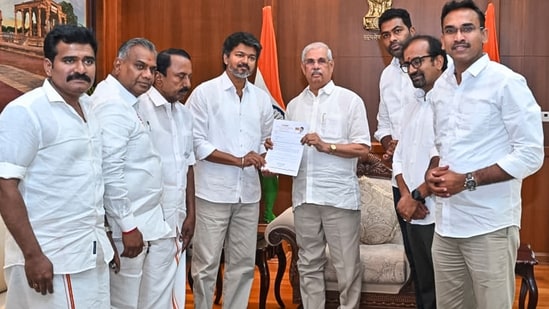
Tamil Nadu news LIVE: 'Will wait and watch', says Stalin; oath delayed as Governor 'not convinced' of majority
# TN Oath Delayed Amid Hung Assembly Drama
By Staff Reporter, Tamil Nadu Politics Desk | May 7, 2026
**CHENNAI** — Tamil Nadu has been plunged into an unprecedented political impasse following the closely contested 2026 Legislative Assembly elections. As of Thursday morning, the state’s Governor has officially delayed the swearing-in ceremony for a new government, citing a lack of conviction that any single pre-poll alliance possesses the requisite numbers to form a stable administration. Incumbent Chief Minister and DMK President MK Stalin has adopted a measured “wait and watch” stance amid the unfolding drama. Concurrently, the principal opposition, the All India Anna Dravida Munnetra Kazhagam (AIADMK), has firmly shut down rampant speculation regarding a post-poll coalition with actor Vijay’s newly formed Tamilaga Vettri Kazhagam (TVK) [Source: Hindustan Times].
The political stalemate marks a rare departure from Tamil Nadu’s traditional electoral outcomes, which typically yield decisive mandates for either of the two Dravidian majors. With the state hovering in constitutional limbo, all eyes are now on Raj Bhavan and the behind-the-scenes negotiations shaping up across Chennai.
## Constitutional Deadlock: Governor Demands Verifiable Majority
The crux of the current crisis centers on the Governor’s refusal to administer the oath of office without concrete proof of a legislative majority. In a 234-member assembly, the magic number required to form the government is 118. Early reports suggest a deeply fractured mandate, preventing any single bloc from easily crossing the halfway mark without relying on unaligned regional forces or independents.
According to Raj Bhavan insiders, the Governor has requested formal letters of support from coalition partners and newly elected Members of the Legislative Assembly (MLAs) before extending an official invitation to form the government. This stringent adherence to constitutional protocol is aimed at preventing immediate instability or controversial horse-trading.
“The Governor is exercising his discretionary powers appropriately under Article 164 of the Constitution,” explains Dr. V. Suryanarayanan, a Chennai-based constitutional expert and former political science professor. “When the mandate is fractured, the Governor is not obligated to blindly invite the single largest party if there is reasonable doubt about their ability to survive a floor test. The Bommai judgment clearly established that while the floor of the House is the ultimate testing ground, the initial invitation requires a prima facie case of majority.” [Additional: Constitutional Legal Analysis].
## AIADMK Categorically Rejects Post-Poll Alliance with TVK
Adding to the complexity of the government formation is the definitive stance taken by the AIADMK regarding post-poll alliances. Overnight, local media networks were abuzz with speculation that the AIADMK leadership was in back-channel talks with Actor Vijay’s TVK to bridge the gap in their seat tally.
However, the AIADMK has vehemently denied these reports, issuing a strong public rebuttal. An AIADMK deputy general secretary released a definitive statement to the press on Thursday morning: **“This is entirely false. Under no circumstances the AIADMK will support the TVK.”** [Source: Hindustan Times].
This outright rejection highlights the deep-seated ideological and strategic rifts between the traditional Dravidian powerhouse and the nascent political entrant. Throughout the 2026 campaign trail, TVK positioned itself as an alternative to the “corrupt and complacent” bipartisan system dominated by the DMK and AIADMK. Consequently, an alliance between AIADMK and TVK would not only compromise the AIADMK’s historical supremacy but also dilute TVK’s primary anti-establishment pitch to the voters.
Political analysts suggest that the AIADMK’s swift denial is a move to consolidate its existing base and prevent its own newly elected MLAs from defecting or feeling alienated by the prospect of submitting to a newer, smaller party’s demands.
## MK Stalin’s Calculated “Wait and Watch” Strategy
On the other side of the political spectrum, the ruling Dravida Munnetra Kazhagam (DMK) is playing its cards close to its chest. Reacting to the Governor’s delayed invitation, DMK President MK Stalin remarked that his party would “wait and watch” how the situation unfolds [Source: Hindustan Times].
Stalin’s restrained approach reflects a seasoned understanding of coalition management. As the leader of the incumbent Secular Progressive Alliance—which includes the Congress, the Left parties, and the VCK—Stalin is acutely aware that aggressive posturing could backfire. By projecting an image of calm confidence, the DMK leadership is attempting to maintain the moral high ground while simultaneously solidifying the loyalty of its pre-poll alliance partners.
“Stalin’s strategy is twofold,” notes senior political commentator R. Meenakshi. “First, he wants to avoid any perception of desperation or unconstitutional maneuvering, which could trigger public backlash. Second, by waiting, he is allowing the opposition factions—namely the AIADMK, BJP, and TVK—to expose their internal contradictions and inability to form a cohesive bloc. The DMK believes that eventually, the sheer arithmetic of their pre-poll alliance will force the Governor’s hand.” [Additional: State Political Commentary].
## The TVK Factor: Actor Vijay’s Disruptive Political Debut
The catalyst for this unprecedented hung assembly is undeniably the electoral debut of Actor Vijay’s Tamilaga Vettri Kazhagam (TVK). Launched with massive fanfare and a promise to cleanse the state’s political landscape, TVK has successfully disrupted the traditional two-horse race in Tamil Nadu.
While final, certified numbers are still being tabulated by the Election Commission, early data suggests that TVK has captured a substantial vote share, heavily denting the margins in pivotal constituencies. By appealing heavily to first-time voters, marginalized communities disillusioned with the Dravidian majors, and Vijay’s massive, highly organized fan base, TVK has emerged as the ultimate kingmaker—even if it is not currently welcomed by the AIADMK.
TVK’s campaign focused heavily on youth employment, transparent governance, and stringent anti-corruption measures. The party effectively capitalized on the anti-incumbency sentiments directed at the DMK government while simultaneously portraying the AIADMK as a fractured and weakened force following its internal leadership battles over the past five years.
The current deadlock underscores a massive shift in Tamil Nadu’s political sociology. The electorate, historically known for delivering sweeping mandates to either the DMK or AIADMK, has shown a willingness to experiment with a strong third alternative. How TVK leverages its newly acquired legislative muscle without compromising its anti-establishment ethos will be the defining political narrative of the coming weeks.
## Analyzing the Complex Electoral Math
To understand the gravity of the Governor’s hesitation, one must look at the projected seat distribution that has led to this constitutional bottleneck. A clear majority requires 118 seats in the Tamil Nadu Legislative Assembly.
| Political Alliance / Party | Projected Seat Range | Key Constituencies Impacted |
| :— | :— | :— |
| **DMK+ (Incumbent Alliance)** | 100 – 110 | Chennai, Northern TN, Delta Regions |
| **AIADMK+ (Opposition)** | 80 – 90 | Western TN (Kongu belt), Southern TN |
| **TVK (Actor Vijay’s Party)** | 25 – 35 | Urban Centers, Mixed Demographics |
| **Others / Independents** | 5 – 10 | Scattered across the state |
*Note: Projected figures based on early May 2026 electoral trends prior to final EC certification. [Additional: Polling Data Estimates]*
As the table illustrates, even if the DMK+ emerges as the single largest pre-poll alliance, it likely falls agonizingly short of the 118-seat threshold. The AIADMK, even with its allies, is further behind. This leaves a bloc of roughly 30 to 45 seats controlled by TVK and independents, giving them disproportionate bargaining power. With the AIADMK ruling out a TVK alliance, the path to a non-DMK government appears mathematically impossible, yet the DMK still requires outside support to guarantee survival on the floor of the House.
## Legal Precedents and the Anti-Defection Law
The shadow of the Tenth Schedule of the Indian Constitution—commonly known as the Anti-Defection Law—looms large over the current scenario. Both the DMK and AIADMK are deploying legal teams to monitor the movements of newly elected MLAs to prevent covert poaching or “resort politics,” a phenomenon unfortunately common in Indian political crises.
If a government is formed through a minority alliance, the immediate hurdle will be the mandatory floor test. Under Supreme Court guidelines established in cases like *S.R. Bommai v. Union of India (1994)* and *Shivraj Singh Chouhan v. Speaker, Madhya Pradesh (2020)*, a floor test must be conducted at the earliest to prevent horse-trading.
Should the DMK attempt to form the government as the single largest party, the Governor may give them a narrow window—typically 48 hours to a week—to prove their majority on the floor of the Assembly. This places immense pressure on independent candidates and smaller unaligned parties to declare their allegiances publicly.
## Looking Ahead: The Socio-Economic Impact of Political Limbo
Beyond the corridors of power, the delayed government formation has tangible implications for the state of Tamil Nadu. As one of India’s most industrialized and economically critical states, administrative continuity is vital.
Foreign direct investments, ongoing infrastructure projects under the “Singara Chennai 2.0” initiative, and the implementation of crucial welfare schemes all hinge on the swift resolution of this political crisis. Investors and corporate stakeholders are watching the situation closely, favoring stability over prolonged legislative chaos.
The next 48 hours will be critical. The Governor is expected to hold a series of meetings with legal experts and constitutional advisors before making a final decision on whom to invite first. Whether MK Stalin’s “wait and watch” strategy yields a second consecutive term, or if back-channel maneuvering leads to a surprise coalition, the 2026 Tamil Nadu elections have already made history by fundamentally altering the state’s bipolar political landscape.
In the end, the ultimate winner of the 2026 election is the democratic process itself, which has proven resilient and unpredictable, reflecting the complex, evolving aspirations of the Tamil electorate.





