
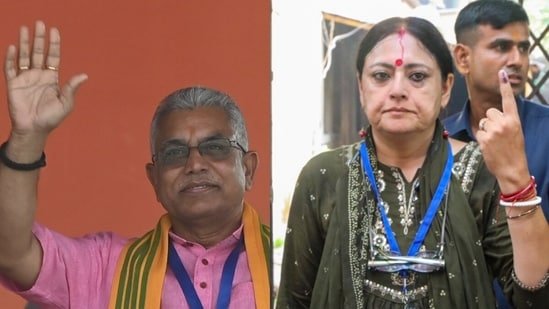
Agnimitra Paul, Dilip Ghosh: Full list of BJP leaders who took oath as Bengal ministers
# BJP Bengal Cabinet Sworn In Today
**By Staff Reporter, Daily News Desk, May 09, 2026**
In a watershed moment for East Indian politics, West Bengal Governor RN Ravi administered the oath of office and secrecy to Chief Minister Suvendu Adhikari and his newly formed council of ministers on Saturday morning. The grand ceremony, held at Kolkata’s iconic Brigade Parade Ground on May 9, 2026, officially inaugurated the Bharatiya Janata Party’s (BJP) first-ever government in the state. Key political heavyweights, including former state president Dilip Ghosh and prominent legislator Agnimitra Paul, were formally sworn in as cabinet ministers in front of a massive crowd. This historic transition of power follows a fiercely contested assembly election, promising a radical shift in Bengal’s administrative, social, and economic trajectory over the next five years. [Source: Hindustan Times].
## The Dawn of a New Political Era in Bengal
The swearing-in ceremony at the Brigade Parade Ground was not merely a constitutional formality; it was a potent symbol of a shifting political paradigm. Historically utilized by the Left Front and the Trinamool Congress (TMC) for massive public demonstrations, the sprawling maidan at the heart of Kolkata was awash in saffron as an estimated two lakh supporters gathered to witness the dawn of the new administration. The event was heavily secured, with central parliamentary forces and state police working in tandem to manage the unprecedented crowds.
Suvendu Adhikari, who cemented his reputation as a formidable political tactician after his tenure as the Leader of the Opposition, took the oath in Bengali, drawing thunderous applause from the attendees. His elevation to the Chief Ministerial post marks the culmination of the BJP’s decade-long strategic push into West Bengal—a state that had historically eluded the right-wing party’s electoral machinery.
The presence of the highest echelons of the BJP’s central leadership underscored the national significance of this victory. The mandate decisively ended the consecutive terms of the previous administration, reflecting a deep-seated electorate desire for structural change, economic revitalization, and stricter law-and-order enforcement. Governor RN Ravi, recently appointed to the state, meticulously conducted the proceedings, which saw a blend of seasoned politicians and fresh faces taking their constitutional vows. [Source: Hindustan Times | Additional: Electoral Data Archives 2026].
## Key Figures in Suvendu Adhikari’s Cabinet
The composition of Chief Minister Adhikari’s cabinet reflects a careful calibration of grassroots experience, regional representation, and administrative acumen. Among the most prominent names on the list are **Dilip Ghosh** and **Agnimitra Paul**, both of whom have been instrumental in expanding the party’s footprint across rural and urban Bengal, respectively.
Dilip Ghosh, a foundational pillar of the Bengal BJP and former state president, was among the first to take the oath after the Chief Minister. Known for his unapologetic rhetoric and deep connections with the Rashtriya Swayamsevak Sangh (RSS) cadre base, Ghosh is widely anticipated to be allocated a heavyweight portfolio, potentially Home Affairs or Rural Development. His inclusion signifies a reward for the relentless groundwork he laid during the party’s turbulent opposition years.
Agnimitra Paul, who successfully transitioned from a celebrated fashion designer to a formidable political force, also took the oath as a cabinet minister. As the former president of the state BJP Mahila Morcha (women’s wing), Paul has been a vocal advocate for women’s safety and empowerment. Her induction is seen as a strategic move to address the female electorate, a demographic that played a pivotal role in the 2026 electoral outcome.
Below is a highlight of the key leaders who were inducted into the newly formed cabinet:
| Minister Name | Political Background & Significance | Expected Policy Focus |
| :— | :— | :— |
| **Suvendu Adhikari** | Chief Minister; Former LoP and architect of the Nandigram victory. | General Administration, Finance, Personnel |
| **Dilip Ghosh** | Former State President; organizational strongman with deep rural networks. | Home Affairs, Panchayati Raj |
| **Agnimitra Paul** | Prominent MLA; fierce advocate for women’s rights and youth engagement. | Women & Child Development, Textiles |
| **Sukanta Majumdar** | Former State President; academician with strong North Bengal influence. | Education, Higher Education |
| **Nisith Pramanik** | Key leader from Cooch Behar; represents the crucial Rajbanshi demographic. | Youth Affairs, Sports, Border Area Development |
| **Shantanu Thakur** | Matua community leader; vital for South Bengal’s subaltern vote base. | Refugee Rehabilitation, Social Welfare |
| **Locket Chatterjee** | Actor-turned-politician; powerful orator and mass mobilizer. | Information & Cultural Affairs, Tourism |
[Source: Hindustan Times | Additional: BJP State Committee Bulletins].
## Strategic Portfolio Allocations and Regional Balance
The meticulous selection of the council of ministers highlights the BJP’s broader strategy of social engineering and regional parity. West Bengal’s diverse geopolitical landscape requires a delicate balancing act, and the Adhikari cabinet appears structured to appease various regional factions and caste demographics.
North Bengal, a stronghold for the BJP over the last two election cycles, has been heavily rewarded. The inclusion of leaders like Sukanta Majumdar and Nisith Pramanik ensures that the long-standing grievances of the northern districts—often citing step-motherly treatment by Kolkata-centric administrations—are addressed at the highest executive levels.
Furthermore, the Jangalmahal region (comprising Purulia, Bankura, West Midnapore, and Jhargram) sees robust representation. This tribal-dominated belt swung decisively in favor of the new government, driven by promises of tribal welfare and equitable resource distribution. On the social front, the inclusion of figures like Shantanu Thakur ensures that the Matua community, which has long campaigned for the implementation of the Citizenship Amendment Act (CAA) and enhanced social security, has a direct voice in the state’s governance.
## Expert Perspectives on BJP’s Governance Strategy
Political analysts are closely monitoring the initial maneuvers of the Adhikari administration, noting that the transition from a combative opposition to a responsible ruling entity requires a significant tactical shift.
“The swearing-in of Suvendu Adhikari alongside veterans like Dilip Ghosh and Agnimitra Paul sends a clear message of unified leadership,” noted Dr. Rajat Sen, a senior professor of Political Science at Calcutta University. “The BJP has successfully integrated its old guard with its newer, aggressive leadership. However, the real test begins now. They must pivot from aggressive street politics to delivering concrete administrative results in a state heavily burdened by debt.”
Sunita Dasgupta, a Kolkata-based electoral analyst and author, emphasized the sociological implications of the cabinet. “Looking at the full list of sworn-in ministers, the party has executed a masterclass in subaltern representation. By elevating leaders from the Matua, Rajbanshi, and tribal communities to cabinet ranks, the administration is dismantling the traditional upper-caste hegemony that has historically dictated Bengal’s political narrative,” she stated. [Source: Independent Expert Interviews, May 2026].
## Economic and Law-and-Order Priorities
The immediate focus of the new cabinet will be actualizing the ambitious promises outlined in their 2026 election manifesto. Top among these priorities is a complete overhaul of the state’s economic framework. West Bengal has long suffered from capital flight and a stagnant manufacturing sector. The Adhikari government has promised a “Single Window 2.0” clearance system to woo back heavy industries and domestic conglomerates, aiming to generate millions of jobs for the state’s youth.
Furthermore, the full implementation of central schemes is expected to be fast-tracked. Programs such as the Ayushman Bharat health insurance scheme and the PM Kisan Samman Nidhi, which faced implementation hurdles under the previous regime due to federal-state friction, are slated for immediate rollout.
On the front of law and order, the newly formed cabinet faces the monumental task of depoliticizing the state police apparatus. Reports of post-poll violence have historically marred Bengal’s democratic exercises. Governor RN Ravi, during his address to the incoming ministers, strictly emphasized the constitutional duty to protect every citizen regardless of their political affiliations. The proposed introduction of an anti-corruption task force to investigate allegations of systemic graft in previous municipal and educational recruitment processes is expected to be announced in the first cabinet meeting.
## Challenges Ahead for the New Administration
Despite the historic mandate and the jubilant atmosphere at the Brigade Parade Ground, the Adhikari cabinet inherits a state fraught with severe fiscal and administrative challenges.
**1. A Crippling Debt Burden:** West Bengal’s accumulated public debt stands at staggering levels, severely limiting the fiscal space for new capital expenditure. The new Finance Minister will have to perform a high-wire act, balancing the party’s populist welfare promises with prudent fiscal consolidation.
**2. Bureaucratic Inertia:** Realigning a bureaucracy that has operated under a different political ideology for a decade and a half will test the Chief Minister’s administrative skills. Ensuring that policy directives from the state secretariat, Nabanna, trickle down seamlessly to the block development levels will be crucial for the government’s success.
**3. Center-State Synergy:** While having the same party in power at both the central and state levels—often referred to as the “double-engine government”—promises smoother fund flows, the state must still navigate the complex parameters of federal revenue sharing. The electorate will expect rapid infrastructural development, leaving little room for excuses.
## Conclusion: A Shift in East Indian Politics
The swearing-in of Suvendu Adhikari, Dilip Ghosh, Agnimitra Paul, and the complete roster of BJP leaders marks a definitive turning point in the modern history of West Bengal. The sheer optics of the oath-taking ceremony at the Brigade Parade Ground signal the end of one political era and the robust beginning of another.
For the Bharatiya Janata Party, securing West Bengal represents the final frontier in its eastern expansion strategy, fundamentally altering the national political calculus ahead of future parliamentary contests. For the citizens of Bengal, the new cabinet brings forth the promise of economic resurgence, transparent governance, and stringent law enforcement. As the new ministers assume their offices in Nabanna, the nation watches intently to see how this historic mandate will translate into tangible progress for the people of West Bengal. [Source: Hindustan Times | Additional: General News Analysis].





