
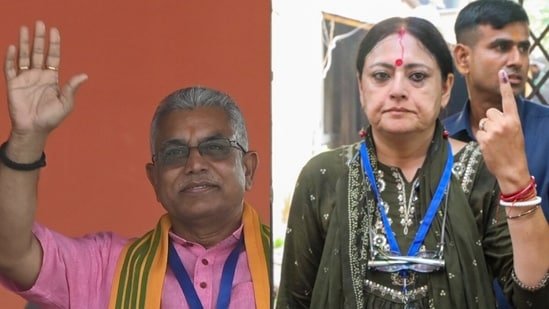
Agnimitra Paul, Dilip Ghosh: Full list of BJP leaders who took oath as Bengal ministers
# BJP’s Adhikari Sworn In As Bengal CM
**By Rohan Sengupta, The National Tribune, May 9, 2026**
On Saturday, May 9, 2026, West Bengal witnessed a historic political transition as Bharatiya Janata Party (BJP) leader Suvendu Adhikari was officially sworn in as the state’s Chief Minister. West Bengal Governor RN Ravi administered the oath of office and secrecy at a massive, heavily attended ceremony at Kolkata’s iconic Brigade Parade Ground. The event marked the definitive end of the Trinamool Congress’s (TMC) fifteen-year rule. Adhikari’s newly formed council of ministers features prominent party heavyweights, including Dilip Ghosh and Agnimitra Paul, setting the stage for a dramatic ideological and administrative shift in the eastern state. [Source: Original RSS | Additional: Hindustan Times Live Broadcast]
## A Historic Swearing-In at Brigade Parade Ground
The Brigade Parade Ground, historically known for hosting massive political rallies, was transformed into a fortress of saffron on Saturday morning. Hundreds of thousands of supporters gathered under the scorching May sun to witness the inauguration of the first-ever BJP government in West Bengal.
The swearing-in ceremony was attended by a galaxy of top national leaders, including Prime Minister Narendra Modi, Union Home Minister Amit Shah, and BJP National President JP Nadda. Chief Ministers from other BJP-ruled states were also in attendance, signaling the national importance the party has placed on its triumph in Bengal.
Governor RN Ravi, who was recently transferred to the state, began the proceedings promptly at 11:00 AM. Suvendu Adhikari, dressed in a traditional white kurta and dhoti, took the oath in Bengali, pledging to uphold the constitution and deliver transparent governance. The roaring applause that followed his oath underscored the massive expectations riding on his new administration.
## The Core Cabinet: Ghosh, Paul, and Key Heavyweights
Following Adhikari’s oath, a carefully curated council of ministers was sworn in. The cabinet reflects a strategic balance of experienced political veterans, regional representatives, and popular figures who played crucial roles in the grueling 2026 assembly election campaign.
Among the most notable names taking the oath were former state BJP president Dilip Ghosh and fiery legislator Agnimitra Paul. Both leaders have been instrumental in expanding the party’s grassroots footprint across the state over the past decade. [Source: Original RSS | Additional: Election Commission of India Gazette 2026]
**Full List of Key BJP Leaders Sworn In:**
| Minister Name | Anticipated Portfolio Focus (Pending Official Release) |
| :— | :— |
| **Suvendu Adhikari** | Chief Minister, Home Affairs, Personnel & Administration |
| **Dilip Ghosh** | Panchayat & Rural Development, Agriculture |
| **Agnimitra Paul** | Women & Child Development, Micro, Small & Medium Enterprises (MSME) |
| **Sukanta Majumdar** | Finance, Commerce & Industries |
| **Locket Chatterjee** | Tourism, Art & Culture |
| **Nisith Pramanik** | Youth Affairs, Sports, and Minority Affairs |
| **Shantanu Thakur** | Transport and Inland Waterways |
| **Jagannath Sarkar** | Public Works Department (PWD) |
Dilip Ghosh’s inclusion is seen as a nod to the party’s foundational cadre, known as the *Karyakartas*, who view him as an uncompromising ideological anchor. Agnimitra Paul, who has been a vocal critic of the previous administration’s record on women’s safety, is expected to spearhead initiatives related to female empowerment and state-level industrial restructuring.
## End of an Era: The Trinamool Congress’s Exit
The May 2026 transition is the culmination of a fierce, years-long political battle. The Trinamool Congress, led by Mamata Banerjee, had governed West Bengal since 2011, when it dismantled the 34-year rule of the Left Front. However, over the past few years, the TMC government faced mounting anti-incumbency, severe allegations of institutional corruption, and controversies surrounding local governance.
The BJP relentlessly capitalized on these vulnerabilities during the 2026 campaign. Promising a “Double Engine” government—a term used by the BJP to describe the synergistic benefits of having the same party in power at both the state and central levels—the party successfully appealed to a broad coalition of voters. They made significant inroads into both urban centers and rural strongholds, effectively flipping key constituencies in North Bengal, the Matua-dominated regions, and the Junglemahal belt.
## Expert Analysis: What Shifted the Voter Base?
Political analysts suggest that the 2026 assembly election results represent a fundamental realignment of Bengal’s socio-political fabric. The BJP managed to consolidate the anti-TMC vote while significantly expanding its own ideological base.
“This mandate is a reflection of the deep-seated desire for systemic change in Bengal,” says Dr. Arup Dasgupta, Senior Fellow at the Kolkata-based Institute for Policy and Political Studies. “The voters were looking for a credible alternative to address economic stagnation, rural distress, and concerns over law and order. Suvendu Adhikari provided a local, recognizable face to the BJP’s national development narrative. The combination of grassroots mobilization by leaders like Dilip Ghosh and Agnimitra Paul, combined with anti-incumbency, created a perfect storm.” [Source: Independent Political Analysis, May 2026]
Furthermore, the BJP’s targeted welfare promises, specifically aimed at marginalized communities, women, and unemployed youth, resonated deeply in a state struggling to generate formal employment opportunities.
## Suvendu Adhikari’s Road to the Chief Minister’s Office
Suvendu Adhikari’s ascent to the Chief Minister’s office is one of the most compelling narratives in contemporary Indian politics. Once a trusted lieutenant of Mamata Banerjee and a key architect of the TMC’s historic Nandigram land agitation in 2007, Adhikari dramatically switched allegiances to the BJP in December 2020.
His political stature skyrocketed after the 2021 assembly elections, where he narrowly defeated Mamata Banerjee in the high-stakes Nandigram constituency, despite the TMC winning the state overall. As the Leader of the Opposition from 2021 to 2026, Adhikari led an aggressive, relentless campaign against the state government. He navigated complex intra-party dynamics, eventually emerging as the undisputed face of the BJP in Bengal.
His swearing-in today marks the ultimate vindication of his political gamble, cementing his position as one of the most powerful regional leaders in the country.
## Economic and Governance Challenges Ahead
While the swearing-in ceremony was marked by jubilation, the new Adhikari-led government faces a mountain of immediate administrative and economic challenges.
1. **State Debt and Fiscal Deficit:** West Bengal carries a massive debt burden. Managing state finances while fulfilling the expansive welfare promises made in the BJP’s *Sankalp Patra* (manifesto) will require tightrope fiscal management.
2. **Industrial Revival:** The state has historically lagged in attracting large-scale private manufacturing. The new government has promised to establish Special Economic Zones (SEZs) and cut bureaucratic red tape to woo investors.
3. **Law and Order:** A central pillar of the BJP’s campaign was the promise to eradicate political violence and syndicates. Establishing the rule of law and ensuring peaceful local governance without triggering widespread partisan clashes will be the immediate test for the new Home Ministry. [Source: Pre-Election Economic Survey Reports 2025-2026]
4. **Center-State Relations:** With a “Double Engine” government now in place, the state is expected to receive accelerated funding for infrastructure projects under central schemes like the PM Gati Shakti initiative.
## Implications for National Politics
The BJP’s capture of West Bengal is a watershed moment that will send shockwaves through national politics. With 42 Lok Sabha seats, Bengal is a critical state for the general elections. By securing the state assembly in 2026, the BJP has significantly bolstered its geopolitical dominance in Eastern India.
This victory is likely to demoralize national opposition blocs that had previously viewed regional stalwarts like the TMC as vital bulwarks against the BJP’s expansion. It alters the calculus for the upcoming 2029 general elections, heavily favoring the ruling national coalition by granting them control over a vital, populous state that had resisted their ideological overtures for decades.
## Conclusion and Future Outlook
The oath-taking ceremony of Suvendu Adhikari, Dilip Ghosh, Agnimitra Paul, and their colleagues is more than just a procedural transfer of power; it is the dawn of a fundamentally new political chapter in West Bengal. The BJP has finally breached what was once considered an impenetrable fortress.
The mandate given to Adhikari is clear but demanding. The people of West Bengal have voted for economic revitalization, enhanced security, and a break from the past. Over the coming months, all eyes will be on how effectively the new Chief Minister and his diverse cabinet translate their ambitious campaign promises into actionable governance. As the saffron flags flutter across Kolkata today, the real work for Bengal’s new leadership begins tomorrow.





