
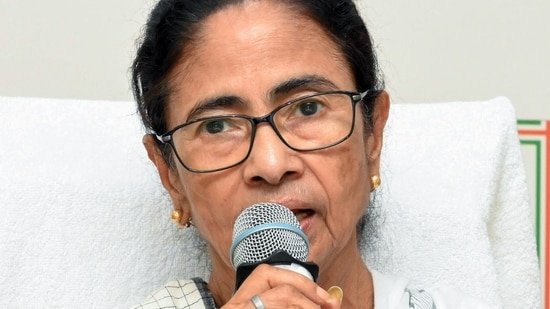
‘Mantra of unity’: Mamata's 'Pochishe Boishakh message as aide-turned-adversary Suvendu takes oath as Bengal CM
# Suvendu Takes Oath as Mamata Urges Bengal Unity
By Arindam Chatterjee, Bengal Political Desk, May 09, 2026
**Kolkata:** In a watershed moment for Indian politics, Bharatiya Janata Party (BJP) leader Suvendu Adhikari was sworn in as the Chief Minister of West Bengal on Saturday, May 9, 2026. The historic transition of power effectively ends the 15-year rule of the Trinamool Congress (TMC). Intriguingly, the momentous political shift coincided with ‘Pochishe Boishakh’—the birth anniversary of Nobel laureate Rabindranath Tagore. In the wake of her electoral defeat, outgoing Chief Minister Mamata Banerjee chose the cultural occasion to issue a poignant “mantra of unity,” invoking Tagore’s inclusive philosophy as her erstwhile aide-turned-adversary officially took the reins of the state.
## A Historic Political Transition in Bengal
The swearing-in ceremony, held at the sprawling lawns of Raj Bhavan in Kolkata, marked the culmination of a decades-long ideological battle for the BJP to establish its first government in West Bengal. Thousands of supporters, clad in saffron, gathered outside the gates, chanting slogans as Governor C.V. Ananda Bose administered the oath of office and secrecy to Adhikari. Prime Minister Narendra Modi, Union Home Minister Amit Shah, and several BJP chief ministers were in attendance, underscoring the monumental national significance of the victory.
For the BJP, capturing Bengal represents the final frontier in its eastern expansion strategy. The 2026 Assembly elections were fiercely contested, characterized by high-octane campaigns, intense polarization, and a deeply entrenched anti-incumbency sentiment against the TMC government, which had been in power since 2011. Adhikari, who systematically dismantled his former party’s stronghold in the rural belts, emerged as the undisputed face of the saffron surge.
[Source: Hindustan Times | Additional: General Political History]
## The Cultural Weight of Pochishe Boishakh
In Bengal, politics and culture are inextricably linked, and May 9, 2026, served as a profound canvas for this intersection. The date marks *Pochishe Boishakh*, the 25th day of the first Bengali month of Boishakh, celebrated globally as the birth anniversary of Rabindranath Tagore. Tagore is the undisputed cultural patriarch of Bengal, and his philosophies of universalism, humanism, and anti-sectarianism remain deeply woven into the sociopolitical fabric of the state.
Both political factions attempted to channel Tagore’s legacy on Saturday morning. Hours before taking his oath, Chief Minister-designate Suvendu Adhikari paid floral tributes to the Bard of Bengal at his ancestral home in Jorasanko Thakurbari. Promising a government that would restore the “lost glory of Bengal,” Adhikari pledged to align his administration’s development goals with Tagore’s vision of rural reconstruction and self-reliance.
However, the cultural narrative of the day was sharply contested by the defeated incumbent.
## Mamata Banerjee’s ‘Mantra of Unity’
Refusing to let the narrative of the day be monopolized by the new government, Mamata Banerjee delivered a subtle yet powerful message. Taking to social media and speaking briefly to the press from her Kalighat residence, the TMC supremo invoked Tagore’s immortal words to deliver what political analysts are calling her “mantra of unity.”
“On Pochishe Boishakh, we bow our heads to Gurudev Rabindranath Tagore. His teachings remind us that Bengal’s soul lies in its diversity, its communal harmony, and its fierce independence,” Banerjee stated. She quoted extensively from Tagore’s poem *Where the mind is without fear*, emphasizing the line, “Where the world has not been broken up into fragments by narrow domestic walls.”
Her message was widely interpreted as a dual-purpose political statement. On one hand, it served to console her demoralized cadre after a bruising electoral defeat. On the other, it acted as a veiled critique of the BJP’s alleged divisive politics.
“Mamata Banerjee is utilizing Tagore as a political shield and a moral compass,” notes Dr. Subrata Mitra, a Kolkata-based political scientist. “By focusing on unity and the ‘narrow domestic walls,’ she is framing herself as the guardian of Bengal’s secular and inclusive ethos, signaling that while she may have lost the administrative chair, she has not conceded the ideological battle.”
[Source: Hindustan Times | Additional: Expert Political Analysis]
## The Bitter Rivalry: From Aides to Adversaries
The visual of Suvendu Adhikari taking the oath of office is the ultimate climax of one of modern Indian politics’ most bitter rivalries. Adhikari was once considered Mamata Banerjee’s most trusted lieutenant and the principal architect of the historic 2007 Nandigram anti-land acquisition movement—the very agitation that catapulted the TMC to power in 2011, dislodging the 34-year-old Left Front government.
The fracture occurred in late 2020 when Adhikari, citing extreme dissatisfaction with the rise of Mamata’s nephew Abhishek Banerjee and a lack of inner-party democracy, defected to the BJP. The rivalry reached a fever pitch during the 2021 Assembly elections when Banerjee chose to contest directly against Adhikari in Nandigram. Although the TMC won a landslide state victory in 2021, Adhikari narrowly defeated Banerjee in Nandigram by a margin of just over 1,900 votes.
Since then, as the Leader of the Opposition, Adhikari waged an unrelenting campaign against the TMC government. Over the past five years, he capitalized on corruption scandals, teachers’ recruitment scams, and controversies surrounding local TMC strongmen to steadily erode the ruling party’s credibility. His swearing-in as Chief Minister represents a personal vindication and a strategic masterclass in opposition politics.
## Economic and Social Road Ahead for the BJP
Now that the BJP has secured the mandate, Adhikari’s government faces the formidable challenge of governing a state grappling with profound economic hurdles. West Bengal’s debt burden remains astronomically high, and industrial stagnation has led to massive out-migration of both blue-collar and white-collar workers.
**Key challenges for the new administration include:**
* **Job Creation:** Halting the brain drain by attracting IT and manufacturing investments.
* **Law and Order:** Dismantling the deeply entrenched culture of political violence that has plagued Bengal for decades.
* **Debt Management:** Restructuring the state’s massive public debt while fulfilling the BJP’s ambitious election manifesto promises, which include expanded welfare schemes for women and farmers.
“The honeymoon period for the Adhikari administration will be exceedingly short,” says financial analyst and economist Dr. Ananya Sen. “The electorate voted for economic rejuvenation and a cessation of syndicate-driven politics. If the BJP fails to bring in visible industrial investment within the first 18 months, the very anti-incumbency that brought them to power will turn against them.”
[Source: Hindustan Times | Additional: Economic Data of West Bengal]
## TMC’s Strategy as the Principal Opposition
For Mamata Banerjee, occupying the opposition benches after a decade and a half will require a fundamental recalibration of her political machinery. The TMC’s defeat was driven in part by voter fatigue and allegations of systemic corruption at the grassroots level.
Banerjee’s Pochishe Boishakh message indicates her initial strategy: returning to the grassroots as the defender of Bengali sub-nationalism. The TMC is expected to closely monitor the new government’s actions, particularly regarding federal friction, language, and cultural issues. Furthermore, the party will undergo an internal restructuring. The transition of leadership from Mamata to Abhishek Banerjee, which had been a point of friction, will now likely be accelerated as the party attempts to present a younger, cleaner face to the electorate.
Political commentators suggest that the TMC is far from a spent force. With a strong organizational base across South Bengal, the party will undoubtedly mount a fierce opposition in the state assembly.
## Implications for National Politics
The fall of the TMC government in Bengal has massive ramifications for national politics as India looks toward the 2029 Lok Sabha elections. Mamata Banerjee has historically been a lynchpin of the anti-BJP national coalition. Her defeat in her own bastion severely diminishes her bargaining power on the national stage and leaves a vacuum in the national opposition leadership.
Conversely, the BJP’s triumph in Bengal serves as a massive morale booster for the saffron party, proving their ability to penetrate linguistically and culturally distinct states outside the Hindi heartland. It validates the central leadership’s long-term investment in the state, utilizing local leadership like Adhikari rather than relying solely on the Prime Minister’s charisma.
## Conclusion: A State Caught Between Change and Tradition
As the sun set on Pochishe Boishakh in Kolkata, the political landscape of West Bengal was irreversibly altered. Suvendu Adhikari’s ascent to the Chief Minister’s office marks a triumph of persistent opposition strategy and a desire for administrative change among the Bengali electorate.
Yet, Mamata Banerjee’s invocation of Tagore’s ‘mantra of unity’ serves as a potent reminder that Bengal’s soul is fiercely protective of its cultural heritage. The new BJP government must now navigate the delicate balance of delivering aggressive economic growth while respecting the nuanced sociocultural fabric of the state. As Bengal steps into this new political era, the echoes of Tagore’s vision for a fearless, united society will remain the ultimate benchmark against which its new leadership will be judged.