
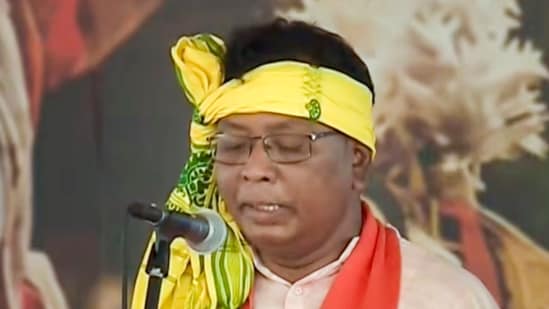
From Jangalmahal's tribal leader to BJP's 1st Bengal cabinet: All about Kshudiram Tudu
# Kshudiram Tudu: BJP’s Tribal Face in Bengal
By Staff Correspondent, State Election Desk
May 9, 2026
In a historic political realignment, first-time Member of Legislative Assembly (MLA) Kshudiram Tudu has emerged as the definitive tribal face of the Bharatiya Janata Party (BJP) in West Bengal. Securing the Ranibandh (Scheduled Tribe) constituency in Bankura district by a staggering margin of over 52,000 votes, Tudu has catapulted from a low-profile grassroots organizer in the Jangalmahal region to a pivotal minister in the BJP’s first-ever state cabinet in Bengal. Sworn in on May 9, 2026, Tudu’s elevation underscores a seismic shift in the state’s tribal vote bank, cementing the saffron party’s dominance in the once-volatile western belt. [Source: Hindustan Times | Additional: Election Commission of India Data]
## The Rise of a Grassroots Leader
For decades, the political landscape of West Bengal has been dominated by towering personalities and vocal orators. Kshudiram Tudu represents a stark departure from this traditional mold. A deeply embedded community leader from the Santhal tribe, Tudu built his political capital not through fiery rallies, but through quiet, persistent social work in the remote hamlets of Bankura.
Before his meteoric rise in the 2026 assembly elections, Tudu was primarily known within the organizational framework of the Rashtriya Swayamsevak Sangh (RSS) and the BJP’s tribal wing, the ST Morcha. He dedicated years to addressing hyper-local issues: ensuring tribal students had access to government scholarships, advocating for better healthcare facilities in forested tracts, and fighting for the land rights of indigenous farmers.
His low-profile nature was, in fact, his greatest asset. In an election season marred by allegations of political elitism and disconnect against the incumbent Trinamool Congress (TMC), Tudu was viewed by the electorate as “one of their own.” His lifestyle, rooted in the cultural ethos of the Santhal community, resonated deeply with voters who felt alienated by the ostentatious displays of wealth by local political heavyweights.
## The Battle for Ranibandh: A 52,000-Vote Mandate
The Ranibandh (ST) assembly seat, nestled in the southern part of Bankura district, has historically been a bellwether for the broader Jangalmahal region. Winning this seat is considered a testament to a party’s grip on the indigenous vote. Kshudiram Tudu’s victory here is not just notable for the win itself, but for the sheer magnitude of the mandate.
A victory margin of over **52,000 votes** is extraordinary in Bengal’s highly competitive electoral environment, where local anti-incumbency usually results in closely contested battles. Electoral data from the past three decades shows that margins in Ranibandh rarely crossed the 15,000-vote threshold. Tudu’s steamroller victory indicates a complete consolidation of the tribal vote.
Political analysts attribute this massive margin to a “perfect storm” of factors: severe rural distress, allegations of corruption in state-sponsored rural housing schemes (PM Awas Yojana), and a highly effective booth-level management strategy executed by the BJP. Tudu capitalized on these grievances, running a campaign focused squarely on transparency, indigenous pride, and integrating the region into the national development grid. [Source: Hindustan Times | Additional: Regional Electoral Analysis]
## Jangalmahal’s Shifting Political Sands
To understand the significance of Tudu’s induction into the BJP’s first Bengal cabinet, one must contextualize the political history of Jangalmahal—a sprawling forested region encompassing the districts of Bankura, Purulia, Paschim Medinipur, and Jhargram.
For over three decades, this region was a seemingly impenetrable fortress of the Left Front. By the late 2000s, crippling poverty and state apathy allowed Maoist insurgency to take root. In 2011, Mamata Banerjee’s TMC swept the region promising peace and development, successfully neutralizing the insurgency and bringing a temporary economic dividend through rice subsidies and civic volunteer jobs.
However, over the last decade, structural stagnation began to frustrate the local youth. The BJP first breached this TMC stronghold during the 2018 Panchayat elections and consolidated its gains during the 2019 Lok Sabha polls, winning key parliamentary seats in the region. Although the TMC managed a partial recovery in the 2021 assembly elections through enhanced welfare cash transfers, the 2026 elections witnessed a definitive structural shift.
Kshudiram Tudu became the focal point of this shift in Bankura. His campaign successfully highlighted the gap between the state government’s welfare promises and the on-ground delivery, pointing out systemic leaks that deprived the tribal populace of their rightful benefits.
## A Strategic Masterstroke: Induction into the Cabinet
The decision to elevate a first-time MLA to the state cabinet is a calculated strategic move by the BJP’s central and state leadership. In forming its first government in West Bengal, the BJP is acutely aware that it must reward the demographics that formed the bedrock of its victory.
By bypassing more seasoned politicians to appoint Tudu, the BJP is sending a clear, multi-layered message:
1. **Rewarding the Grassroots:** It signals to the party cadre that hard work at the booth level supersedes political lineage.
2. **Tribal Empowerment:** Following the national blueprint that saw Droupadi Murmu elevated to the Presidency of India, Tudu’s appointment demonstrates a commitment to giving indigenous communities genuine executive power, rather than mere token representation.
3. **Securing the West:** It ensures that the Jangalmahal region, which provides a massive chunk of assembly seats, feels directly represented in the corridors of power in Kolkata.
“Kshudiram Tudu is not just an MLA; he is a symbol of the subaltern assertion that the BJP has successfully engineered in West Bengal,” notes Dr. Ayanabho Chatterjee, a political sociologist based in Kolkata. “His presence in the cabinet ensures that the policy focus will remain on the long-neglected western districts.”
## Voices from the Ground: Experts Weigh In
The reaction to Tudu’s massive victory and subsequent cabinet induction has been one of cautious optimism among political observers and local stakeholders.
*“For years, leaders from Kolkata or urban centers would dictate terms to Jangalmahal,”* says Sunita Hansda, a tribal rights advocate based in Jhargram. *“Having someone like Kshudiram Tudu, who speaks our language, understands our agrarian cycles, and knows the reality of our schools and hospitals, is a refreshing change. The 52,000-vote margin is not just support for the BJP; it is a desperate plea for authentic local leadership.”*
Furthermore, political economists point out that Bankura’s economy is heavily dependent on rain-fed agriculture and minor forest produce. *“The previous administrations focused heavily on doles. The BJP’s mandate, spearheaded by leaders like Tudu, is built on the promise of infrastructure—cold storages, irrigation networks, and agro-based industries. The voters have bought into this macroeconomic promise,”* explains Prof. R.K. Mahato, an expert in regional economics. [Source: Hindustan Times | Additional: Independent Political Commentary]
## Key Factors Behind Tudu’s Sweeping Victory
Analyzing the electoral data from Ranibandh reveals several micro-factors that contributed to Tudu’s historic margin:
* **Consolidation of the Santhal Vote:** Tudu successfully united various factions of the Santhal community, which had previously been fractured between the Left and the TMC.
* **Youth Mobilization:** High unemployment rates in Bankura drove young tribal voters toward Tudu, who campaigned heavily on bringing central government employment schemes and skill development centers to the district.
* **Anti-Corruption Sentiment:** Deep-seated anger over local-level corruption, particularly the alleged siphoning of funds meant for tribal welfare, pushed voters to seek a clean-image candidate. Tudu’s austere background fit the requirement perfectly.
* **Cultural Connect:** Tudu’s use of the Ol Chiki script and the Santhali language during his campaign fostered a deep cultural resonance that his opponents failed to match.
## Challenges Ahead for the New Minister
While the electoral victory is a moment of triumph, Kshudiram Tudu faces a steep uphill climb as he transitions from an agitational leader to an administrator in the state cabinet. The expectations riding on his shoulders are immense.
Firstly, he must address the systemic development deficit in Jangalmahal. Despite various government interventions over the last fifteen years, healthcare infrastructure remains poor, and access to clean drinking water is a daily struggle in many blocks of Bankura. The prompt implementation of the central government’s *Jal Jeevan Mission* will likely be a top priority.
Secondly, Tudu will have to navigate complex socio-political fault lines, most notably the ongoing agitation by the Kurmi community demanding Scheduled Tribe (ST) status. The issue is highly sensitive; supporting the Kurmis could alienate his own Santhal base, who fear a dilution of their reservation benefits, while opposing them could trigger unrest in the region. As a cabinet minister, Tudu will be expected to play a crucial role in mediating this delicate issue on behalf of the state government.
## Conclusion: A New Era for Bengal Politics
The political trajectory of Kshudiram Tudu from the dusty, red-soil lanes of Ranibandh to the grand halls of the state secretariat in Kolkata is a defining narrative of the 2026 West Bengal assembly elections. His victory margin of over 52,000 votes is a resounding mandate that definitively alters the political sociology of the Jangalmahal region.
By inducting this low-profile tribal leader into its first-ever state cabinet, the BJP has not only rewarded a loyal grassroots worker but has also laid down a marker for its future governance model in Bengal—one that seeks to integrate marginalized indigenous communities into the core of political power. As West Bengal embarks on this new political chapter, all eyes will be on Kshudiram Tudu to see if he can translate his massive electoral support into tangible socio-economic upliftment for the tribal populations of Jangalmahal.





