
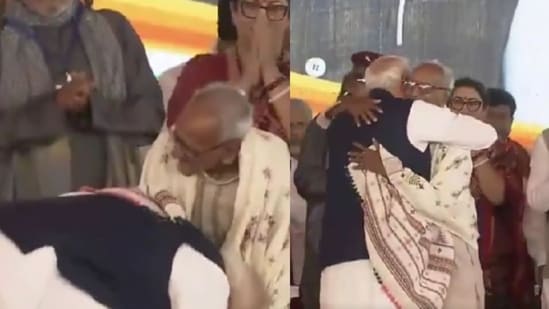
Who is Makhanlal Sarkar, 98-year old BJP worker whose feet PM Modi touched at Bengal oath ceremony
# Modi Honors 98-Year-Old BJP Veteran in Bengal
By Rajat Mukherjee, Senior Political Correspondent, May 9, 2026
**KOLKATA** — In a profoundly symbolic moment that momentarily eclipsed the political magnitude of a historic transition of power, Prime Minister Narendra Modi stepped away from his security detail to touch the feet of 98-year-old Makhanlal Sarkar. The poignant gesture unfolded on Saturday during the grand swearing-in ceremony where Suvendu Adhikari took the oath as West Bengal’s first Bharatiya Janata Party (BJP) Chief Minister since Independence. Amidst the roaring crowds and a stage crowded with national dignitaries, the image of the Prime Minister bowing to a frail, lifelong grassroots worker immediately went viral, encapsulating the BJP’s decades-long, arduous journey to power in the eastern state [Source: Hindustan Times].
This article delves into the life of Makhanlal Sarkar, exploring who he is, what he represents for the saffron party, and why his presence at the 2026 swearing-in ceremony speaks volumes about the shifting sands of West Bengal politics.
## The Viral Moment at a Historic Oath Ceremony
The atmosphere at Kolkata’s iconic Brigade Parade Ground was electric on the morning of May 9, 2026. Hundreds of thousands of supporters had gathered to witness what the BJP has long termed its “final frontier”—forming a government in West Bengal. As Governor C.V. Ananda Bose administered the oath of office and secrecy to Suvendu Adhikari, the crowd erupted in chants of victory.
However, the defining image of the day occurred shortly after the formal proceedings concluded. Prime Minister Narendra Modi, alongside Union Home Minister Amit Shah and BJP National President J.P. Nadda, walked down from the central dais toward the VVIP enclosure. Bypassing several high-ranking elected officials and newly minted state cabinet ministers, PM Modi approached a wheelchair-bound elderly man clad in a crisp, simple white dhoti and kurta.
With folded hands, the Prime Minister bowed deep, touching the feet of Makhanlal Sarkar. Visibly emotional, the 98-year-old veteran placed a trembling hand on the Prime Minister’s head in a gesture of blessing. The interaction, lasting less than a minute, was captured by hundreds of cameras and instantly broadcast nationwide. It was a masterclass in political optics, but more importantly, a genuine acknowledgment of the immense sacrifices made by ordinary party workers who sustained the BJP through its darkest political periods in Bengal [Source: Hindustan Times | Additional: Event Broadcast Analysis].
## Who is Makhanlal Sarkar?
To understand the weight of the Prime Minister’s gesture, one must look into the life of Makhanlal Sarkar. Born in 1928 in undivided Bengal, Sarkar was deeply influenced in his youth by the nationalist ideologies of Dr. Syama Prasad Mookerjee, the founder of the Bharatiya Jana Sangh (the political precursor to the BJP).
Sarkar joined the Jana Sangh in 1952, operating primarily in the remote, rural belts of the North 24 Parganas and Nadia districts. For decades, he worked as a humble primary school teacher, dedicating all his free time and meager resources to organizing localized meetings, distributing party literature, and keeping the ideological flame alive in a state that was rapidly pivoting toward hard-left politics.
Unlike modern politicians accustomed to electoral success and institutional support, Sarkar spent his entire political career in the extreme margins. During the 1960s and 1970s, the Jana Sangh and later the BJP had practically no electoral footprint in West Bengal. Their vote share routinely hovered below the 2% mark. Yet, individuals like Sarkar pedaled on bicycles from village to village, unfurling the party flag, often facing severe social ostracization and physical threats.
## Decades of Political Struggle and Resilience
West Bengal’s political landscape is notoriously uncompromising, marked by a history of intense, often violent, turf wars. From 1977 to 2011, the state was ruled by the CPI(M)-led Left Front, which maintained strict control over grassroots mobilization. Following the Left’s decline, the Trinamool Congress (TMC) under Mamata Banerjee established a similarly dominant, cadre-based hegemony from 2011 until their defeat in the 2026 assembly elections.
During both these eras, being a BJP *karyakarta* (worker) in rural Bengal was fraught with peril. Sarkar’s steadfast loyalty made him a target of repeated intimidation. According to local party historians, Sarkar’s modest home was vandalized during the tumultuous political clashes of the late 1990s, and he was frequently denied basic civic amenities by local panchayats controlled by rival parties.
Despite the insurmountable odds and zero prospect of monetary or political reward, Sarkar refused to defect. He mentored two generations of BJP leaders in the state, instilling in them the ideological persistence required to survive.
“Makhanlal Sarkar is not just an individual; he is a living archive of the BJP’s grueling evolution in West Bengal,” explains Dr. Anirban Chatterjee, a professor of Political Science at Calcutta University. “For 70 years, he essentially fought a lost cause. He embodies the unseen, unglamorous foundation upon which the BJP’s modern, high-tech election machinery was eventually built. Recognizing him is a profound validation for every grassroots worker who suffered political violence.”
## The Symbolism of PM Modi’s Gesture
Prime Minister Narendra Modi is known for his acute understanding of political messaging, frequently using grand stages to highlight marginalized or unsung figures. By touching Makhanlal Sarkar’s feet, Modi effectively communicated several critical messages simultaneously.
Firstly, it signaled a deep respect for the old guard. As the BJP rapidly expanded in West Bengal over the last decade, it absorbed numerous defectors from the TMC and the CPI(M)—including the new Chief Minister, Suvendu Adhikari, who joined the BJP in late 2020. This influx often caused friction with the “Aadi” (original) BJP workers who felt sidelined by the “Tatkal” (instant) arrivals. Honoring Sarkar was Modi’s way of reassuring the core ideological base that their decades of sacrifice had not been forgotten in the pursuit of electoral victory.
Secondly, the gesture served as a somber tribute to the hundreds of BJP workers who lost their lives in the state’s notorious political violence. By bowing to a man who survived the decades-long ordeal, the Prime Minister acknowledged the bloody price paid for the party’s eventual triumph.
## Suvendu Adhikari’s Ascension: A New Era
The backdrop to this emotional interaction was, of course, the monumental political shift represented by Suvendu Adhikari taking the Chief Ministerial oath [Source: Hindustan Times]. Adhikari, once a trusted lieutenant of Mamata Banerjee and the architect of the historic Nandigram land movement, became the tip of the BJP’s spear in Bengal after his defection.
His elevation to Chief Minister marks the culmination of the BJP’s aggressive “Mission Bengal.” The party, which won a mere 3 seats in the 2016 state assembly elections, surged to 77 seats in 2021, establishing itself as the principal opposition. By meticulously capitalizing on anti-incumbency, allegations of corruption, and systematically dismantling the TMC’s rural strongholds, the BJP managed to cross the majority mark in the 2026 elections.
Adhikari’s speech at the swearing-in ceremony emphasized a departure from “syndicate raj” (a term used to describe local extortion rackets) and promised a renewed focus on industrialization, job creation, and the restoration of democratic norms at the panchayat level. Yet, as he laid out his administrative vision, the emotional anchor of the event remained Modi’s interaction with the 98-year-old Sarkar.
## Bridging the Gap Between Ideology and Realpolitik
The juxtaposition of Suvendu Adhikari—the pragmatic, mass-leader who understands the machinations of Bengal’s realpolitik—and Makhanlal Sarkar—the ideological purist who held onto a seemingly impossible dream—perfectly encapsulates the dual engine of the BJP’s current political strategy.
To win elections, the BJP needed the muscle, local intelligence, and mass appeal of leaders like Adhikari. However, to maintain its core identity and discipline, it relies heavily on the moral authority of veterans like Sarkar. The May 9 ceremony was a carefully choreographed marriage of these two elements.
Political commentators note that the BJP’s future success in governing West Bengal will depend entirely on how well it manages this delicate balance. The state faces massive economic challenges, crippling debt, and deep socio-political polarization. The new government will need to deliver on governance while satiating the ideological expectations of its long-suffering cadre.
## Conclusion: The Defining Image of 2026
As West Bengal enters a completely unprecedented era under its first BJP government since Independence, the path forward is fraught with administrative and political challenges. The dismantling of the entrenched TMC machinery and the establishment of a new administrative culture will test Chief Minister Suvendu Adhikari’s capabilities to the limit.
Yet, amid the complex arithmetic of governance, the image of a sitting Prime Minister bowing to a 98-year-old party loyalist serves as a powerful unifying narrative. Makhanlal Sarkar, who for seven decades saw nothing but defeat, marginalization, and struggle, finally witnessed the lotus bloom in Bengal.
For the millions of BJP supporters watching, PM Modi touching Sarkar’s feet was not just a gesture of respect toward an elder; it was a profound declaration that the long, grueling wait was finally over. It framed the 2026 electoral victory not merely as a conquest of political power, but as the fulfillment of a generational vow.





