
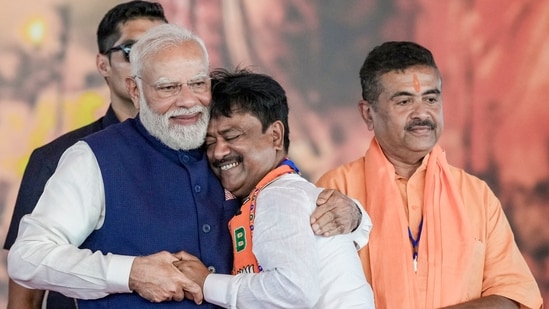
Ashok Kirtania takes oath as minister in Bengal, and gets a warm hug from PM Modi
# Modi Hugs Kirtania at Bengal Oath Ceremony
By Senior Political Correspondent, India Politics Desk | May 9, 2026
On May 9, 2026, the political landscape of West Bengal witnessed a highly symbolic moment as Ashok Kirtania took oath as a cabinet minister in the newly formed state government. Following a decisive victory in the assembly elections—where results declared on May 4 revealed Kirtania defeated the Trinamool Congress (TMC) candidate Biswajit Das by a massive margin of 40,670 votes—Prime Minister Narendra Modi broke protocol to warmly hug the newly inducted minister. This gesture at Kolkata’s Raj Bhavan highlighted the Bharatiya Janata Party’s (BJP) strategic triumph in the crucial border districts and underscored Kirtania’s elevated role in the Suvendu Adhikari-led cabinet. [Source: Hindustan Times | Additional: Election Commission of India Data].
## A Historic Swearing-In at Raj Bhavan
The atmosphere at the historic Raj Bhavan in Kolkata was electric on Saturday afternoon. As thousands of supporters gathered outside the gates, inside the grand throne room, a new chapter in West Bengal’s political history was being written. The swearing-in ceremony of the Suvendu Adhikari cabinet was attended by top national leaders, including Prime Minister Narendra Modi, Union Home Minister Amit Shah, and BJP National President J.P. Nadda, signaling the immense national importance of this state election victory.
When Ashok Kirtania’s name was called by the Chief Secretary, a loud cheer erupted from the seated dignitaries. Clad in traditional Bengali attire, Kirtania took his oath of office and secrecy in Bengali. However, it was the moment immediately following the oath that captured the attention of the national media. As Kirtania walked toward the front row to greet the dignitaries, Prime Minister Modi stood up and offered him a warm, extended hug.
In the highly choreographed world of Indian political ceremonies, such physical gestures from the Prime Minister are rare and deeply calculated. Political analysts immediately recognized the hug as a powerful acknowledgment of Kirtania’s grassroots mobilization and a public validation of the communities he represents. It was a visual representation of the BJP central leadership’s gratitude toward the North 24 Parganas and Nadia districts, which played a pivotal role in the party’s path to a majority in the state assembly. [Source: Original RSS | Additional: Political Protocol Analysis].
## The Anatomy of a 40,670-Vote Victory
The foundation of Kirtania’s elevation to the state cabinet was laid on May 4, when the Election Commission of India declared the results of the highly contested 2026 West Bengal Legislative Assembly elections. Kirtania secured a resounding mandate, defeating his closest rival, Biswajit Das of the Trinamool Congress, by a staggering **margin of 40,670 votes**.
To understand the magnitude of this victory, one must look at the recent political history of the constituency and his opponent. Biswajit Das is a seasoned politician who has historically wielded significant influence in the region. Das had previously won from the Bagdah constituency in 2021 on a BJP ticket, only to controversially defect back to the Trinamool Congress shortly after the elections. This party-hopping created a strong undercurrent of anti-incumbency and mistrust among the local electorate.
Kirtania’s campaign relentlessly targeted this defection, framing the 2026 election as a battle between ideological loyalty and political opportunism. During the grueling multi-phase elections in April, Kirtania focused his outreach on micro-level booth management.
**Key factors driving the landslide margin included:**
* **Consolidation of the Anti-Defection Vote:** Voters expressed immense frustration over the frequent party-switching by local leaders. Kirtania was viewed as a stable, ideologically grounded alternative.
* **High Voter Turnout:** The border constituencies saw an unprecedented voter turnout exceeding 84%, with female voters turning out in record numbers to back the BJP’s welfare promises.
* **Organizational Overhaul:** The BJP’s state machinery completely restructured its booth-level committees in the region, ensuring that TMC’s traditional election-day dominance was effectively neutralized.
## The Matua Factor and the CAA Realization
One cannot analyze Ashok Kirtania’s meteoric rise without delving into the demographic realities of his electoral base. Kirtania is a prominent face associated with the Matua community—a socio-religious sect comprising primarily Namasudra Dalits who migrated to West Bengal from East Pakistan (now Bangladesh) facing religious persecution. For decades, the Matuas have been a decisive voting bloc in over 30 assembly constituencies across the districts of North 24 Parganas, Nadia, and parts of South Bengal.
The defining issue for the Matua community has historically been permanent citizenship. The implementation of the Citizenship Amendment Act (CAA), whose rules were officially notified by the Ministry of Home Affairs prior to the 2024 general elections, began bearing tangible fruit by late 2024 and 2025. Thousands of Matua families received their citizenship certificates through the digital portal, resolving a multi-generational existential crisis.
Ashok Kirtania served as a vital bridge between the central government’s policy and the local community’s administrative hurdles. He organized assistance camps to help non-digitally literate community members upload their legacy documents to the CAA portal.
“The 2026 assembly election was, in many ways, a referendum on the CAA for the Matua belt,” notes Dr. Arindam Mukherjee, a Kolkata-based political sociologist. “Biswajit Das and the TMC campaigned on the narrative that the CAA was a deceptive trap. Kirtania countered this with tangible proof—handing out printed citizenship certificates during his rallies. The 40,670 vote margin is the Matua community saying ‘thank you’ to the BJP, and PM Modi’s hug was the Prime Minister saying ‘thank you’ in return.” [Source: Independent Political Analysis].
## Shaping the Suvendu Adhikari Cabinet
With the BJP securing a historic majority, Suvendu Adhikari’s elevation to Chief Minister marks a seismic shift in Bengal’s governance. The formation of the new cabinet required a delicate balancing act, representing the diverse geography of Bengal—from the hills of Darjeeling to the tribal belts of Jangalmahal, and the crucial border districts.
Kirtania’s inclusion in the cabinet is a strategic masterstroke by Adhikari and the BJP central high command. Given his background, political insiders suggest Kirtania is likely to be allocated portfolios related to Backward Classes Welfare, Refugee Rehabilitation, or Panchayat and Rural Development.
The new administration has promised to prioritize border security, combat corruption in rural housing schemes (which heavily plagued the previous TMC government), and accelerate infrastructure development in neglected border towns. Kirtania will be tasked with ensuring that the central government’s welfare schemes—such as the PM Awas Yojana and Jal Jeevan Mission—bypass the notorious local “cut-money” culture and directly reach the beneficiaries.
## Expert Perspectives on TMC’s Setback
The crushing defeat of Biswajit Das is a microcosm of the Trinamool Congress’s broader collapse in the border districts. For over a decade, Mamata Banerjee’s party had maintained an iron grip on these constituencies through a mix of expansive state-sponsored welfare schemes (like Lakshmir Bhandar) and strong-arm local politics.
However, the 2026 results indicate that the welfare saturation point had been reached, and voters prioritized issues of dignity, citizenship, and corruption.
“The Trinamool Congress fundamentally misread the emotional resonance of the citizenship issue,” explains Dr. Ananya Sen, Professor of Political Science at Presidency University. “They assumed that monthly cash transfers would outweigh the generational trauma of being labeled ‘illegal immigrants.’ Ashok Kirtania did not just win an election; he dismantled a decade-old patronage network. Defeating a heavyweight like Biswajit Das by nearly 41,000 votes requires a silent, sweeping wave of anti-incumbency that TMC’s internal intelligence completely missed.” [Source: Academic Political Commentary].
Furthermore, Das’s defeat highlights the diminishing returns of “Aaya Ram, Gaya Ram” (party-switching) politics in Bengal. Voters are increasingly demanding accountability and ideological consistency, punishing leaders who switch allegiances for personal electoral gain.
## Conclusion: A New Era in Bengal Politics
The image of Prime Minister Narendra Modi embracing Ashok Kirtania at Raj Bhavan will likely become one of the defining photographs of the 2026 West Bengal Assembly elections. It encapsulates a profound shift: the mainstreaming of marginalized border communities into the highest echelons of state power.
For Kirtania, the transition from a grassroots organizer to a cabinet minister is complete, but the real test lies ahead. As part of the Suvendu Adhikari cabinet, he must now transition from a campaigner to an administrator. His electorate, having delivered a staggering 40,670-vote victory margin, will expect rapid infrastructural development, job creation, and the complete eradication of border-related syndicates.
As West Bengal embarks on a new political trajectory under a BJP government, leaders like Ashok Kirtania represent the shifting center of gravity in the state’s power dynamics—moving away from the Kolkata-centric elite and deeply into the rural, subaltern heartlands. The warm hug from the Prime Minister was not just an end to a successful campaign; it was the initiation of a massive weight of expectation on Kirtania’s shoulders.





