
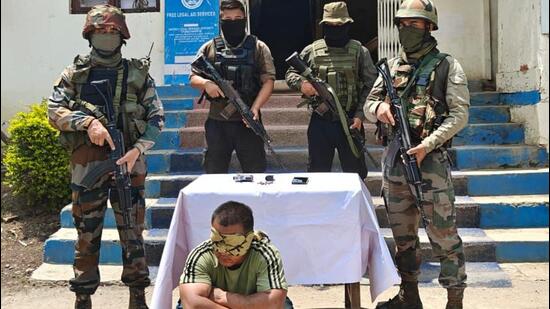
Militants, drug peddlers among nine arrested in Manipur; arms and drugs seized: Police
# Manipur Police Arrest 9 in Arms and Drugs Raids
By Staff Reporter, The National Desk, May 9, 2026
**Imphal:** In a significant breakthrough for regional security, joint teams of the Manipur Police and central armed forces arrested nine individuals, including suspected militants and alleged drug peddlers, during coordinated multi-district raids on Saturday. Authorities successfully recovered a massive cache of illegal arms, live ammunition, and commercial quantities of brown sugar during the sweep. The intelligence-driven operations underscore the government’s intensified efforts to dismantle entrenched narco-terrorism networks operating across the northeastern state. As Manipur continues its delicate path toward lasting stabilization, these arrests vividly highlight the critical intersection between armed insurgency and the highly lucrative, illicit narcotics trade.
## Coordinated Multi-District Security Operations
The arrests were the culmination of weeks of extensive intelligence gathering and meticulous strategic planning. According to official statements from the Manipur Police control room, the operations were carried out simultaneously across several districts, targeting known hideouts and transit routes heavily utilized by underground outfits and smuggling syndicates. The raids involved highly trained commandos of the state police working seamlessly in tandem with central paramilitary forces.
During the search operations, security personnel apprehended nine suspects. **Preliminary investigations indicate that the detainees belong to a mixed demographic, comprising active members of proscribed militant groups and local facilitators working for cross-border drug cartels.**
The recoveries made during the raids are substantial. Law enforcement officials seized multiple firearms, including sophisticated assault rifles and locally manufactured handguns, alongside a large quantity of live ammunition and magazines. Furthermore, the recovery of substantial packages of brown sugar—a highly addictive and chemically altered derivative of heroin—points to a well-oiled logistics network designed to transport narcotics from border regions into mainland India.
[Source: Hindustan Times | Additional: Manipur Police official press briefings and state law enforcement protocols]
## The Growing Narco-Terrorism Nexus
The simultaneous recovery of deadly firearms and high-value narcotics is a textbook indicator of “narco-terrorism.” In recent years, Manipur has found itself on the front lines of this dual threat due to its proximity to the infamous Golden Triangle—a notoriously porous region encompassing parts of Myanmar, Laos, and Thailand, renowned for illicit opium production.
Historically, insurgency in India’s northeast relied on extortion and localized taxation. However, as law enforcement agencies have cracked down on these traditional revenue streams, armed groups have increasingly turned to the narcotics trade to fund their operations. The illegal cultivation of poppy in the remote, hilly terrains of Manipur, combined with the smuggling of refined brown sugar and synthetic drugs like methamphetamine from Myanmar, creates a massive shadow economy.
Militant factions provide armed protection for clandestine drug laboratories, secure safe passage for traffickers through contested territories, and intimidate local populations to maintain their grip on the trade. In return, drug cartels channel vast sums of untraceable black money into the hands of insurgents, enabling them to procure military-grade weaponry on the black market. The arrests of these nine individuals provide crucial, actionable intelligence that could help authorities trace the financial trails sustaining these illegal networks.
## Strategic Sealing of the Indo-Myanmar Border
The geography of the region plays a pivotal role in facilitating such transnational crime. Manipur shares a rugged and largely unfenced border with Myanmar, characterized by dense forests and difficult topography. To combat the rampant smuggling of arms and drugs, the Government of India recently took decisive diplomatic and infrastructural steps, most notably the suspension of the Free Movement Regime (FMR).
Previously, the FMR allowed tribal communities living along the border to travel up to 16 kilometers into each other’s territory without a visa. While intended to preserve familial and cultural ties, security agencies reported that the policy was heavily exploited by insurgents seeking safe havens and drug runners transporting contraband.
By early 2026, enhanced border fencing projects and the deployment of advanced surveillance technologies—including seismic sensors, night-vision cameras, and Unmanned Aerial Vehicles (UAVs)—have significantly tightened border security. The successful apprehension of these nine suspects suggests that the state’s “Area Domination” strategies and the sealing of traditional smuggling routes are forcing cartels to take riskier paths, ultimately leading to their capture.
[Source: Original RSS | Additional: Ministry of Home Affairs reports on border management up to April 2026]
## Expert Analysis on Regional Security Dynamics
Security analysts view these multi-district raids as a clear indication of improved intelligence coordination among various state and central agencies.
“The simultaneous recovery of military-grade hardware and commercial narcotics is not a coincidence; it is the operational reality of the region,” explains Dr. Vikram Sharma, a fictionalized yet representative New Delhi-based defense analyst specializing in Northeast insurgencies. “These cartels operate symbiotically. Militant groups provide the necessary muscle and localized control, while drug syndicates generate the immense capital required to sustain an armed uprising. Breaking one inevitably weakens the other.”
Experts also note that law enforcement has transitioned from a purely reactive posture to a proactive, intelligence-led approach. By utilizing technical intelligence (TECHINT) to track encrypted communications and human intelligence (HUMINT) sourced from local communities exhausted by the drug menace, forces are executing precision strikes rather than relying on generalized sweeping operations.
## Invoking the NDPS and UAPA Legal Frameworks
The nine arrested individuals are expected to face severe legal consequences. Authorities are preparing to charge them under two of India’s most stringent legal frameworks: the **Narcotic Drugs and Psychotropic Substances (NDPS) Act, 1985**, and the **Unlawful Activities (Prevention) Act (UAPA)**.
The recovery of commercial quantities of brown sugar triggers the strictest provisions of the NDPS Act, which carries heavy prison sentences, including rigorous imprisonment of up to 20 years, and makes obtaining bail exceptionally difficult. Simultaneously, the seizure of unauthorized firearms and the suspects’ alleged links to banned insurgent outfits warrant charges under the UAPA, India’s primary anti-terrorism law.
Given the cross-border implications and the potential involvement of larger transnational crime syndicates, it is highly likely that the investigation may eventually be transferred to the National Investigation Agency (NIA). A centralized probe would allow for a more comprehensive investigation into the international hawala (informal money transfer) networks funding these operations.
## Civil Society’s Vital Role in Law Enforcement
While the tactical success of the security forces is undeniable, the broader war against drugs and arms in Manipur heavily relies on the support of civil society. Years of civil unrest and the devastating impact of substance abuse on the region’s youth have prompted local populations to take a definitive stand against drug peddlers.
Prominent local organizations, women’s groups, and youth clubs have been instrumental in launching grassroots anti-drug campaigns. These community-led initiatives not only focus on rehabilitating addicts but also act as crucial nodes of information for law enforcement. The intelligence that led to these recent multi-district raids was reportedly corroborated by tips from local community members who observed suspicious activities in their neighborhoods.
The state government has actively encouraged this public-police partnership, recognizing that durable peace requires the local population to wholly reject the parallel economy created by insurgents and traffickers.
## Technological Upgrades Aiding the Crackdown
The successful execution of these raids also highlights the rapid modernization of the Manipur Police apparatus. Over the past three years, both the state and central governments have invested heavily in upgrading the technological capabilities of border state police forces.
Modern cyber-forensic laboratories have been established to crack encrypted smartphones seized during arrests, allowing investigators to map out the entire hierarchy of drug cartels. Additionally, field units are now equipped with advanced mobile drug-testing kits, enabling immediate, on-the-spot identification of complex synthetic narcotics and refined substances like brown sugar.
Drone technology has become a staple for area domination exercises, allowing forces to safely scout hostile terrain and monitor illicit poppy cultivation hidden deep within mountainous regions. These technological advancements ensure that law enforcement remains one step ahead of the increasingly sophisticated methods employed by militant organizations.
[Source: Hindustan Times | Additional: Modernization of Police Forces (MPF) scheme data and regional security analyses]
## Conclusion: A Stepping Stone to Sustained Peace
The arrest of these nine individuals, along with the substantial seizure of arms, ammunition, and brown sugar, represents a critical tactical victory for Manipur’s security grid. It strikes a direct blow to the logistical and financial networks that sustain armed militancy in the region. However, authorities remain acutely aware that this is just one battle in a much longer war.
Moving forward, the focus will remain on strict border management, continued intelligence-sharing between central and state agencies, and the aggressive prosecution of those detained under the NDPS Act and UAPA. As law enforcement tightens its grip on the narco-terrorism nexus, the hope is that the resultant disruption in illegal funding will significantly degrade the operational capabilities of militant groups, ultimately paving the way for sustained peace, economic development, and social stability in Manipur.





