
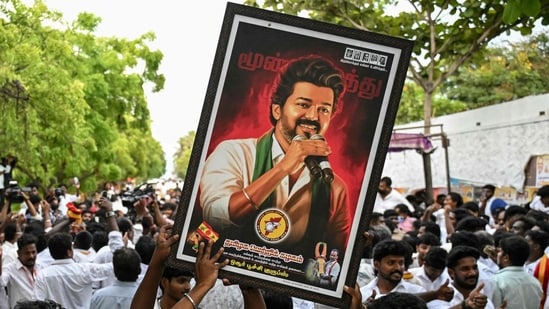
Why Vijay’s blockbuster Tamil Nadu debut needed a VCK script change
# TN Polls: How VCK Holds the Key to Vijay’s CM Bid
**By Special Political Correspondent, India Desk | May 9, 2026**
In a historic political upheaval on May 9, 2026, actor-turned-politician Vijay’s Tamilaga Vettri Kazhagam (TVK) disrupted Tamil Nadu’s decades-old bi-polar politics by emerging as the single largest party with 108 seats. However, in a state assembly of 234, the magic number for a simple majority remains 118. Falling 10 seats short of the Chief Minister’s chair, Vijay now faces his toughest post-production challenge: securing the support of the Viduthalai Chiruthaigal Katchi (VCK). To successfully form the government and keep traditional Dravidian heavyweights at bay, the superstar requires a massive political script change to accommodate the ideological and structural demands of Tamil Nadu’s premier Dalit-led party.
[Source: Hindustan Times | Additional: State Election Commission Mandate Analysis 2026]
## The Fractured Mandate: A Statistical Breakdown
The 2026 Tamil Nadu Legislative Assembly elections will be remembered as the moment the Dravidian duopoly was decisively fractured. For over half a century, power oscillated predictably between the Dravida Munnetra Kazhagam (DMK) and the All India Anna Dravida Munnetra Kazhagam (AIADMK). Vijay’s TVK capitalized on deep-seated anti-incumbency, youth disillusionment, and an aggressive grassroots campaign to secure an unprecedented 108 seats on its debut.
Despite the blockbuster opening, the climax remains unresolved.
**2026 Tamil Nadu Assembly Election Results (Key Projections):**
* **TVK (Tamilaga Vettri Kazhagam):** 108 seats
* **DMK (Dravida Munnetra Kazhagam):** 65 seats
* **AIADMK (All India Anna Dravida Munnetra Kazhagam):** 42 seats
* **VCK (Viduthalai Chiruthaigal Katchi):** 14 seats
* **BJP, NTK, & Independents:** 5 seats
With 14 crucial seats, Thol. Thirumavalavan’s VCK has emerged as the undisputed kingmaker. Traditionally allied with the DMK, the VCK took a calculated gamble to contest independently—or in smaller tactical alliances—in the northern and delta districts, a move that has paid off phenomenally. Now, the path to the Fort St. George (the seat of the Tamil Nadu government) runs directly through the VCK headquarters.
## Why the “Lone Savior” Needs an Ensemble Cast
Throughout his cinematic career, Vijay’s formula relied on the narrative of the lone savior fighting a corrupt system. His initial political campaign mirrored this, promising a “clean, uncorrupt, and caste-free” administration, sharply critical of coalition compromises. However, real-world parliamentary democracy operates on arithmetic, not cinematic liberty.
“Vijay’s cinematic charisma translated flawlessly into votes, but the assembly floor requires raw political pragmatism,” notes Dr. V. Ramanathan, a Chennai-based political sociologist. “He ran an outsider’s campaign. Now, to cross the 118-mark, he must pivot to an insider’s negotiation. The VCK is not a regional fringe player; it is an ideologically driven force representing marginalized communities. They will not offer unconditional support.”
To bridge the gap, TVK needs a “script change.” Vijay must transition from a populist political newcomer to a coalition-builder. This requires articulating a definitive stance on social justice, state autonomy, and caste census—issues that the VCK holds as non-negotiable prerequisites for any alliance.
## The Ideological Bridge: TVK’s Centrist Populism vs. VCK’s Ambedkarite Vision
The primary hurdle in a TVK-VCK alliance is ideological friction. Vijay’s political messaging has largely been centrist, focusing on equitable development, educational reform, and fighting bureaucratic corruption. He has often walked a tightrope, avoiding the deeply entrenched ideological rhetoric of the Dravidian movement to appeal to a broader, pan-caste youth demographic.
Conversely, the VCK is rooted in fierce Ambedkarite and Periyarist ideologies. Their core mandate is the annihilation of caste, radical land distribution, and aggressive affirmative action.
For Thirumavalavan to throw his 14 MLAs behind Vijay, the TVK will have to publicly adopt several of VCK’s progressive charters. Political analysts suggest that closed-door negotiations are already underway, focusing on:
1. **Proportional Representation:** Pushing for internal reservations and stronger protections under the SC/ST (Prevention of Atrocities) Act.
2. **Land Rights:** Reallocating surplus government land to landless Dalit agricultural laborers.
3. **Ideological Stance against the BJP:** The VCK requires an absolute, written commitment from Vijay that his government will not align with the Bharatiya Janata Party (BJP) or support its central policies, ensuring Tamil Nadu remains a secular stronghold.
[Source: Historical TN Electoral Trends & VCK Party Manifesto 2026]
## The Power Sharing Formula: Demands for a Deputy CM
Ideology aside, the pragmatics of power-sharing are proving to be a complex sticking point. Sources close to the VCK leadership indicate that mere cabinet berths will not suffice. For decades, Dalit parties in Tamil Nadu have supported major Dravidian parties from the outside or accepted minimal cabinet representation. With 14 seats and the ultimate leverage to crown the Chief Minister, VCK is reportedly demanding the Deputy Chief Minister position.
“This is a watershed moment for Dalit political representation in Tamil Nadu,” explains S. Murugan, author and commentator on Dravidian politics. “Thirumavalavan knows he holds the golden key. A Deputy CM post for the VCK would shatter a massive glass ceiling in the state’s political hierarchy. If Vijay agrees, it will be hailed as a masterstroke of social engineering. If he refuses out of fear of alienating dominant caste vote banks, the government could be stillborn.”
Additionally, the VCK is likely eyeing crucial portfolios such as Education, Home (or a subset of law enforcement oversight), and Social Welfare. Vijay, who has promised a technocratic and lean cabinet, must now balance his campaign promises with the necessities of coalition management.
## The Raj Bhavan Factor and Potential BJP Maneuvering
Hovering over this high-stakes negotiation is the role of the Governor at the Raj Bhavan. According to constitutional precedent, the Governor is obligated to invite the leader of the single largest party—in this case, Vijay—to form the government and prove a majority on the floor of the house.
However, the timeline granted by the Governor is crucial. A shorter window puts immense pressure on TVK to finalize a rushed, potentially lopsided deal with VCK. A longer window might open the doors for “resort politics” and horse-trading.
The BJP, despite securing a minimal footprint with 3 seats, is watching the situation with intense interest. The national ruling party has long sought to dismantle the DMK-AIADMK dominance in Tamil Nadu. While Vijay’s TVK is not ideologically aligned with the BJP, a minority TVK government dependent on unstable alliances could present future opportunities for the national party to exert influence from New Delhi. Vijay’s camp is acutely aware that a stable, pre-emptive pact with the VCK is essential to block any external political engineering.
## The DMK’s Silent Vigil
While the spotlight is on TVK and VCK, the DMK is not entirely out of the picture. Reduced to 65 seats, the outgoing ruling party is wounded but still commands a formidable legislative bloc. If talks between Vijay and Thirumavalavan collapse, the VCK could theoretically return to its erstwhile ally, the DMK. Though a DMK-led alliance would still fall short of the 118 mark (65 + 14 = 79), it could force a hung assembly, leading to prolonged political instability or even fresh elections—a scenario Vijay is desperate to avoid.
The DMK’s strategy is currently one of strategic silence, hoping that the inexperience of TVK’s political managers will lead to a breakdown in negotiations with the seasoned leadership of the VCK.
## Conclusion: A New Era for Tamil Nadu Politics
The 2026 Tamil Nadu Assembly elections have irreversibly altered the political geography of the state. Vijay’s phenomenal debut has proven that the electorate is hungry for an alternative to the traditional Dravidian giants. However, the mandate has also delivered a profound message: no single leader, no matter how immense their personal charisma, can govern unilaterally without addressing the deep-seated demands for social justice.
**Key Takeaways:**
* **The End of Majoritarian Dominance:** TVK’s 108-seat victory signifies the end of absolute majorities in TN, ushering in an era of coalition politics.
* **Elevation of Dalit Politics:** VCK’s leverage with 14 seats places Dalit political representation at the absolute center of state governance, transitioning them from allies to essential power-brokers.
* **The Ultimate Test for TVK:** To secure the CM chair, Vijay must evolve from a populist idol to a statesman capable of managing complex ideological and administrative alliances.
As Tamil Nadu waits with bated breath, the next few days will determine not just who sits in the Chief Minister’s chair, but the very ideological trajectory of the state for the next five years. For Vijay, delivering a blockbuster debut was only half the battle; rewriting his political script alongside the VCK is the only way to ensure the film doesn’t end in an agonizing cliffhanger.





