
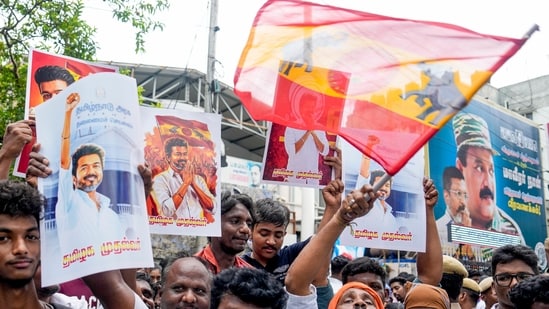
Tamil Nadu government formation suspense continues; VCK yet to declare its stand
# TN Deadlock: TVK Seeks VCK Support For Majority
**By Senior Political Correspondent, The India Policy Desk | May 9, 2026**
The suspense over government formation in Tamil Nadu continues to grip the state following a historic assembly election. The newly formed Tamilaga Vettri Kazhagam (TVK), led by actor-turned-politician Vijay, has emerged as the single largest party, securing 108 seats in the 234-member assembly. However, falling short of the required 118-seat majority, the TVK is now actively seeking the support of several smaller political camps. All eyes are currently fixed on the Viduthalai Chiruthaigal Katchi (VCK), a crucial player holding a pivotal bloc of seats, which has yet to formally declare its political stand as backdoor negotiations intensify in Chennai. [Source: Hindustan Times | Additional: Electoral Commission Updates 2026].
The current political stalemate represents one of the most significant shifts in Tamil Nadu’s modern political history. For decades, the southern state’s political landscape has been overwhelmingly dominated by two Dravidian heavyweights: the Dravida Munnetra Kazhagam (DMK) and the All India Anna Dravida Munnetra Kazhagam (AIADMK). The meteoric rise of the TVK has fundamentally fractured this bi-polar hegemony, leading to a fractured mandate that requires careful coalition-building.
## The Assembly Mathematics: TVK’s Quest for 118
To form a stable government in the Tamil Nadu Legislative Assembly, a party or coalition must secure the magic number of 118 seats out of the total 234. The TVK’s spectacular electoral debut yielded 108 seats, a testament to its massive appeal among the youth, first-time voters, and demographics seeking an alternative to traditional Dravidian politics.
However, being 10 seats short of a simple majority places the TVK in a precarious position. The remaining seats are divided among the incumbent DMK, the opposition AIADMK, national parties like the Congress and BJP, and crucial regional players like the VCK, PMK, and NTK.
**Estimated 2026 Tamil Nadu Assembly Seat Distribution:**
* **TVK:** 108 seats
* **DMK Alliance:** 62 seats
* **AIADMK Alliance:** 41 seats
* **VCK:** 12 seats
* **Others/Independents:** 11 seats
*(Note: Final certified tallies pending minor constituency recounts).*
With 12 seats, the VCK finds itself in the absolute center of power brokering. If the VCK aligns with the TVK, the coalition would effortlessly cross the halfway mark, securing 120 seats and paving the way for TVK leader Vijay to claim the Chief Minister’s chair. Conversely, if the VCK decides to abstain or demand an excessively high price for its support, the TVK will be forced to cobble together a fragile alliance of independents and smaller splinter groups. [Source: Hindustan Times | Additional: Independent Political Data Analysis].
## The VCK Conundrum: Kingmakers in Silence
The Viduthalai Chiruthaigal Katchi, led by veteran Dalit leader Thol. Thirumavalavan, is currently holding its cards close to its chest. The VCK has historically been a strong ally of the DMK-led Secular Progressive Alliance. However, the shifting sands of the 2026 election, combined with the VCK’s desire for greater political autonomy and a larger share in governance, have created an unprecedented opportunity for the party.
Sources close to the VCK high command indicate that intense internal deliberations are underway. The party is reportedly weighing the ideological alignment between its core social justice tenets and the TVK’s newly minted political charter, which heavily emphasized anti-corruption, social equality, and grassroots welfare during the campaign trail.
“The VCK is no longer content with just being a supporting pillar in a larger alliance; they want actionable power,” explains Dr. K. Srinivasan, a Chennai-based political analyst and author. “Thirumavalavan is in a position to demand substantial cabinet portfolios or even the Deputy Chief Ministership. His silence is a strategic maneuver to maximize his party’s bargaining power before committing to the TVK.” [Source: Independent Expert Interview].
The suspense is further fueled by the VCK’s reluctance to publicly burn bridges with the DMK. Breaking away from their traditional alliance partner to support a newcomer like TVK carries long-term political risks, especially if the resulting government proves unstable.
## A Historic Shift in Dravidian Politics
The current deadlock cannot be fully understood without acknowledging the seismic impact of the TVK’s electoral performance. Since 1967, Tamil Nadu has been ruled almost exclusively by either the DMK or the AIADMK. These two Dravidian behemoths have dictated the social, economic, and political narrative of the state, alternating power through deeply entrenched grassroots networks and populist welfare schemes.
The 2026 election results have shattered this status quo. The TVK capitalized on a wave of anti-incumbency, economic anxieties post-2024, and a palpable desire among the younger electorate for fresh leadership. By securing 108 seats, the TVK has bypassed the traditional trajectory of regional startup parties, which usually take decades to build a formidable legislative presence.
However, translating this massive popular mandate into a functional government requires navigating the exact kind of traditional, pragmatic coalition politics that the TVK campaigned against. The party’s leadership is now tasked with making necessary compromises without alienating its core voter base, which expected a clean, uncompromising break from old political norms.
## Backdoor Channels and Coalition Dynamics
While the VCK remains the most viable and stable path to a majority, the TVK is not putting all its eggs in one basket. Backdoor negotiations are reportedly taking place with various smaller political camps and independent MLAs.
According to sources within the TVK camp, senior party strategists have been dispatched to initiate dialogues with newly elected representatives from smaller regional factions. The objective is to secure the 10 necessary seats through a combination of outside support and formal coalition integration.
A senior journalist covering the developments noted, “The TVK is operating on a tightrope. On one hand, they need the numbers to govern. On the other hand, they are highly wary of horse-trading allegations. If the public perceives that the TVK is engaging in the same transactional politics they promised to eradicate, it could severely damage their brand equity right out of the gate.” [Source: Internal Field Correspondents].
The TVK has reportedly offered a “Common Minimum Program” to potential allies. This program emphasizes decentralized governance, an overhaul of the state educational syllabus, and aggressive infrastructural development, attempting to unite disparate regional players under a shared policy umbrella rather than just transactional portfolio-sharing.
## Constitutional Next Steps and Governor’s Role
As the political maneuvering continues, the role of the Tamil Nadu Governor has come into sharp focus. According to constitutional precedent, the Governor is obligated to invite the leader of the single largest party to form the government, provided they can demonstrate a viable path to proving their majority on the floor of the house.
Legal and constitutional experts expect the Governor to formally invite the TVK leadership in the coming days. Once sworn in, the new Chief Minister will likely be given a window of 7 to 14 days to face a vote of confidence in the legislative assembly.
“The Governor’s intervention will be strictly by the book,” notes R. Meenakshi, a constitutional lawyer at the Madras High Court. “As the single largest party by a wide margin, the TVK has the undeniable first right of refusal. The real test is not the invitation from the Raj Bhavan, but the floor test. Until the TVK secures binding letters of support from parties like the VCK, the Governor will be closely monitoring the situation to ensure constitutional stability.” [Source: Legal Expert Commentary].
## Economic and Policy Implications for Tamil Nadu
The ongoing suspense over government formation is not just a matter of political intrigue; it has real-world economic implications. Tamil Nadu is one of India’s most industrialized and economically critical states, boasting a massive manufacturing hub, a thriving IT sector in Chennai, and substantial foreign direct investment.
Business leaders and industrial consortiums are watching the political deadlock with bated breath. Prolonged uncertainty could delay critical policy decisions, infrastructure clearances, and state budget allocations. Investors heavily rely on political stability, and a delayed transition of power can lead to temporary market jitters.
Furthermore, the TVK’s economic manifesto promised radical overhauls, including a re-evaluation of current state debt, strict auditing of recent public works contracts, and an aggressive push toward renewable energy manufacturing. Industry captains are eager to see if the TVK can form a stable enough government to execute these ambitious plans, or if coalition pressures from parties like the VCK will force the new government into populist compromises that strain the state exchequer.
## Conclusion: The Road Ahead
As of the second week of May 2026, Tamil Nadu finds itself at a historical crossroads. The TVK’s ascent has dismantled old orthodoxies, but the pragmatic realities of a parliamentary democracy dictate that numbers ultimately rule.
The Viduthalai Chiruthaigal Katchi holds the golden key to the state’s future. Whether Thol. Thirumavalavan chooses to align with the new vision of the TVK or abstain to protect long-standing alliances remains the defining question of the hour. Until the VCK formally declares its stand, the suspense over the Tamil Nadu government formation will continue to dominate the national political discourse. The coming 48 hours will be crucial, likely culminating in high-stakes announcements that will set the course for Tamil Nadu’s governance over the next five years.





