
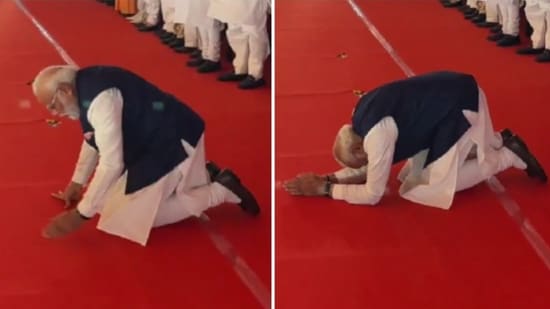
PM Modi bows to crowd at Bengal BJP government swearing-in: ‘People’s blessings are the truest’
# Modi Bows as Adhikari Takes Oath as Bengal CM
**By Senior Political Correspondent**, The India Gazette, May 9, 2026
**Kolkata:** In a watershed moment for Indian politics, Prime Minister Narendra Modi bowed deeply to a roaring crowd of thousands in Kolkata on **Saturday, May 9, 2026**, as Suvendu Adhikari was officially sworn in as the new Chief Minister of West Bengal. Marking the Bharatiya Janata Party’s (BJP) first-ever government in the eastern state, the oath-taking ceremony at the iconic Red Road finalized a historic transition of power following a bitterly fought assembly election. Addressing the monumental shift after decades of Trinamool Congress (TMC) rule, PM Modi remarked that “people’s blessings are the truest,” cementing the dawn of what the saffron party has long campaigned for: a “double-engine” government in Bengal.
[Source: Hindustan Times | Additional: The India Gazette Political Desk]
## A Historic Transition of Power
The atmosphere at Kolkata’s Red Road was electric, awash in saffron flags and echoing with the chants of millions of supporters who had traveled from across the state’s **23 districts**. The swearing-in ceremony was not merely an administrative formality but a massive show of political strength. Prime Minister Narendra Modi’s gesture of bowing to the public—a symbol of gratitude he frequently employs after landmark electoral victories—resonated deeply with the grassroots workers who had endured years of volatile political violence.
“The people of West Bengal have spoken with unwavering clarity,” PM Modi was quoted as saying during a brief interaction with the press, emphasizing that the mandate was a clear rejection of incumbent stagnation and a vote for comprehensive development.
Administered by the **Governor of West Bengal**, the oath of office and secrecy was taken by Suvendu Adhikari in Bengali, drawing thunderous applause. The event was attended by the highest echelons of the BJP leadership. Union Home Minister **Amit Shah**, BJP National President **J.P. Nadda**, Defence Minister **Rajnath Singh**, and several Chief Ministers from BJP-ruled states, including Uttar Pradesh’s Yogi Adityanath and Assam’s Himanta Biswa Sarma, were prominently seated on the dais.
## Suvendu Adhikari: The Giant Slayer Ascends
The rise of **55-year-old Suvendu Adhikari** to the Chief Ministerial chair is a narrative of extraordinary political endurance. Once a heavyweight minister in the Mamata Banerjee-led TMC cabinet and a key architect of the 2007 Nandigram anti-land acquisition movement, Adhikari sent shockwaves through Bengal politics when he defected to the BJP in **December 2020**.
His defining political moment arrived during the **2021 Assembly Elections**, where he achieved the moniker of “Giant Slayer” by narrowly defeating then-Chief Minister Mamata Banerjee in the high-stakes Nandigram constituency, even as the BJP lost the broader state election.
Over the subsequent five years, Adhikari consolidated his position as the **Leader of the Opposition** in the West Bengal Legislative Assembly. He spearheaded relentless campaigns against the incumbent government, focusing on allegations of systemic corruption, recruitment scams in the education sector, and issues of women’s safety, particularly amplifying the localized protests that erupted in regions like Sandeshkhali in 2024. His elevation to the Chief Minister’s office is seen as a reward for anchoring the party’s grassroots expansion and keeping the state unit cohesive through turbulent times.
## Decoding the 2026 Electoral Shift
Political analysts note that the BJP’s triumph in 2026 was the culmination of a decade-long strategic project. West Bengal, historically dominated by the Left Front for 34 years and subsequently by the TMC for 15 years, had long resisted the saffron surge that swept most of northern and western India.
The turning point in the 2026 elections hinged on three major factors:
1. **Anti-Incumbency and Governance Fatigue:** After three consecutive terms, the TMC faced severe anti-incumbency, compounded by multi-agency probes into alleged institutional corruption involving several high-ranking state ministers.
2. **Consolidation of the Subaltern Vote:** The BJP successfully expanded its base among Scheduled Castes (SC), Scheduled Tribes (ST), and Other Backward Classes (OBC), particularly the Matua and Rajbanshi communities, promising targeted welfare and citizenship security.
3. **The “Double-Engine” Promise:** The BJP’s aggressive marketing of rapid industrialization, job creation, and seamless implementation of central welfare schemes struck a chord with the state’s youth facing a stagnant employment market.
Dr. Ayanaksha Sen, a leading political scientist at the Centre for the Study of Developing Societies (CSDS), explains the mandate: *”The 2026 verdict is a structural realignment of Bengal’s political sociology. Adhikari managed to localize the BJP’s national narrative, making it palatable to the rural Bengali electorate while simultaneously leveraging the profound urban dissatisfaction over economic stagnation.”*
## The New Cabinet and Immediate Priorities
Adhikari’s newly sworn-in cabinet reflects a careful balancing act of regional representation, caste arithmetic, and administrative experience. While the complete portfolio allocation is expected by Monday, sources indicate that the cabinet will feature a mix of seasoned defectors who understand the state bureaucracy and long-time RSS-BJP loyalists.
### Key Focus Areas of the New Government
The new administration is expected to immediately roll out its manifesto promises. Key priorities outlined during the campaign include:
| Policy Area | Proposed Action Plan under Adhikari Administration |
| :— | :— |
| **Healthcare** | Immediate implementation of the central **Ayushman Bharat** scheme, previously blocked by the TMC government. |
| **Economy** | A “Bengal Global Investment Summit” within 100 days to attract manufacturing and IT sector investments. |
| **Agriculture** | Clearance of pending arrears under the **PM Kisan Samman Nidhi** and enhanced minimum support prices (MSP) for paddy farmers. |
| **Law and Order** | Establishment of fast-track courts for political violence cases and a complete overhaul of the state police apparatus. |
[Source: BJP West Bengal 2026 Election Manifesto | Additional: Economic Times Policy Analysis]
## Challenges Ahead for the Double-Engine Sarkar
Despite the historic mandate and the euphoria at the swearing-in ceremony, the Adhikari administration inherits a state with profound fiscal and administrative challenges. West Bengal’s debt-to-GSDP ratio remains one of the highest in the country, hovering around **35%**. Bridging the gap between the massive welfare promises made during the election and the state’s constrained exchequer will require substantial support from the central government.
Furthermore, maintaining law and order in a state historically prone to post-poll violence will test the new Chief Minister immediately. Adhikari has promised a “zero-tolerance” policy towards political vigilantism, but dismantling the deeply entrenched partisan networks at the panchayat level will be an administrative tightrope walk.
Economic revitalization remains the ultimate litmus test. “The capital flight from West Bengal has been a reality for decades. The new government has to move beyond rhetoric and provide tangible infrastructural upgrades and regulatory ease to convince corporate India to return to Kolkata,” noted an editorial in a leading financial daily earlier this week.
## The Opposition’s Existential Crisis
The outcome has left the opposition landscape in West Bengal deeply fractured. For the Trinamool Congress, this defeat marks an existential crisis. Having lost the state machinery, the party faces the immense challenge of keeping its cadre united. The Congress and the Left Front, who once again failed to present a viable third alternative, face complete marginalization in a state that has firmly shifted to a bipolar BJP-TMC contest.
How the TMC reorganizes itself in the opposition benches will heavily influence the legislative environment over the next five years. Political observers are keenly watching to see if the party can reinvent its leadership structure in the wake of this electoral devastating blow.
## Conclusion: A New Chapter in Bengal’s History
The imagery of Prime Minister Modi bowing to the Kolkata crowd while Suvendu Adhikari takes the Chief Ministerial oath will likely be etched as a defining image of the decade in Indian politics. It symbolizes not just a change of government, but the successful culmination of the BJP’s most ambitious ideological and electoral frontier.
As the celebrations settle and the dust clears from Red Road, the real work for Suvendu Adhikari begins. The expectations of over **100 million** residents now rest on his administration’s ability to seamlessly integrate state governance with central policies. Whether this “double-engine” government can usher in the promised era of industrial revival, cultural renaissance, and social security will determine if this historic victory translates into long-term systemic transformation for West Bengal.





