
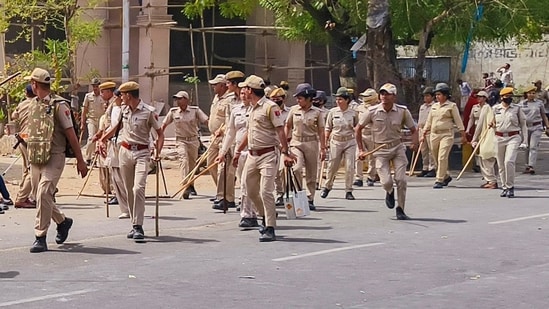
‘Felt insulted’: Dalit bride forced to get off horse in Rajasthan, protest escalates a week later
# Dalit Bride Forced Off Horse: Protests Escalate
By Staff Correspondent, National Affairs Desk, May 10, 2026
In a stark reminder of India’s deep-rooted caste prejudices, widespread protests have erupted across Rajasthan following an incident where a Dalit bride was allegedly forced to dismount her horse during her pre-wedding procession. The confrontation, which occurred last week, escalated significantly by May 9, 2026, as local activists and community members demanded immediate arrests. According to eyewitnesses and protesting groups, approximately a dozen individuals, including women from dominant caste groups, obstructed the path and hurled casteist slurs. The delay in decisive police action has sparked state-wide outrage, turning a local indignity into a major flashpoint for constitutional rights and social justice. [Source: Hindustan Times].
## The Incident: A Celebration Disrupted
The incident took place during a traditional *Bindori*—a customary pre-wedding procession in Rajasthan where the bride or groom rides a horse through their village to seek blessings. For the Dalit community, participating in this ritual has long been fraught with risk, as dominant castes frequently view it as a direct challenge to the established social hierarchy.
According to the primary reports, the bride’s family had organized a modest procession to celebrate her upcoming nuptials. As the procession moved through the village thoroughfare, it was abruptly intercepted. Protestors and eyewitnesses alleged that around a dozen people, notably including several women from the village’s dominant caste communities, blocked the road.
The bride later expressed to local reporters that she “felt insulted” and profoundly humiliated as the joyous occasion devolved into a hostile confrontation. The perpetrators allegedly hurled caste-based profanities and physically intimidated the family until the bride was forced to get off the horse. Fearing for their physical safety and the disruption of the impending wedding, the family complied, concluding the procession on foot under an atmosphere of fear and degradation. [Source: Hindustan Times | Additional: Public Witness Statements].
## Escalating Protests and Demands for Justice
What began as a localized dispute has snowballed into a formidable protest movement. A week after the incident, the lack of immediate arrests has infuriated local Dalit rights organizations, student groups, and human rights defenders.
On Saturday evening, hundreds of protestors gathered outside the district administrative headquarters, staging a sit-in demonstration. The protestors are demanding the immediate arrest of the dozen individuals identified by the bride’s family. They are also calling for the suspension of local police officers who, they allege, failed to provide adequate security despite prior requests from the bride’s family.
**Key demands from the protesting factions include:**
* Immediate arrests of all accused under the Scheduled Castes and the Scheduled Tribes (Prevention of Atrocities) Act, 1989.
* Disciplinary action against local law enforcement for alleged dereliction of duty.
* State-sponsored security for the bride’s family to prevent retaliatory violence.
* A state-wide mandate requiring police protection for all Dalit wedding processions upon request.
“This is not just about a horse; it is about our fundamental right to live with dignity,” stated a spokesperson for the Dalit Adhikar Manch during Saturday’s rally. “The fact that women were actively involved in pulling another woman down from a horse shows how deeply ingrained and normalized caste patriarchy is in our society.”
## The Symbolism of the Horse in Caste Dynamics
To understand the gravity of the incident, it is essential to contextualize the symbolism of the horse in rural Indian society. Historically, riding a horse was a privilege reserved exclusively for royalty, warriors, and dominant land-owning castes. It is a potent visual symbol of pride, social mobility, and honor.
When a Dalit individual rides a horse, it is perceived by orthodox upper-caste groups as a transgression of unspoken social boundaries. While there have been numerous documented instances of Dalit *grooms* being attacked, pelted with stones, or dragged off horses, a Dalit *bride* facing such discrimination adds an intersecting layer of gendered oppression.
Sociologists note that dominant castes often use public humiliation as a tool to enforce subordination. By forcing the bride to dismount in front of her entire community, the perpetrators were not merely disrupting a wedding; they were publicly reasserting a regressive social order.
## Systemic Caste Discrimination in Rajasthan
This incident is not an isolated anomaly but a symptom of systemic caste-based discrimination that continues to plague parts of Rajasthan. Despite constitutional guarantees of equality and stringent laws against untouchability, enforcement at the grassroots level remains inconsistent.
According to historical trends from the National Crime Records Bureau (NCRB), Rajasthan consistently ranks among the states with the highest rates of atrocities committed against Scheduled Castes (SCs).
**Common forms of caste-based discrimination in the region include:**
* Prohibiting Dalit communities from using public wells or temples.
* Forcing Dalit grooms to dismount horses during wedding processions.
* Imposing social boycotts on Dalit families who assert their legal rights.
* Economic retaliation, such as denying employment or land access to marginalized groups.
In recent years, the state police introduced initiatives like “Operation Samanta” (Equality) aimed at providing police escorts to Dalit grooms. However, the continuation of such incidents highlights the limitations of police intervention in the absence of broader societal reform. The fact that the bride’s family felt compelled to yield to the mob underscores the pervasive fear of violence that marginalized communities endure daily. [Additional Source: Sociological Analysis of NCRB Crime Trends in Northern India].
## Legal Framework and Police Response
In response to the escalating protests, the district police have issued a statement confirming that a First Information Report (FIR) has been registered. The charges reportedly include sections related to criminal intimidation, wrongful restraint, and violations under the stringent SC/ST (Prevention of Atrocities) Act.
A senior police official, speaking on the condition of anonymity, stated, “We have identified the individuals involved based on video evidence and witness testimonies. Raids are being conducted to apprehend the accused who have absconded from the village. We appeal to the public to maintain peace while the law takes its course.”
Despite these assurances, legal experts point out that securing convictions in such cases is notoriously difficult. Witnesses often turn hostile due to immense socio-economic pressure from dominant village factions. Furthermore, investigations are sometimes marred by procedural lapses, leading to acquittals.
Advocate Ramesh Meghwal, a human rights lawyer practicing in the Rajasthan High Court, explains: “The law is robust on paper, but its implementation is routinely compromised by the caste biases of the investigating agencies themselves. The delay of an entire week in making arrests in an open-and-shut case of public humiliation reflects a systemic apathy toward Dalit dignity.”
## Expert Perspectives on Deep-Rooted Prejudice
The active participation of dominant-caste women in the harassment of the Dalit bride has drawn particular attention from sociologists and gender studies experts. It shatters the misconception that caste violence is solely the domain of patriarchal male enforcers.
Dr. Sarita Varma, a professor of Sociology specializing in rural Indian dynamics, notes, “Caste is an institution maintained by endogamy and strict social policing, in which women of dominant castes are often conditioned to act as gatekeepers. When they humiliated the Dalit bride, they were fiercely guarding their own perceived social superiority. It shows that caste supremacy transcends gender, weaponizing women against other, more marginalized women.”
Furthermore, experts argue that economic anxieties and shifting political power dynamics in rural India are exacerbating these conflicts. As Dalit communities become more educated, economically independent, and politically aware, their assertion of equality triggers reactionary pushback from traditional elites who feel their historical dominance slipping away.
## Political Fallout and Civil Society Action
The incident has inevitably taken a political turn. Opposition leaders in the Rajasthan legislative assembly have seized upon the issue, accusing the incumbent state government of failing to protect marginalized communities and allowing a culture of impunity to thrive.
State political representatives have visited the bride’s family, offering financial compensation and promises of swift justice. However, civil society organizations emphasize that financial handouts are a band-aid solution to a gangrenous wound.
Grassroots organizations are now planning a “Swabhiman Yatra” (March for Self-Respect) across the district to raise awareness and stand in solidarity with the bride. They aim to encourage other marginalized families to assert their right to celebrate their milestones without fear of upper-caste retribution.
## Conclusion and Future Outlook
The forced dismounting of a Dalit bride in Rajasthan is a grim indicator of the distance India still has to travel to achieve true social equality. While the nation makes rapid strides in technology, economics, and global diplomacy, the persistence of feudal caste practices remains a profound moral failure.
The escalating protests a week after the incident signify a changing tide. Marginalized communities are no longer willing to suffer indignities in silence. They are demanding accountability, not just from the perpetrators, but from the state apparatus entrusted with their protection.
Moving forward, the state government faces a crucial litmus test. Swift arrests and a watertight prosecution under the SC/ST Act will send a strong deterrent message. Conversely, continued delays will only validate the protestors’ fears of systemic bias. Ultimately, eliminating such medieval practices requires more than just reactive policing; it demands a sustained, proactive social movement to dismantle the ideological foundations of caste supremacy. Until the right to a dignified celebration is guaranteed for all, the promises of the Indian Constitution remain unfulfilled for millions.





