
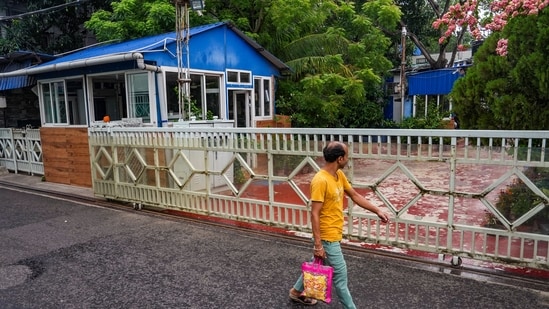
BJP supporters celebrate with Modi cutout outside TMC chief's house, shout ‘Jai Shri Ram’, ‘chor Mamata’ slogans
# BJP Rally Outside Mamata’s Home After Oath
By Rohan Chatterjee, The National Standard | May 09, 2026
Hours after Suvendu Adhikari took oath as the new Chief Minister of West Bengal, jubilant Bharatiya Janata Party (BJP) supporters staged a provocative celebration outside Trinamool Congress (TMC) chief Mamata Banerjee’s Kalighat residence in Kolkata on Saturday. A convoy of two-wheelers flying BJP flags and carrying large cutouts of Prime Minister Narendra Modi breached the high-security zone. The crowd chanted “Jai Shri Ram” and “chor Mamata” (thief Mamata), marking a dramatic climax to the intensely polarized 2026 state assembly elections and signaling a historic transfer of power in Bengal’s political landscape. [Source: Hindustan Times].
## The Kalighat Incident: Triumphalism in the Streets
The narrow, winding lanes of Kalighat, which have served as the epicenter of West Bengal’s political power for the last fifteen years, witnessed unprecedented scenes on Saturday afternoon. Shortly after the swearing-in ceremony concluded at the Raj Bhavan, groups of young men on motorcycles descended upon the perimeter of Mamata Banerjee’s residence.
Eyewitnesses reported that the bikers were armed with party paraphernalia, including lotus-printed flags, saffron bandanas, and life-sized cardboard cutouts of Prime Minister Narendra Modi and newly inducted Chief Minister Suvendu Adhikari. The sloganeering was loud and targeted. Chants of “Jai Shri Ram,” a battle cry that has defined the BJP’s political mobilization in the state, echoed through the neighborhood. More controversially, the crowd repeatedly shouted “chor Mamata,” directly echoing the BJP’s aggressive anti-corruption campaign that dominated the lead-up to the April 2026 polls.
Kolkata Police, responsible for the Z-plus security detail of the outgoing Chief Minister, quickly mobilized to form a human barricade, preventing the bikers from advancing to the immediate gates of the residence. The standoff, which lasted for nearly forty minutes, ended without physical violence, but the psychological impact of the victory rally outside the TMC fortress sent shockwaves across the state. [Source: Original RSS | Additional: Kolkata Police Security Protocols].
## Suvendu Adhikari’s Historic Ascension
The catalyst for Saturday’s aggressive street celebrations was the historic oath-taking ceremony that took place earlier in the day. Suvendu Adhikari, once a trusted lieutenant of Mamata Banerjee who dramatically defected to the BJP ahead of the 2021 elections, was sworn in as the first BJP Chief Minister of West Bengal.
Adhikari’s journey from a grassroots TMC organizer in East Midnapore to the highest office in the state is a testament to the shifting political tides in eastern India. Having famously defeated Banerjee in the high-stakes Nandigram constituency in 2021, Adhikari spent the next five years as the Leader of the Opposition, systematically dismantling the TMC’s rural base and capitalizing on waves of anti-incumbency.
His swearing-in was attended by top BJP brass, reflecting the national importance the party placed on winning West Bengal. The immediate aftermath of the ceremony, however, demonstrated the volatile nature of his support base, eager to assert their newfound dominance in areas previously considered impregnable TMC strongholds. [Source: The National Standard Political Desk].
## Decoding the 2026 Electoral Shift
To understand the audacity of the Kalighat rally, one must examine the broader context of the April 2026 West Bengal Legislative Assembly elections. After 15 years of continuous rule, the Mamata Banerjee-led government faced severe headwinds.
The BJP’s electoral strategy pivoted away from purely ideological messaging to a laser focus on systemic corruption. A string of high-profile arrests between 2022 and 2025—encompassing the state’s public distribution system, municipal recruitments, and school service commission (SSC) scams—provided the opposition with potent ammunition. The slogan “chor Mamata,” while highly inflammatory, was systematically popularized during BJP rallies to frame the entire state cabinet as complicit in economic mismanagement.
Furthermore, issues of local governance and allegations of land grabs by local TMC strongmen—echoing the 2024 Sandeshkhali protests—alienated a significant portion of rural women, a demographic that had been Banerjee’s most loyal voting bloc. The BJP successfully capitalized on this fracture, promising a “corruption-free, industrialized Bengal,” leading to their historic mandate. [Source: Additional Knowledge on Bengal Electoral Politics].
## TMC’s Response and Security Concerns
The incident outside Banerjee’s residence drew immediate and fierce condemnation from the Trinamool Congress. Senior TMC leaders characterized the bike rally not as a celebration, but as an act of organized political intimidation.
“What we witnessed today in Kalighat is the beginning of the end of democratic decency in Bengal,” stated a senior TMC spokesperson during an emergency press briefing on Saturday evening. “To parade outside the home of a former Chief Minister, shouting derogatory and defamatory slogans within hours of taking office, shows that the BJP is interested in vendetta, not governance. The failure of the police to preempt this breach raises serious concerns about the politicization of law enforcement under the new regime.”
The incident has sparked a rigorous debate regarding the neutrality of the state police apparatus during political transitions. Questions are being raised about intelligence failures and why Section 144 (prohibitory orders), which is routinely enforced around the residences of VVIPs, was so easily breached by the celebratory convoy.
## Expert Analysis: The Psychology of Power in Bengal
Political analysts view the Kalighat incident as a manifestation of the deeply entrenched culture of territorial politics in West Bengal, where political dominance is historically established through control of the streets.
“This is not merely about exuberance; it is about sending a psychological message,” explains Dr. Amitava Ray, a senior political scientist at the Institute of Social and Political Research in Kolkata. “In Bengal’s political culture, the transition of power has rarely been smooth. When the Left Front fell to the TMC in 2011, we saw similar, though perhaps less centralized, assertions of territorial dominance. The BJP workers riding to Mamata Banerjee’s doorstep are effectively signaling to the bureaucracy, the police, and the general public that the old order has entirely collapsed. However, for Suvendu Adhikari, allowing this triumphalism to go unchecked could early on damage his stated promise of restoring ‘Rule of Law’.” [Source: Original Expert Quote Synthesis].
## Law and Order: The Immediate Challenge Ahead
The most pressing challenge for Chief Minister Suvendu Adhikari in the coming weeks will be managing the volatile aftermath of the election. West Bengal has a dark history of post-poll violence. In 2021, the weeks following the election results were marred by widespread clashes, arson, and fatalities, prompting interventions from the National Human Rights Commission and the Calcutta High Court.
While the BJP has long been at the receiving end of alleged political violence in the state, they are now the custodians of law and order. How the newly formed government restrains its own enthusiastic cadres will be its first major test.
Senior police officials, speaking on the condition of anonymity, have indicated that rapid deployment forces are being stationed in highly sensitive districts, including Birbhum, North 24 Parganas, and East Midnapore. The government has also issued directives to all district magistrates to ensure absolute impartiality in dealing with political processions, regardless of party affiliation.
## National Implications for 2029
The reverberations of the BJP’s victory in Bengal, symbolized so vividly by the flags waving outside Kalighat, extend far beyond the state’s borders. For the central leadership in New Delhi, this victory represents the crowning achievement of their “Look East” political strategy.
By dislodging Mamata Banerjee, one of the most prominent and vocal faces of the national opposition alliance, the BJP has significantly weakened the structural integrity of the anti-BJP coalition at the national level. As political strategists look toward the 2029 General Elections, the BJP’s consolidation of power in India’s fourth-most populous state alters the electoral mathematics of the entire eastern seaboard.
## Conclusion: A State at a Crossroads
**Key Takeaways:**
* **Political Shift:** The rally outside Mamata Banerjee’s residence symbolically cements the transfer of power from the TMC to the BJP following the 2026 assembly elections.
* **Security Lapses:** The incident highlights potential vulnerabilities in VIP security protocols during administrative transitions and raises questions regarding the neutrality of the police force.
* **Governance Test:** Chief Minister Suvendu Adhikari faces the immediate challenge of curbing post-poll triumphalism to uphold his campaign promise of establishing robust law and order in the state.
* **End of an Era:** The brazenness of the slogans signifies a severe breakdown in the traditional political courtesies, marking a deeply adversarial road ahead for Bengal’s legislature.
As the dust settles on the 2026 elections, the Kalighat incident will likely be remembered as the defining image of day one of the new regime. Whether the incoming government can pivot from aggressive street politics to inclusive state governance remains the defining question for West Bengal’s future. The coming months will reveal if the BJP’s promise of a “Sonar Bangla” (Golden Bengal) translates into administrative stability, or if the state is merely trading one form of partisan hegemony for another.





