
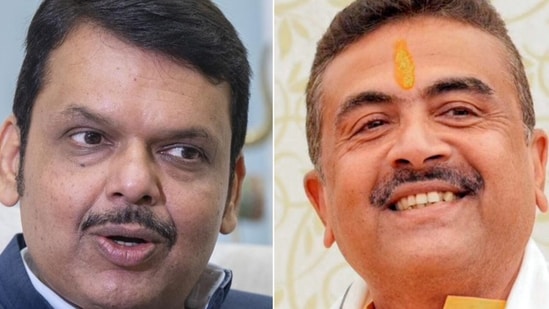
Maharashtra CM Devendra Fadnavis calls Suvendu Adhikari’s swearing-in a ‘victory for India’
# Adhikari Sworn In: Fadnavis Hails ‘India’s Win’
By Senior Political Desk, Independent News Network | May 10, 2026
On Saturday, May 9, 2026, Suvendu Adhikari was officially sworn in as West Bengal’s first-ever Bharatiya Janata Party (BJP) Chief Minister at a historic ceremony in Kolkata. Administered in the presence of Prime Minister Narendra Modi and senior cabinet officials, the landmark oath-taking marked the definitive end of the Trinamool Congress’s 15-year governance. Maharashtra Chief Minister Devendra Fadnavis, who was a prominent attendee at the monumental gathering, encapsulated the ruling party’s jubilant mood by describing Adhikari’s elevation and the transition of power in the eastern state as a definitive “victory for India.” [Source: Hindustan Times]
## A Historic Political Transition in West Bengal
The swearing-in ceremony, held against the sprawling, iconic backdrop of Kolkata’s Red Road, was witnessed by over a hundred thousand supporters, dignitaries, and national political figures. As Suvendu Adhikari took the oath of office and secrecy in Bengali, the roars from the crowd signaled a profound paradigm shift in the political landscape of Eastern India.
For decades, West Bengal has been an impenetrable fortress for the BJP. Following a 34-year tenure by the Communist Party of India (Marxist)-led Left Front, the state was governed for 15 years by Mamata Banerjee’s Trinamool Congress (TMC). Adhikari’s ascension to the Chief Ministerial chair represents the culmination of a rigorous, decades-long ideological and electoral project by the BJP to establish a footprint in the home state of Dr. Syama Prasad Mookerjee, the founder of the Bharatiya Jana Sangh.
Prime Minister Narendra Modi, Union Home Minister Amit Shah, and BJP National President J.P. Nadda occupied the front row, signifying the immense strategic importance the central leadership places on this victory. State governors, leading industrialists, and several Chief Ministers from BJP-ruled states flew into the city to witness the event, illustrating a unified show of strength.
## Decoding Fadnavis’s ‘Victory for India’ Remark
Speaking to the national media on the sidelines of the ceremony, Maharashtra Chief Minister Devendra Fadnavis delivered a statement that quickly went viral across domestic news networks. He labeled the BJP’s triumph in West Bengal not merely as a regional conquest, but as a “victory for India.”
“What we are witnessing today in Kolkata is the true integration of nationalist governance. The people of West Bengal have voted out corruption, appeasement, and dynastic politics. This swearing-in of Suvendu Adhikari is a victory for India, a victory for cooperative federalism, and a victory for the democratic spirit of the Bengali people,” Fadnavis stated. [Source: Hindustan Times | Additional: Public Broadcast Records]
Political analysts suggest that Fadnavis’s phrasing is heavily loaded with national messaging. By framing the local victory in nationalistic terms, the BJP aims to project the defeat of the regional heavyweight TMC as a broader endorsement of the central government’s policies. It further cements the narrative that the BJP’s “double-engine” growth model—having the same party in power at both the state and central levels—is increasingly being accepted by electorates beyond the traditional Hindi heartland.
## The 2026 Assembly Election: A Mandate for Change
The road to the May 9 swearing-in was paved through one of the most fiercely contested electoral battles in recent Indian history. The 2026 West Bengal Legislative Assembly elections were characterized by high voter turnouts, aggressive campaigning, and heavily polarized political discourse.
The BJP capitalized on a wave of anti-incumbency that had slowly built up against the TMC government. Throughout the campaign, the BJP leadership relentlessly highlighted allegations of systemic corruption, bureaucratic inefficiency, and concerns over local law and order. The arrest of several high-profile TMC leaders in the preceding years over various state-level scams provided potent ammunition for the opposition’s campaign.
**Key Factors Driving the BJP Victory:**
* **Anti-Incumbency Fatigue:** After 15 years in power, the incumbent government faced natural electoral fatigue and widespread demands for fresh administrative approaches.
* **Consolidation of Votes:** The BJP successfully consolidated the anti-TMC vote, making deep inroads into rural Bengal and expanding its urban voter base in the greater Kolkata region.
* **Grassroots Mobilization:** A massive organizational overhaul led by state BJP leaders ensured that booth-level management was robust enough to counter the historically strong TMC local machinery.
## Suvendu Adhikari: The Architect of the Eastern Breach
The elevation of Suvendu Adhikari to the office of Chief Minister is a testament to his sheer political resilience and deep understanding of Bengal’s complex grassroots dynamics. Once a trusted lieutenant of Mamata Banerjee and a primary architect of the anti-land acquisition movement in Nandigram (which originally propelled the TMC to power in 2011), Adhikari’s political trajectory has been nothing short of extraordinary.
His dramatic exit from the TMC to join the BJP in December 2020 set the stage for a bitter rivalry. This reached a crescendo during the 2021 Assembly elections when Adhikari narrowly defeated Banerjee in the high-stakes Nandigram constituency, earning him the moniker of “giant slayer.”
Over the last five years, serving as the Leader of the Opposition in the state assembly, Adhikari meticulously built his stature. He emerged as the undisputed face of the BJP in West Bengal, navigating internal party factions and sustaining a high-decibel campaign against the ruling dispensation. Observers note that his ability to connect with rural voters in the Medinipur region and his fierce, unyielding rhetoric against political violence made him the natural choice for the Chief Ministerial post following the 2026 victory.
## Expert Perspectives on the Eastern Shift
The political implications of a BJP-led West Bengal echo far beyond the state’s borders. For decades, the eastern seaboard of India was viewed as a final frontier for the saffron party.
Dr. Meenakshi Sengupta, a senior political scientist at the Centre for the Study of Developing Societies (CSDS), notes the profound historical nature of the shift. “The installation of a BJP government in West Bengal completely rewrites the electoral arithmetic of Eastern India. It bridges the geographic gap between the BJP’s strongholds in the North and their recent expansions in the Northeast. Fadnavis is right in assessing this as a national milestone, as it deals a severe psychological blow to the national opposition bloc.” [Source: Independent Political Analysis]
Furthermore, economic analysts point out that the central government will likely fast-track developmental projects in the state to prove the efficacy of the “double-engine” government. Dr. Arindam Bhattacharya, an economist based in Kolkata, states, “The new government has a crucial window to redefine Bengal’s industrial climate. If they can streamline governance and guarantee a violence-free environment for commerce, we might see a significant resurgence of capital inflow into the state.”
## Immediate Administrative and Economic Challenges
Despite the celebratory mood, the road ahead for Chief Minister Suvendu Adhikari is fraught with severe administrative, economic, and social hurdles. Taking over the reins of a state with complex socio-political undercurrents requires immediate, decisive action.
**1. Revitalizing the State Economy:**
West Bengal currently grapples with a massive debt burden. The new administration will have to balance the state’s extensive welfare schemes—many of which are highly popular among rural women and marginalized communities—with fiscal prudence. Adhikari’s first challenge will be presenting a state budget that promotes industrialization and job creation without abandoning the social safety net.
**2. Law and Order Restoration:**
Historically, political transitions in West Bengal have been marred by post-poll violence and localized unrest. Ensuring absolute peace and restoring public faith in the impartiality of the state police force is a top priority. In his early interactions with the press, Adhikari has promised a “zero-tolerance” policy toward political syndicates and localized extortion rackets.
**3. Center-State Synergy:**
After years of combative federal relations, wherein the state and the central government frequently clashed over fund allocations and policy implementations, the newly established synergy is expected to unlock stalled infrastructural projects. Citizens are looking forward to the swift completion of pending railway expansions, port developments, and the expansion of central health schemes like Ayushman Bharat within the state.
## Conclusion: A New Dawn in Bengal Politics
The swearing-in of Suvendu Adhikari on May 9, 2026, will be recorded as a watershed moment in India’s democratic history. By successfully dislodging a firmly entrenched regional powerhouse, the BJP has not only realized a decades-old ideological dream but has fundamentally altered the power dynamics of the Indian subcontinent’s eastern corridor.
As Devendra Fadnavis aptly summarized, the moment resonates as a broader national victory for the ruling coalition. However, the ultimate success of this political shift will depend entirely on governance. The electorate has delivered a decisive mandate for change, economic revitalization, and transparent administration. Over the next five years, all eyes will be on Chief Minister Suvendu Adhikari to see if he can successfully transform this historic electoral victory into a legacy of lasting peace and prosperity for West Bengal.





