
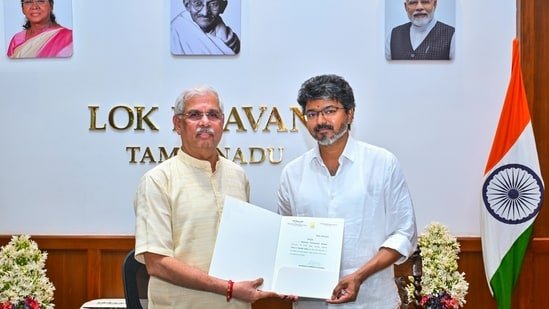
Aadhav Arjuna, 8 other TVK leaders sworn in as part of Vijay's Tamil Nadu cabinet. Full list
# TVK Cabinet Sworn In Before Trust Vote
By Political Correspondent, National News Desk, May 10, 2026
Actor-turned-politician Thalapathy Vijay’s Tamilaga Vettri Kazhagam (TVK) officially assumed executive power in Tamil Nadu on Sunday morning. During a high-profile ceremony at the Chennai Raj Bhavan, nine prominent TVK leaders—including chief strategist Aadhav Arjuna, political veteran K.A. Sengottaiyan, and rising star S. Keerthana—were sworn into the newly formed state cabinet. Following a fiercely contested 2026 Legislative Assembly election that fractured traditional Dravidian vote banks, Chief Minister Vijay now faces a critical constitutional mandate. He is expected to prove his legislative majority on the floor of the Assembly through a vote of confidence on or before May 13. [Source: Hindustan Times]
## A Strategic Mix of Youth and Experience
The composition of Vijay’s inaugural cabinet signals a highly calculated approach to governance, blending the disruptive energy of youth leaders with the seasoned acumen of traditional political heavyweights. The swearing-in of Aadhav Arjuna is particularly notable. A former basketball administrator and political strategist who made waves in the run-up to the 2026 elections, Arjuna is credited with engineering TVK’s grassroots mobilization strategy. His inclusion in the cabinet rewards his backroom maneuvering and signals TVK’s focus on youth welfare, sports development, and data-driven governance.
Conversely, the inclusion of K.A. Sengottaiyan represents a masterstroke in political pragmatism. A long-time stalwart of the All India Anna Dravida Munnetra Kazhagam (AIADMK) and a powerful voice in the western Kongu belt, Sengottaiyan’s recent shift to TVK provided Vijay with the crucial electoral momentum needed to dismantle the traditional bipolar dominance of the DMK and AIADMK. His presence in the cabinet assures bureaucrats and the rural electorate that the new government possesses the administrative experience necessary to run the complex machinery of the state.
## The Full List of Sworn-In Ministers
The Sunday morning ceremony saw Governor R.N. Ravi administer the oath of office and secrecy to the following nine legislators. While the official allocation of portfolios is expected to be gazetted later this evening, preliminary sources within the TVK leadership have outlined the likely responsibilities of the new ministers:
| Minister Name | Likely Portfolio Allocation | Political Background |
| :— | :— | :— |
| **Aadhav Arjuna** | Youth Welfare, Sports Development, and IT | Political strategist; key architect of TVK’s 2026 digital and youth campaign. |
| **K.A. Sengottaiyan** | Public Works Department (PWD) and Revenue | Veteran politician; former AIADMK heavyweight from the Kongu region. |
| **S. Keerthana** | Social Welfare and Women’s Empowerment | Prominent civil rights activist and head of TVK’s women’s wing. |
| **Bussy N. Anand** | Municipal Administration and Water Supply | TVK General Secretary; long-time trusted associate of Chief Minister Vijay. |
| **Dr. R. Mahendran** | Health and Family Welfare | Medical professional and former MNM vice-president who consolidated urban votes. |
| **Jagadish Palanisamy** | Finance and Planning | Chief Minister Vijay’s long-term manager; known for deep corporate sector ties. |
| **M. Velmurugan** | Agriculture and Farmers’ Welfare | Farmers’ union leader who rallied the Delta region behind the TVK platform. |
| **Dr. V. Prakash** | School and Higher Education | Academician focused on overhauling the state’s public education infrastructure. |
| **R. Meenakshi** | Transport and Highways | Former bureaucrat brought in to modernize Tamil Nadu’s transit networks. |
[Source: Hindustan Times | Additional Context: Tamil Nadu State Assembly Gazetted Records 2026]
## The Defection Factor: Decoding Sengottaiyan’s Shift
One of the most consequential narratives of the 2026 election cycle has been the fragmentation of the AIADMK, highlighted by K.A. Sengottaiyan’s high-profile defection to TVK. For decades, the Kongu Nadu region has served as an impenetrable fortress for the AIADMK. By successfully courting Sengottaiyan, Vijay achieved two critical objectives: he severely crippled the opposition’s geographical stronghold and brought instant institutional credibility to his nascent political outfit.
Sengottaiyan’s induction into the cabinet is a clear message to other fence-sitters in rival camps. It demonstrates that TVK is not merely a fan-club-turned-political-party, but a broad-based coalition willing to integrate experienced leaders who align with Vijay’s vision for a corruption-free, efficiently governed Tamil Nadu.
“Sengottaiyan’s presence in the TVK cabinet bridges the gap between cinematic charisma and ground-level administrative reality,” notes Dr. V. Arulselvan, a political science professor at the University of Madras. “Vijay has learned from the historical missteps of leaders like Vijayakanth and Kamal Haasan. He knows that to govern a state with a GDP equivalent to many small nations, star power must be supplemented by hardened political operators.”
## The May 13 Floor Test: Navigating the Numbers Game
While Sunday’s swearing-in ceremony was a moment of triumph for the TVK, the immediate hurdle remains the upcoming vote of confidence. The Hindustan Times confirmed that Vijay is mandated to prove his majority on the floor of the Assembly on or before May 13. The Tamil Nadu Legislative Assembly comprises 234 seats, requiring a simple majority of 118 seats to form a stable government.
Current electoral data indicates that the TVK, along with its pre-poll alliance partners, hovers perilously close to this magic number. The fractured mandate of 2026 saw the DMK coalition and the AIADMK bloc secure significant chunks of the electorate, making the role of independent MLAs and smaller regional parties crucial.
To clear the May 13 floor test smoothly, TVK’s floor managers—led by the newly sworn-in Aadhav Arjuna and Bussy Anand—are reportedly in intense negotiations. Political analysts anticipate that the TVK will easily secure the required numbers, potentially through strategic abstentions by opposition factions or last-minute outside support from unaligned regional blocs. The success of this floor test will dictate the stability of the state government and consumer confidence in the region’s massive industrial corridors.
## Policy Priorities: Economy, Welfare, and Anti-Corruption
Assuming TVK successfully clears the confidence vote next Wednesday, the real work begins. Vijay’s campaign was heavily predicated on the “Tamil Nadu 2.0” manifesto, which promised a radical departure from the Dravidian majoritarian politics of the past fifty years, focusing instead on hyper-localized economic development, strict anti-corruption measures, and digital transparency.
The inclusion of Jagadish Palanisamy, expected to handle the Finance portfolio, points toward a pro-business, reformist agenda. Palanisamy’s extensive connections with corporate India and international investors will be vital as Tamil Nadu seeks to maintain its status as India’s premier destination for foreign direct investment (FDI), particularly in the electric vehicle (EV), semiconductor, and renewable energy sectors.
Furthermore, S. Keerthana’s elevation signals a serious commitment to the social welfare schemes that have long defined the “Dravidian Model” of governance, but with a modern twist. Her mandate is expected to involve streamlining the delivery of state subsidies using blockchain and advanced biometric systems to eliminate leakages and middlemen, directly addressing the systemic corruption that Vijay’s campaign so fiercely criticized.
## Comparisons to Cinematic Predecessors
The swearing-in of a reigning cinema superstar as Chief Minister inevitably draws historical parallels. The ascent of M.G. Ramachandran (MGR) in the late 1970s in Tamil Nadu and N.T. Rama Rao (NTR) in Andhra Pradesh in the 1980s set the precedent for screen idols successfully transitioning to the highest executive office.
However, contemporary political analysts argue that Vijay’s path has been fundamentally different. “MGR and NTR rode massive waves of emotional populism in a pre-digital era,” explains senior political journalist Malini Parthasarathy. “Vijay is taking power in 2026, an era defined by social media scrutiny, highly aware young voters, and complex geopolitical economic pressures. His strategy reflects this reality. He didn’t just rely on his fan clubs; he built a technocratic core, as evidenced by his cabinet choices today.”
By surrounding himself with strategists like Aadhav Arjuna and administrators like Dr. R. Mahendran, Vijay is attempting to shield his administration from the criticisms that plagued previous actor-politicians, who were often accused of running personality cults rather than professional governments.
## Conclusion: The Road Ahead After May 13
As Tamil Nadu watches the dawn of a new political epoch, all eyes remain fixed on the Legislative Assembly. The May 13 vote of confidence will be the first true crucible for Thalapathy Vijay’s leadership. Will the carefully constructed coalition hold? Will the traditional Dravidian parties mount an aggressive counter-offensive?
For now, the induction of these nine diverse leaders into the TVK cabinet projects an image of confidence and readiness. By balancing the grassroots appeal of Bussy Anand, the strategic youth outreach of Aadhav Arjuna, and the veteran stability of K.A. Sengottaiyan, Vijay has laid a sturdy foundation.
If the new administration can smoothly navigate the impending floor test, it will set the stage for a dramatic restructuring of Tamil Nadu’s political landscape—one where policy, technology, and modern governance replace the entrenched paradigms of the past half-century. The TVK government’s ability to transition from electoral promises to tangible administrative success will dictate the state’s trajectory for the next five years.





