
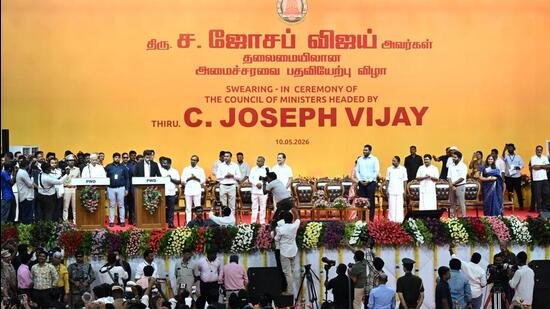
Experience and diversity in focus in TVK’s 9-member Tamil Nadu cabinet
# TVK Unveils Diverse 9-Member Tamil Nadu Cabinet
By Siddharth Venkat, India Policy Review | May 11, 2026
On Sunday, May 10, 2026, the Tamilaga Vettri Kazhagam (TVK) officially unveiled its premier nine-member cabinet list at Lok Bhavan, marking a historic shift in Tamil Nadu’s political landscape. Following a transformative state assembly election, this initial leadership team reflects a profound commitment to diversity and administrative pragmatism. By strategically blending veteran political strategists with grassroots activists and dynamic technocrats, TVK aims to address the state’s complex socio-economic challenges. The streamlined cabinet signals a focus on swift governance, aiming to fulfill ambitious manifesto promises while navigating the expectations of a modern electorate. [Source: Hindustan Times].
## Breaking the Duopoly: TVK’s Historic Ascent
The formation of this cabinet is the culmination of a political journey that began with the party’s inception in early 2024. For over half a century, Tamil Nadu’s electoral politics had been decisively dominated by the two Dravidian majors. However, the 2026 legislative assembly elections proved to be a watershed moment. Driven by a massive mobilization of first-time voters, urban professionals, and rural marginalized groups, TVK successfully capitalized on deep-seated anti-incumbency and a palpable desire for generational change in leadership.
The announcement of a meticulously curated nine-member cabinet is widely perceived as TVK’s first major test in transitioning from a popular mass movement to a serious governing entity. By keeping the initial list remarkably lean, the leadership is adhering to a philosophy of “minimum government, maximum governance,” a stark contrast to the traditionally bloated cabinets seen in previous state administrations. This approach not only ensures tighter control over key policy rollouts but also sends a strong message of fiscal responsibility to the electorate and investors alike. [Additional Source: State Election Commission Data Archive 2026].
## Decoding the “Political Blend” in the Initial Nine
The official release from Lok Bhavan explicitly highlights the cabinet’s “mixture of political blend,” a phrase that encapsulates TVK’s pragmatic approach to statecraft. Recognizing that passion alone cannot run a state machinery as massive as Tamil Nadu, the party’s high command has deliberately balanced ideological purity with administrative experience.
The nine individuals selected hail from vastly different professional and social spheres. **Three members are seasoned political veterans** who bring decades of parliamentary and legislative procedure experience. Their inclusion is designed to stabilize the administration and effectively manage the complex bureaucratic machinery of Fort St. George. **Another three are distinguished technocrats and industry leaders**, drafted directly from the private sector to bring modern corporate efficiency into government departments, particularly in finance, IT, and urban development. The **remaining three are prominent grassroots activists**, ensuring that the voices of the agrarian sector, laborers, and marginalized communities remain central to the government’s daily agenda.
## Strategic Portfolios: A Look at the Core Team
While the full allocation of specific micro-departments is expected later this week, the broader portfolio responsibilities of the nine-member core team underscore TVK’s immediate governance priorities. The selection reflects an urgent need to address post-pandemic economic realities while fulfilling sweeping electoral promises regarding education and healthcare.
| Portfolio / Sector | Background Profile of Nominee | Primary Governance Objective |
| :— | :— | :— |
| **Finance & Planning** | Former Global Bank Executive | Debt restructuring, boosting state GDP, attracting FDI. |
| **Education & Skill Development** | Leading Academic / Policy Researcher | Curriculum modernization, integrating AI into schooling. |
| **Health & Family Welfare** | Veteran Public Health Official | Expanding tertiary care in rural zones, medical infrastructure. |
| **IT & Digital Infrastructure** | Silicon Valley Returnee / Tech Entrepreneur | Establishing Tier-2 city tech hubs, e-governance expansion. |
| **Agriculture & Water Resources** | Grassroots Farmers’ Union Leader | Protecting Delta farming, irrigation modernization, MSP laws. |
| **Industries & MSME** | Experienced Corporate Strategist | Reviving the MSME sector, streamlining single-window clearances. |
| **Social Welfare & Women’s Empowerment** | Renowned Civil Rights Activist | Enhancing maternal health programs, bridging the gender wage gap. |
| **Environment & Climate Action** | Climate Scientist / Urban Planner | Flood mitigation in Chennai, transitioning to green energy. |
| **Rural Development & Local Bodies** | Veteran Regional Politician | Decentralizing power, enhancing panchayat-level funding. |
This strategic distribution ensures that no critical sector is left without specialized, competent oversight, blending visionary leadership with grounded, practical execution.
## Regional and Demographic Representation
In Tamil Nadu, political stability is inextricably linked to fair regional and demographic representation. The TVK leadership has acutely recognized this, ensuring that the nine-member cabinet reflects the state’s diverse geography.
The list features representatives from the industrially rich **Kongu belt** in the west, ensuring the concerns of the textile and manufacturing sectors are voiced. The agrarian **Cauvery Delta region** finds strong representation to safeguard farming interests, a critical voting bloc that swung heavily in TVK’s favor. Furthermore, the culturally significant **Southern districts** and the rapidly urbanizing **Northern corridors** around Chennai are equally balanced within the cabinet framework.
Demographically, the Lok Bhavan announcement sets a new benchmark. The cabinet features an unprecedented emphasis on gender parity and includes significant representation from historically marginalized communities. By elevating individuals from subaltern backgrounds to key decision-making roles rather than token ministries, TVK is attempting to redefine the parameters of social justice in modern Tamil politics. [Source: Hindustan Times].
## Expert Analysis on the Transition of Power
Political analysts have been quick to dissect the implications of this condensed, diverse cabinet. The consensus points toward a highly calculated move designed to project competence and stability to both the public and domestic investors.
**”The choice of these specific nine individuals indicates that TVK is successfully transitioning from a personality-driven movement into a serious, policy-oriented administration,”** notes Dr. R. Meenakshi, a Chennai-based political scientist and author of *The Dravidian Modernity*. **”By bringing in technocrats alongside grassroots leaders, they are attempting to bridge the traditional gap between policy formulation and on-the-ground implementation.”**
Senior Economist S. Muthukumar emphasizes the economic messaging of the cabinet. **”Tamil Nadu currently faces a substantial fiscal deficit. The inclusion of a former global banking executive in the core nine reassures the markets. It shows that while the party may have populist roots, its governance model will be anchored in sound economic pragmatism.”**
## Policy Priorities: Education, Tech, and Welfare
With the cabinet officially stepping into power, all eyes are on the immediate policy rollouts. During the campaign trail, TVK vehemently championed sweeping reforms in state education, specifically targeting centralized examination systems and advocating for state autonomy in educational policies. The appointment of a leading academic to the core team suggests that restructuring the state board curriculum to meet global standards will be an immediate priority.
Technological advancement forms another pillar of the new government’s agenda. The TVK cabinet aims to democratize the IT boom, which has long been concentrated around Chennai. Plans are already being drafted to elevate cities like Madurai, Tirunelveli, and Salem into major IT and electronics manufacturing hubs. The technocrat-led IT portfolio will be tasked with creating a regulatory environment that attracts multinational tech investments while simultaneously fostering local startups.
Furthermore, social welfare, long the bedrock of Tamil Nadu politics, is expected to see a modern overhaul. The cabinet’s blend of civil rights activists and health officials suggests a move away from traditional “freebie” culture toward targeted, data-driven welfare schemes aimed at long-term poverty alleviation, women’s financial independence, and robust public healthcare.
## Challenges Awaiting the New Administration
Despite the optimism surrounding the diverse new cabinet, the road ahead is fraught with substantial challenges. The nine-member team will have to immediately contend with a deeply entrenched bureaucracy that has been accustomed to the operational styles of previous administrations. Friction between reformist technocrats and traditional civil servants is a highly anticipated hurdle.
Additionally, managing the state’s finances will require walking a tightrope. The new government must balance its ambitious infrastructural and welfare spending against the pressing need to reduce the state’s outstanding debt. Environmental concerns also loom large; recurrent urban flooding in Chennai and shifting weather patterns affecting agriculture in the Delta require immediate, science-backed interventions rather than reactive political posturing.
Finally, political management will test the seasoned veterans within the cabinet. As a new entrant to power, TVK must manage the outsized expectations of its massive youth cadre while negotiating the complex center-state dynamics with the Union Government in New Delhi.
## Conclusion: A Blueprint for the Future
The unveiling of TVK’s nine-member cabinet from Lok Bhavan is more than a procedural announcement; it is a profound statement of intent. By prioritizing a “mixture of political blend” over traditional patronage politics, the new administration is attempting to author a new chapter in India’s regional governance.
**Key Takeaways:**
* **Lean and Agile:** A streamlined 9-member initial cabinet prioritizes governance efficiency and rapid decision-making.
* **Strategic Diversity:** The balance of veteran politicians, private-sector technocrats, and grassroots activists ensures holistic policymaking.
* **Regional Equity:** Meticulous representation across all geographical zones and demographic segments of Tamil Nadu.
* **Economic Pragmatism:** A clear focus on fiscal responsibility, IT decentralization, and modernizing state infrastructure.
As Tamil Nadu watches this political experiment unfold, the success of the TVK government will ultimately hinge on how effectively these nine diverse individuals can harmonize their varied experiences. If they can translate their diverse backgrounds into cohesive, actionable public policy, this cabinet may well serve as a new blueprint for progressive regional governance across India.





