
In Cong support for Vijay in TN, an AAP echo from Delhi and a ’90s redux: How the party backs own replacements
# Congress Backs TVK in TN: A Familiar Gamble
**By Senior Political Correspondent, The National Desk**
**May 11, 2026**
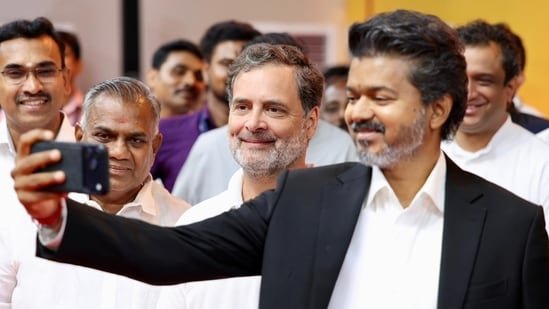
In a seismic shift following the fiercely contested Tamil Nadu state assembly elections in May 2026, the Indian National Congress has agreed to a strategic coalition with actor-turned-politician Vijay’s Tamilaga Vettri Kazhagam (TVK). While this alignment ensures that the Congress remains a stakeholder in the state’s ruling coalition, political analysts and historians view the move as a double-edged sword. By propping up a rising regional force to counter traditional Dravidian heavyweights—the DMK and AIADMK—the Grand Old Party is repeating a historically perilous pattern. From inadvertently launching the Aam Aadmi Party (AAP) in Delhi to fueling regional satraps in the 1990s Hindi heartland, the Congress has repeatedly fostered its own replacements for the sake of short-term political survival.
### The 2026 Realignment in Tamil Nadu
The political landscape of Tamil Nadu witnessed an unprecedented upheaval this May. Vijay’s TVK, which was launched in 2024 and built a massive grassroots infrastructure over two years, managed to fracture the entrenched Dravidian duopoly. Capitalizing on massive anti-incumbency, generational shifts, and the charisma of its founder, TVK emerged as a formidable block. The Congress, previously a junior partner in the DMK-led Secular Progressive Alliance, tactically shifted its allegiance to back TVK’s claim to power.
For the Congress, the immediate electoral calculus is clear: by aligning with the victorious upstart, the party retains ministerial berths and access to state power, which is critical for its resource mobilization ahead of future national contests. Furthermore, the alliance is packaged as a necessary step to keep the Bharatiya Janata Party (BJP) from filling the opposition vacuum in the southern state.
[Source: Hindustan Times | Additional: Election Commission of India May 2026 Reports]
However, beneath the surface of this immediate victory lies a structural vulnerability. Congress has not led a government in Tamil Nadu since the era of K. Kamaraj ended in 1967. For nearly six decades, it has survived by riding the coattails of either the DMK or the AIADMK. By now shifting its weight to a nascent party like TVK, the Congress is essentially handing over the anti-establishment and youth vote—demographics it desperately needs to rebuild its own base—to a new regional powerhouse.
### The Delhi Echo: The AAP Phenomenon
To understand the long-term risk of the Congress-TVK alliance, one must look back to the political earthquake of Delhi in 2013. Following widespread anti-corruption protests, Arvind Kejriwal launched the Aam Aadmi Party, directly challenging the three-term Congress government led by Sheila Dikshit.
When the 2013 Delhi assembly elections resulted in a hung assembly, AAP secured 28 seats, while the Congress was reduced to a mere eight. In a bid to keep the BJP (which had won 31 seats) out of power, the Congress high command made the fateful decision to offer “outside support” to AAP, allowing Kejriwal to form his first government.
“The tactical blunder of 2013 was that Congress legitimized its primary challenger,” explains Dr. Neerja Rao, a Delhi-based political historian. “By backing AAP, the Congress signaled to its own voters—particularly the urban poor, minorities, and the working class—that AAP was a viable, secular alternative. The voters made the shift permanent.”
When fresh elections were held in Delhi in 2015, AAP won a historic 67 out of 70 seats. The Congress vote share collapsed from 24.5% in 2013 to just 9.7%, securing zero seats. AAP subsequently replicated this model in Punjab, entirely replacing the Congress as the primary pole of power. The ghost of Delhi now looms over Chennai: by validating TVK as a ruling entity, Congress risks permanently transferring its residual Tamil Nadu vote bank to Vijay’s outfit.
### A 1990s Redux: Surrendering the Hindi Heartland
The pattern of the Grand Old Party cannibalizing its own future for present-day relevance dates back even further to the turbulent 1990s. Following the implementation of the Mandal Commission report and the rise of the Ram Janmabhoomi movement, the political dynamics of Uttar Pradesh and Bihar were fundamentally altered.
Faced with a surging BJP, the Congress adopted a defensive strategy. Instead of rebuilding its grassroots organization to accommodate the rising aspirations of Other Backward Classes (OBCs) and Dalits, the party chose to outsource its political battles to regional chieftains. In Uttar Pradesh, the Congress repeatedly propped up Mulayam Singh Yadav’s Samajwadi Party (SP) and Mayawati’s Bahujan Samaj Party (BSP). In Bihar, it became a subordinate ally to Lalu Prasad Yadav’s Rashtriya Janata Dal (RJD).
[Source: Hindustan Times | Additional: Historical Political Archives]
The short-term goal was achieved: secular coalitions were formed, and the BJP was periodically kept out of power. However, the long-term cost was catastrophic. The Congress’s traditional umbrella coalition—comprising Brahmins, Dalits, and Muslims—realized that the regional parties were the true anchors of power. Why vote for the proxy when you can vote for the principal? Consequently, the Congress was relegated to the margins in India’s two most populous states, a position from which it has never recovered.
By aligning with TVK in Tamil Nadu, Congress is employing the same defensive playbook. The party is prioritizing the immediate formation of a “secular, anti-BJP, anti-incumbency” government over the arduous task of rebuilding the Tamil Nadu Congress Committee (TNCC) as an independent political force.
### The “Legitimization Trap” and Organizational Decay
Political scientists often refer to this phenomenon as the “legitimization trap.” When a national party with declining regional capital allies with a rising insurgent party, the national party hopes to absorb the insurgent’s momentum. In reality, the opposite occurs.
1. **Ideological Surrender:** TVK’s platform relies heavily on Tamil sub-nationalism, localized welfare economics, and anti-corruption rhetoric. By endorsing this, Congress subordinates its own national ideological framework to regional populism.
2. **Cadre Demoralization:** Congress workers on the ground, who have fought for decades against regional domination, find themselves subservient to newly minted TVK cadres. This often leads to mass defections, where ambitious mid-level Congress leaders jump ship to the rising regional star.
3. **Loss of Opposition Space:** In any democracy, the opposition space is highly contested. By joining the TVK government, Congress forfeits the opportunity to be the voice of the aggrieved citizen, leaving that critical space wide open for other actors, including the BJP or a resurgent AIADMK.
“Vijay’s entry into politics was framed entirely around dismantling the corrupt status quo,” notes Dr. R. Srinivasan, a senior fellow at the Chennai Centre for Policy Studies. “For the Congress, an establishment party par excellence, to ride Vijay’s coattails is an act of extreme desperation. They are validating a leader who essentially claims that all traditional parties, including Congress, have failed the people.”
### TVK’s Gain, Congress’s Existential Risk
For Vijay and the TVK, the alliance with the Congress is a masterstroke. It provides the relatively inexperienced party with national legitimacy, administrative expertise, and a buffer against potential friction with the central government. It also brings in the Congress’s legacy vote share—roughly 4% to 6% of loyalists in Tamil Nadu—which is highly concentrated among minority communities and in the state’s southern districts.
For the Congress, the benefits are strictly temporal. Yes, the party flag will fly on ministerial cars in Chennai. Yes, they will have a say in the state budget and resource allocation. But if history is any indicator, the TVK will use this term in office to consolidate its power, expand its welfare distribution networks, and permanently secure the voters that Congress brought to the table.
### Conclusion: A Pattern Unbroken
The Indian National Congress’s decision to back TVK in Tamil Nadu in May 2026 is an undeniable testament to the party’s pragmatism in a fragmented political era. Remaining in power, even as a junior partner to a political debutant, keeps the party financially and visibly active in a crucial southern state.
However, ignoring the historical precedents of Delhi, Uttar Pradesh, and Bihar requires a dangerous level of political myopia. By consistently outsourcing its ideological battles to regional upstarts, the Congress continues to act as an incubator for its own replacements. Until the Grand Old Party figures out how to rebuild its primary organization rather than renting out its legacy to the highest regional bidder, it risks watching the Tamil Nadu story end the exact same way the Delhi story did: with a decisive, self-inflicted fade into irrelevance.





