
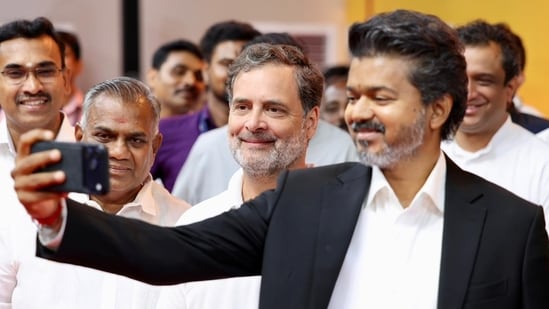
In Cong support for Vijay in TN, an AAP echo from Delhi and a ’90s redux: How the party backs own replacements
# Cong-TVK Alliance: Backing Own Replacements
In May 2026, the Indian National Congress formalized a critical coalition with actor Thalapathy Vijay’s Tamilaga Vettri Kazhagam (TVK) ahead of the pivotal Tamil Nadu Assembly elections. This strategic realignment ensures the Congress remains near the corridors of state power amidst shifting Dravidian dynamics. However, political analysts warn that the Grand Old Party is repeating a historic blunder. By acting as the national scaffolding for a surging regional populist, the Congress is echoing its past missteps—from Delhi’s Aam Aadmi Party to the heartland satraps of the 1990s—where it systematically backed local forces that ultimately cannibalized its own voter base. [Source: Hindustan Times].
## The Tamil Nadu Gambit: Survival Over Supremacy
The political landscape of Tamil Nadu underwent a seismic shift following the launch of the **Tamilaga Vettri Kazhagam (TVK)** by cinematic titan Vijay in early 2024. Building a grassroots network over two years, Vijay successfully transformed his massive fan clubs into a disciplined political machine. For the Congress, facing severe seat-sharing friction and growing anti-incumbency sentiments alongside its traditional ally, the Dravida Munnetra Kazhagam (DMK), the TVK presented a lucrative alternative.
By allying with the TVK, Congress secures an immediate lifeline. The partnership allows the national party to piggyback on Vijay’s astronomical appeal among first-time voters, rural demographics, and marginalized communities disillusioned with the traditional DMK-AIADMK binary. Congress brings national legitimacy, administrative experience, and a consolidated minority vote bank to the TVK’s raw populist surge.
Yet, this coalition is fraught with existential risk. Congress has effectively positioned itself as the junior partner to a nascent, hyper-regional force. While the alliance mathematically increases the chances of Congress maintaining its footprint in the Tamil Nadu legislative assembly, it effectively halts any organic growth for the national party’s state unit. [Source: Hindustan Times | Additional: Historical Election Data Analysis].
## The AAP Echo: Lessons Unlearned from Delhi
To understand the long-term peril of the Congress-TVK alliance, one must look back at the winter of 2013 in the national capital. After ruling Delhi comfortably for 15 years under Chief Minister Sheila Dikshit, the Congress faced a massive anti-corruption wave spearheaded by Arvind Kejriwal’s newly formed **Aam Aadmi Party (AAP)**.
When the 2013 assembly election threw up a hung verdict—with the BJP winning 31 seats, AAP winning 28, and Congress reduced to 8—the Congress high command made a fateful decision. To keep the ideological rival BJP out of power, Congress offered outside support to the AAP, allowing Kejriwal to form his first government.
The strategy backfired spectacularly. By validating the AAP’s anti-establishment credentials and providing them the stage of governance, Congress actively facilitated its own demise. AAP quickly co-opted the Congress’s core constituencies: the lower-income groups, the minorities, and the urban middle class. In the subsequent 2015 assembly elections, AAP secured a historic 67 out of 70 seats. The Congress vote share plummeted from 24.5% in 2013 to a dismal 9.7%, yielding zero seats—a baseline from which the party has never recovered in the capital.
By allying with Vijay’s TVK, a party that campaigns heavily on anti-corruption, youth empowerment, and welfarism—much like AAP did—Congress risks validating a force that appeals to the exact same progressive, secular demographic that the Grand Old Party needs for its own survival.
## A ’90s Redux: The Hindi Heartland Hollowing
The phenomenon of Congress outsourcing its political battles to regional leaders is not new; it is a structural reflex dating back to the post-Mandal era of the 1990s. In states like Uttar Pradesh and Bihar, the Congress faced the dual onslaught of the Ram Janmabhoomi movement (championed by the BJP) and the Mandal Commission agitations (championed by regional caste-based parties).
Instead of cultivating its own backward-class leadership to counter these shifts, Congress opted for the path of least resistance. In Uttar Pradesh, it entered tactical alliances with Mulayam Singh Yadav’s **Samajwadi Party (SP)** and Kanshi Ram’s **Bahujan Samaj Party (BSP)**. In Bihar, it became a subordinate ally to Lalu Prasad Yadav’s **Rashtriya Janata Dal (RJD)**.
The rationale at the time was identical to the current TVK strategy: consolidate the secular vote and prevent the BJP from taking power. However, the regional satraps utilized the Congress’s organizational decay to absorb its traditional vote banks. The Dalits shifted entirely to the BSP, the Muslims moved to the SP and RJD, and the upper castes migrated to the BJP.
“The Congress party’s tragedy is that it operates with a landlord mindset but lacks the underlying real estate,” explains Dr. R. V. Krishnan, a Chennai-based political sociologist. “In the 1990s, they outsourced the fight for social justice in the heartland to regional players. Those players didn’t just fight the battle; they kept the spoils. Today, Congress is outsourcing the anti-incumbency space in Tamil Nadu to TVK. History tells us that Vijay will consolidate that space, leaving Congress with nothing.” [Additional: Centre for Electoral Studies Data].
## Short-Term Gains vs. Long-Term Marginalization
Why does a 140-year-old national party continually fall into this trap? The answer lies in a combination of high-command centralization and a persistent drought of charismatic regional leadership within the Congress.
In states where the Congress has maintained strong local leaders—such as Karnataka under Siddaramaiah, or Telangana under Revanth Reddy—the party has successfully fought regional forces on its own terms. However, in states like Tamil Nadu, West Bengal, Uttar Pradesh, and Bihar, the Congress local units have been systematically hollowed out over decades, lacking the financial muscle and ground-level cadres to fight a standalone battle.
For the party’s central leadership in New Delhi, the immediate priority is always the Lok Sabha numbers. To maximize parliamentary seats, the Congress leadership frequently sacrifices state-level expansion, preferring to tie up with whoever dominates the regional assembly space.
By backing TVK in 2026, the Congress secures a guaranteed share of the Tamil Nadu pie—perhaps a handful of state ministries and a favorable seat-sharing arrangement for the 2029 general elections. But in doing so, it signals to the Tamil electorate that it is not a serious contender for governance, permanently cementing its status as an electoral appendage.
## Electoral Math: What the TVK Partnership Means
The mechanics of the 2026 Tamil Nadu elections reveal the immediate pragmatism behind this alliance. The ruling DMK, despite its formidable organizational strength, faces inevitable wear-and-tear after a full term. The principal opposition, AIADMK, remains factionalized, attempting to regain the monolithic stature it held under the late J. Jayalalithaa.
Enter Thalapathy Vijay. With TVK, he has positioned himself outside the traditional Dravidian fault lines, appealing directly to aspirational youth, disgruntled rural voters, and women—groups that traditionally swing elections in the state.
Congress brings a crucial 4-6% baseline vote share to this equation. While small, this margin is often the difference between victory and defeat in Tamil Nadu’s first-past-the-post system. By marrying Congress’s traditional minority support with TVK’s surging fan-base-turned-cadre, the alliance creates a formidable third pole that threatens to disrupt the DMK-AIADMK duopoly.
Yet, the long-term math is grim for the national party. “If the TVK-Congress alliance performs well, Vijay will be credited as the charismatic architect of the victory,” notes political strategist Ananya Deshmukh. “If they fail, Congress will be blamed for holding the alliance back due to its lack of ground cadre. It is a no-win scenario for Congress’s state-level revival.”
## Expert Perspectives on the Grand Old Party’s Strategy
Political observers remain sharply divided on whether this strategy is a necessary evil or a terminal miscalculation.
**Proponents of the alliance** argue that realpolitik dictates survival first. With the BJP aggressively pushing into Tamil Nadu through tactical social engineering and heavy campaigning, Congress cannot afford to fight on multiple fronts. Allying with TVK prevents the anti-DMK votes from consolidating behind the BJP or the AIADMK.
**Critics, however, point to the parasitic nature of such alliances.** Regional parties, by their very design, seek to monopolize their home states. Once TVK achieves critical mass, it will inevitably view the Congress as dead weight—just as Mamata Banerjee’s Trinamool Congress did in West Bengal, or K. Chandrashekar Rao’s BRS did in Telangana after Congress granted statehood.
“The tragedy of the Congress is its inability to incubate its own Vijays or Kejriwals,” says senior journalist Tariq Mansoor. “Instead of nurturing aggressive, mass-appeal leaders within their ranks, they rent them from the outside. You can rent a house for decades, but you will never own the equity.”
## Conclusion: A Stepping Stone to Oblivion?
As the 2026 Tamil Nadu assembly election approaches, the Congress-TVK alliance will undoubtedly generate massive electoral heat. Actor Vijay’s undeniable charisma, combined with the structural backing of a national party, creates a potent force on the ballot. For the Congress high command, this coalition is a sigh of relief, ensuring they remain relevant in the complex matrix of southern Indian politics.
However, beneath the surface of this pragmatic alliance lies a familiar, fatal flaw. By continually acting as the kingmaker for regional forces, the Congress has slowly abdicated its claim to the throne. Whether it is the AAP in Delhi, the SP in Uttar Pradesh, the RJD in Bihar, or now the TVK in Tamil Nadu, the pattern is unmistakable: the Grand Old Party possesses a tragic penchant for nurturing its own replacements. If history is any indicator, Thalapathy Vijay’s rise will not be the rebirth of the Congress in Tamil Nadu, but rather the final nail in its regional coffin.
***
By Special Correspondent, The India Policy Desk, May 10, 2026.





