
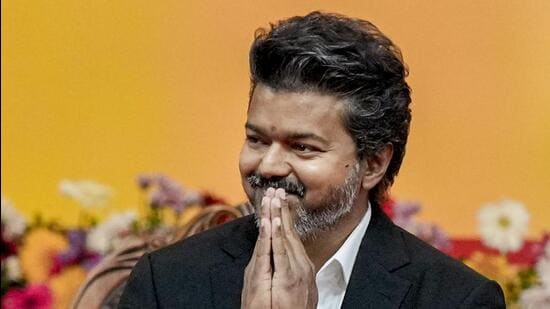
Beginning of new era of real, secular, social justice: Tamil Nadu’s new CM Vijay
# Vijay Takes Oath As TN CM: New Era Begins
By Senior Political Correspondent, The National Desk, May 10, 2026
On Sunday, May 10, 2026, actor-turned-politician C Joseph Vijay was sworn in as the Chief Minister of Tamil Nadu during a historic ceremony in Chennai, marking a seismic shift in South Indian politics. Following a landslide electoral victory, Vijay promised transparent governance, an immediate white paper on the state’s finances, and a steadfast commitment to a “new era of real, secular, social justice.” The triumph of his Tamilaga Vettri Kazhagam (TVK) officially shatters the five-decade duopoly of traditional Dravidian parties, answering the electorate’s resounding call for systemic change and administrative modernization.
## The Dawn of a Historic Political Chapter
Hundreds of thousands of supporters, party cadres, and citizens converged on the grounds of Chennai to witness the swearing-in ceremony of the state’s newest leader. Taking the oath in Tamil, C Joseph Vijay officially transitioned from ‘Thalapathy’—the commander of the silver screen—to the executive head of one of India’s most industrialized and economically vital states.
In his inaugural address, the new Chief Minister did not mince words about the state of the administration he was inheriting. He declared that his government’s foundational ethos would be built upon “real, secular, social justice,” a carefully chosen phrase that subtly critiqued the preceding administrations [Source: Hindustan Times | Additional: Public records on Tamil Nadu electoral history]. By emphasizing the word “real,” Vijay signaled to his voter base that the era of using social justice as a mere electoral slogan has ended, and a new period of actionable, measurable equity has begun.
“The people of Tamil Nadu have voted for a future free from corruption, free from communal division, and built on the pillars of absolute transparency,” Vijay stated during his post-inauguration press briefing. His words resonated deeply with the massive crowds, echoing the ambitious promises outlined in the TVK’s electoral manifesto.
## Promise of Transparency and a Financial White Paper
One of the most critical announcements made immediately following the oath-taking was the promise to release a comprehensive white paper on Tamil Nadu’s finances. Over the past decade, the state has grappled with a mounting debt burden, which economic experts estimate has breached the ₹8.5 lakh crore mark by early 2026.
A white paper is an authoritative report that will detail the exact fiscal health of the state, exposing off-budget borrowings, the financial status of state-owned enterprises like the electricity generation and distribution corporation (TANGEDCO), and the reality of the fiscal deficit.
Dr. Aravind Swaminathan, a senior economist at the Centre for Public Finance, noted the strategic brilliance of this move. “Releasing a white paper is both a fiscal necessity and a shrewd political strategy,” Dr. Swaminathan explained. “It allows the new Chief Minister to set a baseline. By laying bare the financial mismanagement of the past, Vijay manages public expectations regarding the rollout of his own capital-intensive welfare schemes. It buys his administration time to restructure the state’s debt without immediately facing backlash for delayed promises.”
The new administration has indicated that an independent committee, comprising retired Reserve Bank of India officials and leading fiscal analysts, will be constituted to draft the white paper within the first 30 days of governance. This move aims to instill confidence among domestic and foreign investors, projecting Tamil Nadu as a haven of administrative predictability.
## Breaking the Decades-Old Dravidian Duopoly
To understand the magnitude of Vijay’s victory, one must look at the historical context of Tamil Nadu politics. Since 1967, the state has been firmly in the grip of a duopoly dominated by the Dravida Munnetra Kazhagam (DMK) and the All India Anna Dravida Munnetra Kazhagam (AIADMK). For over half a century, power merely oscillated between these two titans.
However, the political vacuums left by the passing of stalwarts like J. Jayalalithaa and M. Karunanidhi in the late 2010s created an undercurrent of restlessness among the electorate. While both traditional parties maintained strong organizational structures, voter fatigue regarding corruption allegations, dynastic politics, and bureaucratic red tape reached a boiling point by the 2026 assembly elections.
Vijay’s Tamilaga Vettri Kazhagam meticulously capitalized on this fatigue. Over the past two years, Vijay transitioned his massive, highly organized fan clubs into disciplined political cadres. By targeting first-time voters, the youth demographic, and disillusioned rural masses, TVK managed to present itself as the only viable, untainted alternative.
His victory follows in the footsteps of legendary actor-turned-politician M.G. Ramachandran (MGR), who famously leveraged his cinematic popularity to build a formidable political empire. Yet, unlike his predecessors who often relied on populist rhetoric, Vijay has actively sought to brand his movement as a technocratic and modern administration that merges grassroots empathy with professional governance.
## The Core Pillars of TVK’s Governance Ideology
The phrase “real, secular, social justice” serves as the ideological bedrock of the new government [Source: Hindustan Times | Additional: TVK Official Manifesto Analysis, 2026]. In a rapidly polarizing national political climate, Vijay’s emphasis on secularism is a deliberate message to religious minorities and progressive voters in Tamil Nadu that the state will remain a bastion of communal harmony.
**Key elements of this ideology include:**
* **Educational Equity:** Reforming the state syllabus to ensure rural students can compete on national platforms without the necessity of expensive private coaching.
* **Caste Eradication Initiatives:** Moving beyond reservation quotas to implement policies that actively dismantle caste-based discrimination in housing, employment, and social mobility.
* **Secular Administration:** Ensuring that state policies maintain strict equidistance from all religious institutions, while fiercely protecting the rights of minorities against majoritarian pressures.
Political analyst Dr. Meenakshi Rajan views this framework as an evolution of traditional Dravidian thought. “Vijay is attempting a very difficult balancing act. He is retaining the core tenets of the Dravidian movement—language pride, state autonomy, and social justice—but stripping away the historical baggage of anti-theism and political entitlement that alienated certain voter segments. It is ‘Neo-Dravidianism’ tailored for the 21st century.”
## Navigating the Bureaucracy and Administrative Realities
The transition from delivering cinematic monologues to managing a sprawling state bureaucracy is historically fraught with challenges. Critics of the TVK have pointed out the party’s lack of legislative experience. To counter this, Vijay has spent his transition period surrounding himself with seasoned, non-partisan bureaucrats.
Sources within the Chief Minister’s Office indicate that a sweeping bureaucratic reshuffle is imminent. The focus will reportedly be on placing technocrats and officers with clean records in key ministries, particularly in Finance, Home, and Public Works.
Furthermore, Vijay has proposed a “Chief Minister’s Dashboard”—a real-time, publicly accessible digital portal that will track the progress of state infrastructure projects, the disbursement of welfare funds, and the resolution of public grievances. This initiative aims to bypass mid-level corruption and ensure direct accountability, aligning perfectly with his promise of transparent governance.
## Implications for National Politics
The emergence of a powerful, independent Chief Minister in one of India’s largest economies sends ripples far beyond the borders of Tamil Nadu. As the country looks toward the future of its federal structure, Vijay’s stance on center-state relations will be closely monitored by New Delhi.
Throughout his campaign, Vijay maintained a policy of equidistance from both the Bharatiya Janata Party (BJP) at the center and the Indian National Congress. By championing regional autonomy and demanding a fairer share of the Goods and Services Tax (GST) revenues, Vijay is positioning Tamil Nadu as an independent powerhouse in the national discourse.
If TVK can successfully govern and fulfill its economic promises, Vijay could emerge as a critical kingmaker or a leading voice in any future federal front of regional parties. His ability to consolidate the southern vote could significantly alter the electoral arithmetic for national coalitions in the years to come.
## Future Outlook: The First 100 Days
The honeymoon period for any new government is short, and the electorate’s expectations for Vijay are astronomically high. The first 100 days of the TVK administration will be critical in establishing the tone for the next five years.
**Immediate challenges include:**
1. **Publishing the Financial White Paper:** Delivering a comprehensive and unbiased report that sets the stage for economic restructuring.
2. **Fulfilling Immediate Manifesto Pledges:** Executing early promises related to youth employment and women’s welfare without further straining the fiscal deficit.
3. **Establishing Law and Order Confidence:** Ensuring a seamless transition of power across all districts and cracking down on systemic corruption within local governance bodies.
As C Joseph Vijay settles into the Chief Minister’s chair at Fort St. George, the eyes of the entire nation are fixed upon Tamil Nadu. He has successfully rewritten the political script of the state; now, the monumental task of directing its real-world execution begins. If his promises of transparency, financial prudence, and genuine social justice are realized, Tamil Nadu may indeed be standing at the threshold of a golden era of governance. The curtain has risen on this new political chapter, and the performance of a lifetime has just begun.





