
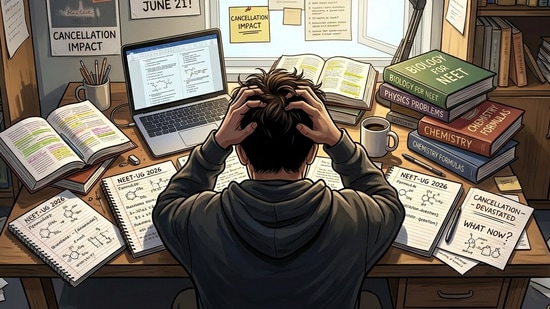
‘Emotionally shattered, under immense mental stress’: How NEET-UG paper leak took lives of these aspirants
# NEET-UG Paper Leak: Tragic Toll on Aspirants
By Staff Reporter, The National Education Desk, May 16, 2026
The abrupt cancellation of the National Eligibility cum Entrance Test (NEET-UG) in May 2026 has plunged India’s medical education system into an unprecedented crisis. Following widespread, verified allegations of a catastrophic paper leak, the annulment of the highly competitive exam has instantly impacted over **22 lakh candidates** nationwide. However, the fallout extends far beyond administrative chaos and delayed academic calendars; it has triggered a severe psychological emergency among the youth. Reports confirm that the immense mental stress and shattered dreams caused by this systemic failure have tragically claimed the lives of at least three aspirants. This devastating outcome highlights the urgent need to address the toxic pressure and systemic vulnerabilities within India’s high-stakes examination infrastructure. [Source: Hindustan Times | Additional: Public Education Records]
## The Weight of Scrapped Dreams
The NEET-UG is not merely an examination; for millions of Indian households, it is viewed as the ultimate equalizer—a singular, grueling gateway to a prestigious career in medicine and a ticket to upward socioeconomic mobility. In 2026, a record-breaking **2.2 million (22 lakh) students** registered for the test, vying for roughly 1.1 lakh medical seats across the country. The statistical improbability of success already subjects candidates to unimaginable pressure.
When the National Testing Agency (NTA) and the Union Education Ministry were forced to cancel the exam just days after its administration due to undeniable evidence of question paper leaks on encrypted messaging apps, the psychological floor fell out from under the student community. Years of nocturnal studying, rigorous coaching, and immense familial expectations were rendered meaningless in an instant.
Students who had relocated to competitive coaching hubs, far from their families, suddenly found themselves in an agonizing limbo. The cancellation meant that their sacrifices, and the financial investments of their parents, were suddenly paused indefinitely, pending a re-examination whose integrity many now deeply distrust. [Source: Hindustan Times]
## A Psychological Crisis Among the Youth
The psychological toll of the NEET-UG fiasco cannot be overstated. As the headline from the primary report poignantly stated, students have been left “emotionally shattered” and operating under “immense mental stress.” Tragically, this overwhelming despair culminated in the loss of three young lives, highlighting a public health emergency that intersects directly with the nation’s educational policies.
Medical professionals and adolescent psychologists have long warned about the pressure-cooker environment of competitive exams. The sudden cancellation acted as a catastrophic trigger for students already balancing on the edge of clinical burnout.
> “When a student prepares for an exam like NEET for two to three years, their entire identity becomes intertwined with their academic performance. A sudden cancellation due to systemic corruption induces a profound sense of betrayal and helplessness,” explains Dr. Ananya Sharma, a clinical psychologist specializing in adolescent academic stress. “They are not just mourning a delayed test; they are mourning the loss of fairness, hope, and their perceived future. This can easily lead to severe depressive episodes if immediate psychological first aid is not provided.” [Source: Additional Expert Analysis]
The tragic loss of life has prompted nationwide outrage, with student unions and parents demanding accountability not just for the compromised examination, but for the collateral damage inflicted on the mental well-being of the youth.
## Anatomy of the Paper Leak
Understanding the despair of the students requires examining the blatant compromises in the examination’s security protocol. Investigations into the 2026 leak revealed a sophisticated syndicate operating across multiple states. According to preliminary reports from investigative agencies, “solver gangs” managed to breach the security protocols at regional printing presses and distribution nodes.
Photographs of the question paper, complete with corresponding answer keys, were reportedly circulated on the dark web and private Telegram groups hours before the candidates entered the examination halls. Prices for these leaked papers allegedly ranged from ₹15 lakh to ₹30 lakh, a sum that explicitly favors wealthy candidates and deeply marginalizes students from lower-income backgrounds who rely strictly on merit.
When the government initially hesitated to acknowledge the full scale of the leak, student protests erupted in major cities including New Delhi, Patna, and Kota. The subsequent, unavoidable cancellation by the authorities was framed as a necessary step to protect the sanctity of the medical profession, but it provided little comfort to the honest students who had poured their lives into preparation.
## The Vicious Cycle of Coaching Culture and Financial Burden
To fully grasp why an exam cancellation can drive students to such desperate measures, one must look at the economics of the Indian coaching industry. The preparation for NEET-UG is highly commercialized. Parents frequently take out substantial educational loans, liquidate assets, or mortgage agricultural land to fund their children’s enrollment in elite coaching institutes.
These institutes, located in hyper-competitive cities, often charge upwards of ₹2 lakh to ₹3 lakh annually for tuition, excluding the cost of accommodation and living expenses. For a family from a rural background, a “drop year”—an additional year taken to study and retake the exam—is a monumental financial gamble.
> “The cancellation of NEET-UG is not just an academic delay; it is a financial catastrophe for the lower-middle class,” notes Dr. Vikram Sethi, an education policy analyst. “When an exam is voided, families are forced to fund another year of living expenses and coaching for their children. The guilt of imposing this ongoing financial burden on their parents is a massive contributing factor to the emotional shattering we are witnessing in these aspirants.” [Source: Additional Policy Analysis]
The tragedy of the three lost lives is a stark reminder that the pressure is not merely about securing a rank; it is about justifying the immense sacrifices made by the entire family unit.
## Systemic Failures and the Call for Urgent Reform
The 2026 crisis has severely damaged the credibility of the National Testing Agency. While the NTA was established to standardize and secure large-scale admissions testing, consecutive logistical failures and security breaches have sparked calls for a complete structural overhaul.
Experts and lawmakers are currently debating several stringent reforms to prevent a recurrence of such a tragedy:
* **Transition to Computer-Based Testing (CBT):** Many advocates are pushing for an immediate shift away from pen-and-paper OMR formats. While challenging to implement for 22 lakh students simultaneously, a multi-shift, normalized CBT model drastically reduces the physical touchpoints where a paper can be leaked.
* **Decentralization of Exams:** Some education boards are suggesting a return to state-level pre-medical tests (PMTs), arguing that a single national exam creates a high-value target for organized crime syndicates.
* **Stricter Anti-Leak Legislation:** Parliament is facing mounting pressure to pass draconian laws against paper-leak syndicates, including non-bailable warrants and the attachment of properties for anyone found guilty of compromising national exams.
* **Mandatory Psychological Support:** A major policy push is emerging to force coaching institutes to maintain a mandated ratio of certified psychological counselors to students, treating mental health infrastructure as a prerequisite for operating educational businesses.
## Support Systems and the Path Forward
In the wake of the suicides, the immediate priority for the government and civil society must be the psychological triage of the remaining 22 lakh candidates. The Ministry of Education and various state health departments have rapidly expanded 24/7 mental health helplines specifically dedicated to distressed students.
However, helplines are only a reactive measure. The broader solution requires a fundamental cultural shift in how Indian society values academic success versus human life. Parents, educators, and the media must collaborate to de-stigmatize failure and emphasize that no examination is worth the cost of a young life.
As the country awaits the announcement of the rescheduled NEET-UG dates, the focus must remain squarely on ensuring a transparent, foolproof re-examination. The government must rebuild trust, not just through statements, but through visible, ironclad logistical security.
## Conclusion: A Wake-Up Call for the Nation
The cancellation of the 2026 NEET-UG exam will go down in Indian educational history not just as a monumental administrative failure, but as a profound human tragedy. The immense mental stress that led to the loss of three young aspirants is a devastating indictment of a system that allowed corruption to flourish while leaving its most vulnerable stakeholders to bear the ultimate cost.
As over 22 lakh students tentatively return to their textbooks, emotionally shattered and weary, the onus is entirely on the state machinery to ensure that this dark chapter is never repeated. Restoring the sanctity of the medical entrance exam is paramount, but safeguarding the mental health and lives of the youth must be the ultimate, non-negotiable priority.





