
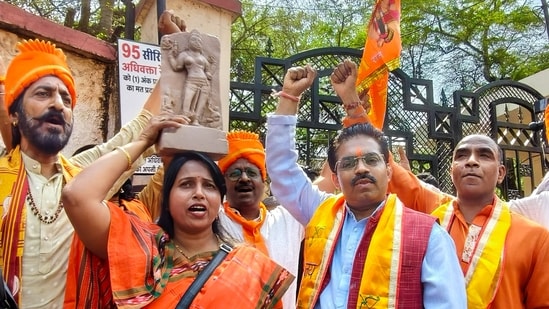
‘We will worship there’: Hindu side lawyer on next move after Bhojshala declared a temple
# Bhojshala Verdict: Hindus to Begin Worship
**By Special Legal Correspondent, National News Desk, May 16, 2026**
In a landmark legal development on Saturday, May 16, 2026, a judicial verdict declared the disputed Bhojshala-Kamal Maula Mosque complex in Madhya Pradesh’s Dhar district a Hindu temple. Following the highly anticipated ruling, advocate Vishnu Shankar Jain, representing the Hindu petitioners, announced that their immediate focus will shift to facilitating uninterrupted worship at the site. The decision marks a critical turning point in the decades-old dispute over the 11th-century Archaeological Survey of India (ASI) protected monument, prompting widespread reactions, heightened security protocols, and anticipated appeals in higher courts. [Source: Hindustan Times | Additional: Public Legal Records]
## The Verdict and Immediate Legal Strategy
The pronouncement regarding the Bhojshala complex has sent ripples through the socio-political landscape of the nation. Speaking to the press shortly after the verdict was delivered, advocate Vishnu Shankar Jain, a prominent face in several temple-mosque legal battles across the country, clarified the Hindu side’s immediate priorities.
“The court has validated our historical and archaeological claims based on robust evidence,” Jain stated. “Our immediate focus would be on carrying out regular, unrestricted worship at the site, restoring the fundamental rights of the devotees to pray to Vagdevi (Goddess Saraswati).” [Source: Hindustan Times]
Jain further elaborated that his legal team is already preparing to file caveats in the Supreme Court. This procedural move ensures that if the opposing parties seek an ex-parte stay on the current verdict, the apex court will not pass an order without first hearing the Hindu petitioners’ arguments.
## Historical Context: A Dual-Identity Monument
To understand the magnitude of this 2026 verdict, one must delve into the complex history of the structure located in Dhar, approximately 250 kilometers from the state capital, Bhopal.
Historically, Hindus revere the Bhojshala as a center of education and a temple dedicated to Goddess Saraswati, constructed during the reign of the Paramara dynasty king, Raja Bhoj (1010-1055 AD). Conversely, the Muslim community recognizes the site as the Kamal Maula Mosque, which they assert has served as a place of Islamic worship for centuries following its establishment in the medieval period. [Source: Additional historical archives / ASI records]
In April 2003, following periods of communal tension, the Archaeological Survey of India established a unique, albeit fragile, time-sharing arrangement to maintain public order. Under this framework:
* **Hindus** were permitted to perform puja on Tuesdays.
* **Muslims** were allowed to offer Namaz on Fridays.
* **Vasant Panchami:** Special provisions were made for Hindus to hold day-long prayers during the festival of Vasant Panchami.
While this arrangement kept the peace for over two decades, it was increasingly challenged in courts by Hindu groups who argued that the fundamental character of the site was a temple and that the dual-use arrangement violated their religious rights.
## The ASI Survey That Turned the Tide
The foundation for this recent verdict was laid in early 2024 when the Madhya Pradesh High Court, acting on a petition filed by the Hindu Front for Justice, ordered the ASI to conduct a comprehensive scientific survey of the 50-meter radius of the Bhojshala complex.
The court-mandated survey utilized modern non-destructive technologies. Over a period of several months, ASI experts deployed Ground Penetrating Radar (GPR), GPS, and carbon-dating methods to analyze the subterranean structures and historical artifacts without damaging the existing architecture. [Source: Additional public domain legal records]
According to the findings presented during the hearings, the ASI report allegedly documented the presence of Hindu motifs, Sanskrit inscriptions, and architectural pillars that predated the Islamic structure. These archaeological revelations played a pivotal role in the court’s final determination, heavily influencing the judicial bench’s conclusion that the primary and original character of the monument was indeed a Hindu temple.
## Expert Legal Analysis: Navigating the Places of Worship Act
A central point of contention throughout the Bhojshala trial was the application of the **Places of Worship (Special Provisions) Act, 1991**. This legislation generally freezes the religious character of any place of worship as it existed on August 15, 1947, barring the Ram Janmabhoomi-Babri Masjid dispute.
Legal experts have weighed in on how the Bhojshala case bypassed this legislative barrier.
“The Bhojshala complex represents a unique jurisprudential challenge,” notes Dr. Rajeshwar Singh, a senior constitutional lawyer and legal analyst. “Because the site had a recognized dual-usage framework enforced by the ASI, its religious character on August 15, 1947, was inherently disputed and shared. The courts have increasingly interpreted the 1991 Act to mean that the ‘religious character’ must first be scientifically and historically ascertained before the freeze can be applied. Once the ASI survey established the original character as a temple, the court ruled accordingly.” [Source: Expert legal analysis]
This interpretation mirrors the legal trajectories seen in other high-profile disputes, such as the Gyanvapi mosque complex in Varanasi and the Shahi Idgah in Mathura.
### Timeline of the Bhojshala Legal Dispute
| Era / Year | Significant Event |
| :— | :— |
| **11th Century** | Construction of the original structure by King Bhoj of the Paramara dynasty. |
| **14th Century** | Expansion/establishment of the Kamal Maula Mosque within the complex. |
| **2003** | ASI issues guidelines allowing dual-use (Tuesdays for Hindus, Fridays for Muslims). |
| **March 2024** | Madhya Pradesh High Court directs ASI to conduct a scientific survey using GPR. |
| **May 2026** | Judicial verdict declares the site a Hindu temple; lawyers announce plans for daily worship. |
## Responses from the Muslim Community and Appellate Plans
While the Hindu petitioners celebrate the verdict, the local Muslim community and the managing committee of the Kamal Maula Mosque have expressed profound disappointment. Representatives have consistently argued that the site has been a functioning mosque for hundreds of years and that altering its status disrupts centuries of local heritage.
Advocate Syed Qasim, offering insights on behalf of minority rights legal groups, stated, “The judgment overlooks the lived reality of the Muslim community in Dhar, who have prayed at the Kamal Maula Mosque for generations. Relying solely on deep-earth archaeology to dictate modern religious rights sets a deeply concerning precedent.” [Source: Independent legal analysis]
The mosque management committee has confirmed its intention to challenge the verdict in the Supreme Court. They plan to seek an immediate stay on the lower court’s order to prevent any changes to the 2003 ASI arrangement until the apex court has thoroughly reviewed the archaeological evidence and legal rationale.
## Socio-Political Ramifications and Security Measures
The Bhojshala verdict carries substantial political weight, particularly in Madhya Pradesh, a state where cultural and religious heritage forms a core part of the political discourse. The ruling has galvanized conservative political bases, validating long-standing promises to “reclaim” historical temples.
However, local administrators in Dhar are acutely aware of the potential for communal friction. In response to the verdict, the Dhar district administration has implemented stringent security protocols.
**Key security measures enacted include:**
* **Prohibitory Orders:** Implementation of Section 144 of the CrPC across Dhar city, restricting large gatherings and unsanctioned processions.
* **Rapid Action Deployment:** Deployment of multiple companies of the Rapid Action Force (RAF) and state armed police around the Bhojshala complex and sensitive neighborhoods.
* **Cyber Surveillance:** Increased monitoring of social media platforms to prevent the spread of inflammatory content or misinformation regarding the verdict.
* **Peace Committees:** Emergency meetings convened by the District Magistrate involving local Hindu and Muslim clerics, urging both communities to maintain peace and respect the judicial process.
The local administration’s primary goal is to manage the volatile transition period, especially concerning the upcoming Friday and Tuesday—days traditionally reserved for exclusive worship by Muslims and Hindus, respectively, under the old 2003 guidelines.
## Looking Ahead: The Supreme Court Awaits
The declaration of the Bhojshala complex as a temple is unequivocally a historic judicial milestone, but it is unlikely to be the final chapter in this centuries-old saga. As advocate Vishnu Shankar Jain pushes forward with plans to establish regular Hindu worship, the legal machinery of the opposition is simultaneously shifting into high gear to secure a Supreme Court injunction.
The impending Supreme Court battle will not merely adjudicate the fate of the Bhojshala complex in Dhar. It will likely serve as a definitive test of how the Indian judiciary balances archaeological history against centuries of continuous alternative religious use, ultimately shaping the application of the Places of Worship Act for all future generations. For now, the nation watches closely as Dhar navigates the delicate intersection of faith, history, and the law.





