
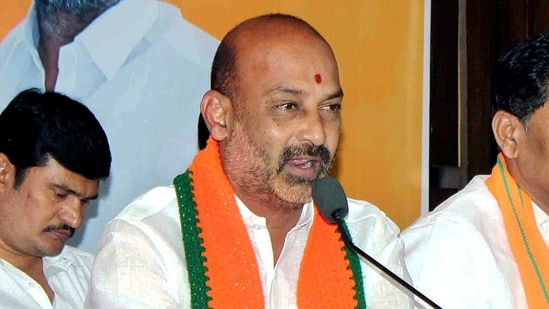
Union minister Bandi Sanjay seeks removal of content linking him with son Bhageerath's POCSO case
# Minister Seeks Link Removal in Son’s POCSO Case
By Senior Legal Correspondent, The Delhi Standard, May 16, 2026
**NEW DELHI** — Union Minister Bandi Sanjay Kumar has formally requested the removal of online articles, social media posts, and digital search results that explicitly link his name and political designation to an ongoing criminal investigation involving his son. The case revolves around severe allegations against the minister’s son, Bandi Sai Bhageerath, who is accused of sexually harassing a 17-year-old girl under the stringent Protection of Children from Sexual Offences (POCSO) Act. Submitted to regulatory authorities and digital intermediaries on Saturday, May 16, 2026, the minister’s plea argues that the continuous association of his public profile with his adult son’s alleged actions constitutes digital defamation, unjustly damaging his political reputation and violating his right to privacy [Source: Hindustan Times].
## The Core of the Legal Plea: Defamation vs. Public Interest
The legal representatives for Union Minister Bandi Sanjay Kumar have mobilized swiftly to manage the digital fallout of the allegations. According to the filings, the minister contends that while the media has a right to report on the criminal investigation concerning Bandi Sai Bhageerath, repeatedly using the minister’s photographs, official title, and name in the headlines and thumbnails crosses the line from factual reporting into sensationalism and character assassination.
The defense strategy hinges on the premise that an adult accused of a crime is solely legally responsible for their actions. By algorithmic association, search engines and social media algorithms have deeply intertwined the minister’s digital footprint with the POCSO case. The minister’s legal team has reportedly dispatched takedown notices to major search engines and social media intermediaries under the provisions of the Information Technology (Intermediary Guidelines and Digital Media Ethics Code) Rules, 2021 [Additional Source: IT Act Legal Framework Review 2025].
The notices request the immediate delinking of the minister’s name from the specific keywords related to the sexual harassment allegations. The argument asserts that political figures, despite their public nature, retain a fundamental right to reputation under Article 21 of the Indian Constitution, which protects life and personal liberty.
## Understanding the Allegations and the POCSO Framework
The controversy stems from an active police investigation into Bandi Sai Bhageerath. According to preliminary reports, a First Information Report (FIR) was registered following a complaint alleging that Bhageerath sexually harassed a 17-year-old female victim. Because the alleged victim is a minor, the case falls strictly under the jurisdiction of the Protection of Children from Sexual Offences (POCSO) Act, 2012.
The POCSO Act is one of India’s most stringent legal frameworks, designed specifically to safeguard minors from sexual exploitation and abuse. The Act mandates absolute anonymity for the victim, swift judicial processes, and non-bailable warrants for specific offenses. Under Section 74 of the Juvenile Justice Act and Section 228A of the Indian Penal Code, media outlets are strictly barred from disclosing any information that could lead to the identification of a minor victim [Additional Source: Ministry of Women and Child Development Legal Guidelines].
While the media has largely adhered to the anonymity guidelines regarding the 17-year-old girl, the intense spotlight has instead turned toward the accused and, by extension, his high-profile father. Law enforcement agencies are currently conducting a thorough investigation into the merits of the allegations against Bhageerath, collecting digital evidence, witness testimonies, and electronic communications to build the case file.
## Navigating Digital Intermediaries and IT Rules
The minister’s request to scrub his name from these specific reports thrusts digital platforms into a complex legal and ethical dilemma. Social media giants and search engines operate under Section 79 of the Information Technology Act, 2000, which grants them “safe harbor” protection—meaning they are not generally liable for the content posted by third parties, provided they act quickly to remove unlawful content when directed by a court or authorized government agency.
However, the definition of “unlawful” content is highly contested when it involves news reporting. Journalistic publications argue that mentioning the familial relationship of the accused to a sitting Union Minister is entirely factual and highly relevant to public interest, as it raises legitimate questions about potential power dynamics, influence over local law enforcement, and political accountability.
When a takedown request is issued on the grounds of defamation rather than a direct violation of criminal law, tech platforms typically hesitate to act without a binding court injunction. Removing legitimate news reports from search indexes solely because a politician objects to the association could trigger accusations of private censorship and bias. As of now, tech companies are carefully reviewing the legal notices to determine whether the content genuinely violates community guidelines or if it remains protected under free speech provisions.
## The Right to Be Forgotten: A Maturing Jurisprudence
Bandi Sanjay’s plea touches upon the emerging, yet highly debated, legal concept of the “Right to be Forgotten” (RTBF) in India. Tracing its roots to the landmark 2017 Justice K.S. Puttaswamy (Retd.) vs. Union of India judgment, which recognized privacy as a fundamental right, the RTBF allows individuals to request the removal of personal information from the internet if it is no longer relevant, is misleading, or causes undue harm [Additional Source: Supreme Court of India Database].
However, the application of RTBF is heavily nuanced, especially concerning public figures and ongoing criminal matters. Courts must constantly balance an individual’s right to digital privacy against the public’s right to information and the freedom of the press.
Legal experts point out that while an ordinary citizen acquitted of a crime might successfully petition a court to remove old news articles to rebuild their life, a sitting Union Minister attempting to delink their name from an active, high-profile investigation involving an immediate family member faces a much higher legal threshold. The courts must weigh whether the minister’s right to reputation supersedes the democratic necessity of transparent reporting on the families of powerful officials.
## Political Ramifications and the Optics of Power
Beyond the legal mechanics, the minister’s move to suppress the digital association has massive political implications. Bandi Sanjay Kumar is a prominent leader and a crucial figure in his party’s regional and national strategies. The opposition has already begun weaponizing the allegations against his son to question the moral authority of the ruling coalition.
In the fast-paced ecosystem of Indian politics, optics are often as critical as legal realities. By serving takedown notices to media organizations and platforms, the minister risks falling victim to the “Streisand Effect”—a phenomenon where an attempt to hide, remove, or censor information inadvertently draws wider public attention to it.
Political analysts note that the opposition will likely frame the takedown notices as an abuse of power, accusing the minister of using his position to silence the press and intimidate digital platforms. Conversely, the minister’s supporters argue that the opposition and certain media houses are conducting a malicious trial by media, using an unproven allegation against a family member to derail a successful political career.
## Expert Perspectives on Media Ethics and Defamation
To understand the broader implications of this development, media ethics and cyber law specialists have weighed in on the delicate balance required in such high-stakes reporting.
“This scenario presents a classic conflict between an individual’s right to reputation and the public’s right to information,” explains Dr. Aranya Menon, a constitutional and cyber law expert based in New Delhi. “While a father is not legally culpable for the independent actions of his adult son, the societal reality in India dictates that the families of powerful politicians are subject to heightened scrutiny. If the media’s reporting is factually accurate regarding the relationship and the FIR, compelling platforms to remove those links without a court order sets a dangerous precedent for press freedom.”
Meanwhile, advocates for digital privacy highlight the disproportionate impact of algorithmic association. “Search engines do not understand nuance,” notes digital rights advocate Vikram Sethi. “When an algorithm continuously pairs a minister’s name with ‘POCSO’ and ‘sexual harassment,’ it creates a permanent digital stigma. From a purely reputational standpoint, the minister has a legitimate grievance regarding how his digital identity is being hijacked by an event he is not legally a party to.”
## Implications for Journalistic Integrity
For newsrooms across India, this case underscores the necessity of strict editorial guidelines when reporting on sensitive criminal matters related to high-profile individuals. The fundamental journalistic mandate is to report the truth without malice. Mentioning that the accused is the son of a Union Minister provides essential context to the reader, establishing the gravity of the situation and explaining why the story warrants national attention.
However, ethical journalism also requires restraint. Editors must ensure that headlines do not misleadingly imply the minister’s direct involvement in the crime, and that the coverage does not devolve into political point-scoring at the expense of a fair trial for the accused and justice for the minor victim. The focus must remain steadfastly on the legal process, police accountability, and the protection of the 17-year-old girl’s identity as mandated by the POCSO Act.
## Conclusion and Future Outlook
Union Minister Bandi Sanjay Kumar’s ongoing effort to remove digital content linking him to his son’s POCSO case is poised to become a defining test case for digital privacy, media freedom, and political accountability in India [Source: Hindustan Times]. As the legal notices reach the compliance departments of major tech corporations, the immediate outcome will likely depend on whether a civil court issues an injunction forcing the takedowns.
In the interim, the criminal investigation into Bandi Sai Bhageerath will proceed under the rigorous guidelines of the POCSO Act. Law enforcement agencies are under immense public pressure to conduct a transparent, unbiased probe, immune to the political weight of the accused’s family.
Moving forward, this controversy will undoubtedly accelerate national conversations regarding the regulation of search algorithms, the boundaries of the right to be forgotten for public officials, and the enduring tension between protecting individual reputations and preserving a free, unhindered press in the digital age. As India approaches its next major political milestones, how digital intermediaries handle the clash between political influence and the public’s right to know will set vital precedents for the future of digital democracy.





