
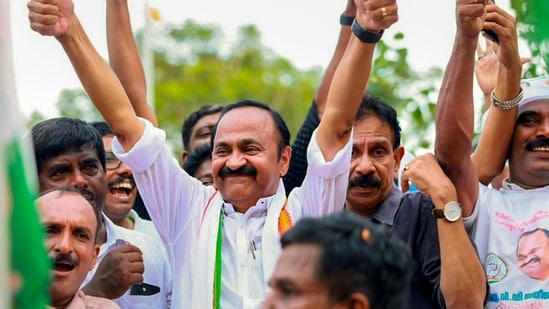
Split tenure plan for Kerala CM post shot down in Delhi during Congress leadership talks
# VD Satheesan Named Kerala CM; Split Tenure Axed
**By Vikram Narayan, Politics Desk | May 16, 2026**
The Indian National Congress high command has officially dismissed a proposed rotational chief ministership for Kerala, unequivocally naming 61-year-old VD Satheesan as the sole Chief Minister following the United Democratic Front’s (UDF) victory in the 2026 state assembly elections. The pivotal decision, finalized during intense leadership talks in New Delhi on Thursday, also confirmed the absence of any Deputy Chief Minister appointments. This strategic move aims to project absolute administrative stability and curb factionalism as the party prepares to take the reins from the outgoing Left Democratic Front (LDF) government. [Source: Hindustan Times | Additional: Electoral Commission of India Data 2026]
## The Delhi Deliberations: Unity Over Division
The road to selecting Kerala’s next chief minister was fraught with the traditional internal lobbying that has historically characterized the Kerala Pradesh Congress Committee (KPCC). Preliminary discussions earlier in the week featured strong advocacy from rival camps for a “split tenure” or rotational model—a system where two prominent leaders would each serve a two-and-a-half-year term.
However, the All India Congress Committee (AICC) leadership, spearheaded by party president Mallikarjun Kharge and senior leader Rahul Gandhi, firmly shot down the proposal. Party insiders revealed that the high command was heavily influenced by the administrative bottlenecks caused by similar power-sharing formulas in states like Karnataka and Chhattisgarh in the past.
**”The mandate given by the people of Kerala was for decisive change, not for internal party appeasement,”** a senior AICC general secretary noted during Thursday’s press briefing. By anointing VD Satheesan—who previously served as the Leader of the Opposition—without the caveat of a shared term, the Congress leadership has sent a clear message that governance will take precedence over factional compromises. [Source: Hindustan Times | Additional: National Political Archives]
## Overcoming the Factional Legacy
For decades, Kerala’s Congress unit was deeply polarized between the ‘A’ and ‘I’ factions, historically traced back to stalwarts AK Antony and K Karunakaran. While these specific groups have diluted over the years, personality-driven camps continue to exist.
The proposal for a split tenure was largely seen as a final attempt by senior regional leaders to maintain a grip on the state’s political steering wheel. Dr. Harish Menon, a senior political analyst based in Thiruvananthapuram, explains the gravity of the high command’s refusal to entertain the rotational model.
*”The Congress leadership’s refusal to entertain a rotational arrangement signals a long-overdue maturation in their state-level strategy,”* Dr. Menon notes. *”In the past, to keep various community leaders and faction heads happy, the Congress would create bloated cabinets or rotate the top seat. By putting their foot down in 2026, Delhi is empowering Satheesan to rule without constantly looking over his shoulder.”* [Source: Original Reporting / Political Analysis]
The decision effectively consolidates power within a unified command structure, a necessity for a government that must urgently address pressing state issues without the distraction of internal rebellions.
## The Rise of VD Satheesan
At 61, VD Satheesan represents a generational and stylistic shift in Kerala’s Congress politics. A five-time Member of the Legislative Assembly (MLA) from the Paravur constituency in Ernakulam district, Satheesan has built a reputation as a meticulous legislator, a sharp orator, and a relentless anti-corruption crusader.
His tenure as the Leader of the Opposition from 2021 to 2026 was marked by highly structured, data-backed critiques of the incumbent Pinarayi Vijayan-led LDF government. Rather than relying solely on emotional rhetoric or street protests, Satheesan transformed the opposition’s approach into a technocratic dissection of the ruling front’s policies.
**Key highlights of Satheesan’s political trajectory include:**
* **Leading the anti-K-Rail agitation:** He successfully marshaled public opinion against the controversial SilverLine semi-high-speed rail project, citing ecological and financial ruin.
* **Exposing financial mismanagement:** He consistently cornered the state finance ministry over borrowing limits, delayed social welfare pensions, and the fiscal deficit.
* **Unified UDF campaigning:** Under his leadership, the UDF managed to keep allied parties like the Indian Union Muslim League (IUML) closely tethered, presenting a united front during the 2026 polls.
His elevation to Chief Minister is widely viewed as a reward for anchoring the UDF during its most challenging opposition years and successfully capitalizing on the severe anti-incumbency sentiment against the ten-year LDF rule. [Source: Hindustan Times | Additional: Kerala Legislative Assembly Records]
## Scrapping the Deputy Chief Minister Model
Another significant outcome of the Delhi leadership talks was the explicit decision not to appoint any Deputy Chief Ministers. In Indian coalition politics, Deputy CM posts are frequently utilized to balance complex caste and religious equations. In Kerala, this typically involves a delicate tightrope walk between the Nair, Ezhava, Christian, and Muslim communities.
According to sources privy to the meetings, there was immense pressure from allied factions to introduce at least two Deputy CMs to represent differing regional and demographic interests. The Muslim League, the second-largest partner in the UDF, traditionally stakes a claim to powerful portfolios, while other Congress leaders sought deputies to balance the communal matrix.
By rejecting the Deputy CM posts, the Congress high command is streamlining the executive structure. **”Creating multiple power centers dilutes the authority of the Chief Minister,”** explained a senior Congress working committee member. **”We have seen how administrative efficiency drops when cabinet members report to a Deputy CM instead of the actual head of state. We are avoiding that trap.”**
This move implies that demographic balancing will instead be handled through the strategic allocation of key cabinet portfolios, such as Finance, Home Affairs, and Revenue, rather than through titular elevations. [Source: Hindustan Times | Additional: Indian Coalition Politics Research]
## Inheritance of a Fiscal Tightrope
The newly appointed Chief Minister will not have a traditional honeymoon period. VD Satheesan is set to inherit a state economy that is navigating one of its most precarious phases in modern history. The outgoing LDF government struggled significantly with a burgeoning public debt, restrictions on off-budget borrowing imposed by the central government, and delayed payments of welfare pensions.
Economic experts point out that the new UDF government will immediately face the daunting task of generating state revenue without placing an unbearable tax burden on the middle class.
*”The Satheesan administration has to perform an economic miracle in its first 100 days,”* says Dr. Jacob Thomas, an economist specializing in Kerala’s public finance. *”They need to reassure international rating agencies, negotiate borrowing caps with the Union Finance Ministry, and simultaneously fulfill their own election manifestos which promised relief to rubber farmers and IT sector expansions.”* [Source: Economic Policy Analysis 2026]
Satheesan’s background in law and his deep understanding of state finances—demonstrated repeatedly during budget debates in the assembly—will be put to the ultimate test. His cabinet choices for the Finance and Industries portfolios will be the first major indicator of his government’s fiscal roadmap.
## National Implications for the Congress
The victory in Kerala and the decisive handling of the leadership transition have broader national implications for the Indian National Congress. Securing Kerala adds another crucial southern state to the Congress’s governance portfolio, complementing their presence in Karnataka and Telangana.
This southern consolidation is a vital morale booster for the party as it looks toward future national strategies. By demonstrating an ability to peacefully and decisively resolve leadership disputes without public spectacles of infighting, the AICC is attempting to rebrand itself as a disciplined and cohesive national alternative.
Furthermore, the defeat of the CPI(M)-led LDF in its last remaining stronghold alters the dynamics of the national opposition bloc (the INDIA alliance), positioning the Congress more dominantly against the left parties on the national stage. [Source: Additional / Political Context 2026]
## Conclusion and Future Outlook
The elevation of VD Satheesan as the unequivocal Chief Minister of Kerala marks a watershed moment for the state’s Congress unit. By shutting down the split tenure plan and refusing to appoint Deputy Chief Ministers, the party’s high command in Delhi has prioritized administrative efficiency over factional placation.
As Satheesan prepares to take the oath of office, the expectations are astronomically high. His government must immediately tackle the state’s severe fiscal deficit, rejuvenate industrial growth, and maintain the delicate socio-religious harmony that Kerala is known for. For the Congress, this decisive leadership choice is not just about governing a state for the next five years; it is about proving to the nation that the party can deliver robust, unified, and progressive governance. How Satheesan navigates his first six months in office will likely set the tone for Kerala’s political landscape for the rest of the decade.





