
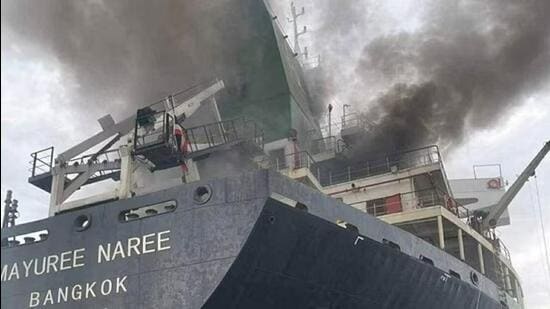
India denounces attacks on merchant shipping after Iran targets Kandla-bound vessel| India News
India Condemns Gulf Shipping Strikes As Kandla Bound Vessel Attacked Omni 360 News
The high seas, lifelines of global commerce, are once again witnessing unsettling turbulence. Recent incidents, particularly an Iran-linked strike on a Thai-flagged merchant vessel en route to India’s bustling Kandla port, have drawn sharp condemnation from New Delhi. This act of aggression underscores the escalating tensions in critical maritime choke points, especially near the Strait of Hormuz, and raises significant concerns for international shipping and trade, a matter of paramount importance to Omni 360 News.
For decades, the free movement of goods across oceans has underpinned global prosperity. Now, that freedom is facing challenges from non-state actors and proxy groups operating in a volatile region. India, a nation deeply reliant on maritime trade for its energy needs and economic growth, views these attacks with utmost seriousness.
Understanding the Recent Attack and India’s Response
Details emerging from maritime security channels indicate that a Thai-flagged commercial vessel, carrying vital cargo and sailing towards Kandla, a major port on India’s west coast, was targeted in what has been described as an Iran-linked strike. While the full extent of the damage and precise details are still under investigation, the incident itself is a stark reminder of the perils faced by innocent merchant ships traversing these strategic waters.
India’s Ministry of External Affairs and shipping authorities have wasted no time in condemning these attacks. Statements from New Delhi emphasize the nation’s unwavering commitment to the freedom of navigation and maritime security. Such acts of aggression, often carried out using drones or missiles, are not just threats to individual vessels or crews; they are direct assaults on the principles of international law and the stability of global supply chains. India has called for immediate de-escalation and urged all parties to respect international maritime norms. The safety of Indian crew members, frequently employed on various international vessels, remains a top priority, adding another layer of concern to these developing events.
The Strait of Hormuz A Global Choke Point Explained
To truly grasp the gravity of the situation, one must understand the significance of the Strait of Hormuz. Imagine a narrow doorway, barely 21 nautical miles wide at its narrowest point, connecting the Persian Gulf with the Arabian Sea and the broader Indian Ocean. This is the Strait of Hormuz. It’s not just any waterway; it is the world’s most critical oil transit chokepoint. Roughly one-fifth of the world’s total petroleum consumption, and a quarter of the world’s liquefied natural gas (LNG), passes through this strait daily.
For countries like India, which imports a substantial portion of its crude oil and gas from the Gulf region, the Strait of Hormuz is an indispensable artery. Any disruption here has immediate and far-reaching consequences, affecting energy prices, trade routes, and ultimately, the cost of living for ordinary citizens worldwide. For a 12th standard student, think of it like a vital highway connector for all the trucks delivering essential goods to your city; if that connector is blocked or made unsafe, everything slows down, and prices go up.
The “Iran-Linked” Dimension and Regional Tensions
The term “Iran-linked” is crucial here. While direct state-on-state attacks might be rare, various militant groups, often referred to as proxies, operate in the region with varying degrees of support, training, or equipment from Iran. Groups like the Houthis in Yemen, for example, have openly targeted shipping in the Red Sea and Gulf of Aden, claiming solidarity with Palestinian causes. These actions, even if not directly ordered by Tehran, contribute to a broader climate of instability that benefits certain geopolitical agendas and allows attacks to be attributed to a wider network of actors.
The current escalation is rooted in a complex web of geopolitical rivalries, regional conflicts, and the ongoing Israel-Hamas conflict, which has injected new fervor into existing flashpoints. The Red Sea, the Gulf of Aden, and now incidents spilling into the Strait of Hormuz region, are all part of a contiguous maritime theatre of tension.
Why These Attacks Matter to India
India’s economic trajectory is inextricably linked to safe and secure maritime trade.
1. Energy Security: A majority of India’s crude oil imports, powering its industries and transportation, transit through these very waters. Disruptions translate directly into higher energy costs and potential shortages.
2. Trade Dependence: India is a major trading nation. Ports like Kandla, Mundra, and JNPT on the west coast handle immense volumes of cargo from the Gulf, Europe, and beyond. Attacks make these routes riskier, increasing shipping costs (due to higher insurance premiums and diverted routes) and delivery times.
3. Inflationary Pressure: Higher shipping costs and energy prices ultimately feed into inflation, affecting the prices of everything from fuel to food, impacting the common citizen.
4. Seafarer Safety: A significant number of Indian nationals serve as seafarers on merchant vessels globally. Their safety and well-being are a constant concern for the Indian government.
India’s Proactive Steps and Calls for Cooperation
In response to the deteriorating security situation, India has not merely issued condemnations. The Indian Navy has significantly enhanced its surveillance and presence in the Arabian Sea and the Gulf of Aden. Warships are being deployed to monitor trade routes, offer assistance to distressed vessels, and provide a deterrent presence. This proactive stance reflects India’s commitment as a responsible maritime power, ensuring the safety of its own trade and contributing to regional stability.
Furthermore, India is actively engaging in diplomatic efforts, advocating for dialogue and de-escalation at international forums. It emphasizes the need for collective action to safeguard global commons and uphold the principle of innocent passage. New Delhi urges a comprehensive and collaborative approach to address the root causes of instability and deter future acts of maritime aggression.
Economic Ripple Effects
The immediate consequence of these attacks is a surge in insurance premiums for vessels traversing the affected regions. Shipping companies are faced with tough choices: pay higher costs, reroute their vessels (which adds significant time and fuel expenses), or risk potential attacks. These additional costs are inevitably passed down to consumers, leading to higher prices for imported goods. Major shipping lines have already announced diversions around the Cape of Good Hope, a much longer route, impacting global supply chains and potentially causing delays for products reaching markets worldwide.
Looking Ahead: The Need for Sustained Vigilance
The recent attack on the Thai-flagged vessel bound for Kandla serves as a potent reminder that the challenges to maritime security are persistent and evolving. While India continues its diplomatic and naval efforts, the long-term solution lies in sustained international cooperation, robust intelligence sharing, and a concerted effort to address the underlying causes of instability in the region. The global community must stand united in upholding the rules-based international order and ensuring the safety of vital shipping lanes. Omni 360 News will continue to monitor these critical developments closely.
Key Takeaways:
* Attacks on merchant shipping, like the recent one on a Thai-flagged vessel bound for Kandla, pose a grave threat to global trade.
* India has strongly condemned these Iran-linked attacks, emphasizing its commitment to maritime security and freedom of navigation.
* The Strait of Hormuz is a critical global chokepoint, vital for energy and trade, especially for India.
* Escalating regional tensions and proxy activities fuel instability in key shipping lanes.
* India is taking proactive steps, including naval deployments and diplomatic engagement, to safeguard its interests and promote stability.
* The economic impacts include rising insurance costs, rerouted vessels, and potential inflationary pressures on global goods.





