
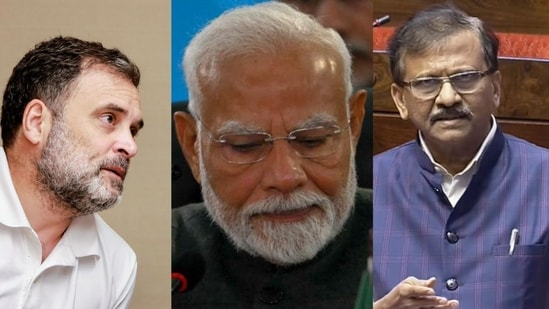
‘Ab jhola uthao aur chale jao’: Opposition mounts pressure on government, PM Modi over inflation| India News
Political Firestorm Shiv Sena Leader Sanjay Raut Questions PM’s Priorities Amid Inflation Woes
In a direct and sharp critique that has ignited political debate across the nation, Shiv Sena (Uddhav Balasaheb Thackeray) leader Sanjay Raut recently declared that the time has come for the Prime Minister to “pick his bag and leave.” Raut’s provocative statement stems from his assertion that the nation’s top leader appears more preoccupied with the intricate dynamics of upcoming state elections than with the pressing and pervasive issue of inflation, which continues to squeeze the pockets of ordinary citizens.
This bold pronouncement from a prominent opposition voice underscores a growing sentiment among critics regarding the government’s perceived focus. As household budgets strain under rising prices for essentials, the political discourse often veers towards questions of priorities – national economic stability versus electoral victories in various states.
The Core of Raut’s Rebuke
Sanjay Raut, known for his no-holds-barred commentary, articulated his frustration by suggesting a departure of leadership. His statement isn’t merely a personal attack but a pointed accusation about governance priorities. For Raut and many in the opposition, the optics of the Prime Minister actively campaigning in state after state, holding rallies and addressing public meetings, while reports of increasing food and fuel prices dominate local news cycles, present a stark and concerning contrast. This criticism resonates with a segment of the public that feels the brunt of economic pressures directly.
When a leader says someone should “pick his bag and leave,” it’s a strong political signal. It’s not just about a change of person, but a perceived failure in handling core responsibilities. In this case, Raut frames it as a failure to prioritize the economic well-being of the average Indian family over the political strategy required for state-level electoral success.
Inflation: A Daily Reality for Millions
To understand the weight of Raut’s argument, it’s crucial to grasp what inflation truly means for a 12th-standard student, or indeed, any household. Imagine the cost of your favorite snack, your daily bus fare, or the ingredients for dinner. When prices for these things keep going up, but your pocket money or your parents’ income stays the same, you can buy less. That’s inflation in simple terms – your money loses its buying power.
In India, inflation has been a persistent concern, particularly for essential commodities. Local market reports from various cities often highlight the soaring prices of vegetables, pulses, edible oils, and dairy products. Fuel prices, a critical component that affects everything from transportation costs to the price of goods, have also remained a pain point. For a family managing a monthly budget, these increases are not abstract statistics; they are tangible reductions in their quality of life. Many local newspapers, beyond the big national headlines, extensively cover how these rising costs impact small businesses, daily wage earners, and middle-class families struggling to make ends meet.
The impact ripples through communities. Small shopkeepers find it harder to stock goods, farmers face higher input costs, and consumers cut back on non-essential spending. This creates a challenging economic environment where the common person feels their hard-earned money simply doesn’t stretch as far as it used to. The frustration is palpable in local conversations and community discussions, forming a backdrop to Raut’s critique.
The Pull of State Elections
Simultaneously, India’s federal structure means that state elections are a continuous cycle. From the recently concluded general elections, where regional parties and state-level issues played a significant role, to upcoming contests in states like Maharashtra, Haryana, and Jharkhand, political parties are perpetually in campaign mode. For national leaders, campaigning in these elections is often seen as vital to consolidate power, expand influence, and ensure the party’s presence at all levels of governance.
The Prime Minister, as the face of the ruling party, naturally plays a central role in these campaigns. His presence can energize party workers, draw crowds, and swing votes. However, Raut’s criticism suggests that this necessary political engagement might be overshadowing the primary duty of national governance, particularly when severe economic challenges are prevalent. The argument is not against campaigning itself, but against the perceived imbalance, where political rallies seem to command more immediate attention than the detailed policy interventions required to stabilize prices.
Local political observers often note the intensity of state election campaigns. They involve extensive travel, numerous public appearances, and focused policy announcements tailored to regional concerns. While this is a part of democratic functioning, the question posed by Raut is whether this focus comes at the expense of addressing broader national distress signals like inflation.
Political Battleground: Opposition’s Narrative
Sanjay Raut’s statement fits into a larger narrative that opposition parties, including the Shiv Sena (UBT), have been building. They frequently accuse the government of being detached from the ground realities faced by ordinary citizens. By highlighting the contrast between high-profile election rallies and the struggle against inflation, the opposition aims to portray the ruling dispensation as out of touch with public suffering. This strategy seeks to mobilize public discontent and present an alternative vision of governance that prioritizes economic relief.
The Shiv Sena (UBT), having gone through significant internal shifts, is keen to re-establish its strong voice in national politics, particularly from Maharashtra. Raut, as its spokesperson and a seasoned journalist himself, understands the power of a striking statement to capture public attention and frame the debate. His words are designed to put the government on the defensive and to amplify the everyday economic anxieties of voters. This is a common tactic in a vibrant democracy, where opposition scrutiny is vital.
Government’s Perspective and Counter-Arguments
While Raut’s critique is sharp, the government typically defends its actions by pointing to global economic headwinds as a significant contributor to inflation. They often cite efforts to manage supply chains, provide subsidies, and implement welfare schemes to alleviate the burden on the poor. Furthermore, the government would argue that a strong political presence in states is essential for effective implementation of national policies and for maintaining stability, making the Prime Minister’s campaign involvement a necessary part of his role.
They might also highlight other economic indicators, such as growth rates or foreign investments, to present a more holistic picture of the economy, suggesting that inflation, while a concern, is being actively addressed within a broader economic strategy. The narrative from the ruling party often emphasizes long-term vision and resilience in the face of global challenges, positioning their focus on both development and political outreach as complementary, not contradictory.
Key Takeaways for Omni 360 News Readers
- Sharp Political Critique: Shiv Sena leader Sanjay Raut’s call for the Prime Minister to “pick his bag and leave” highlights a significant rift in political priorities, according to the opposition.
- Inflationary Pressures: The core of the criticism revolves around the persistent issue of inflation, particularly affecting daily essentials and household budgets across the country.
- Electoral Focus vs. Economic Woes: Raut alleges that the Prime Minister’s intense involvement in state election campaigns overshadows the urgent need to address national economic challenges.
- Public Sentiment: This debate taps into the everyday struggles of citizens who feel the direct impact of rising prices, fueling questions about governmental attention to their hardships.
- Broader Political Strategy: The statement is part of a larger opposition effort to frame the ruling party as detached from public realities and to challenge its governance agenda.
Concluding Thoughts on Governance and Public Trust
The debate sparked by Sanjay Raut’s comments on Omni 360 News goes beyond mere political rhetoric. It touches upon fundamental questions of governance in a large, diverse democracy like India. When economic pressures mount, citizens naturally look to their leaders for immediate relief and reassurance. The perceived balance between political ambition and responsive governance becomes a crucial factor in public trust.
This discussion serves as a reminder that in the complex interplay of national economy and state politics, the ultimate measure of leadership often lies in its ability to effectively address the daily challenges faced by its people. Whether the Prime Minister’s engagements in state elections are a necessary part of his role or a distraction from urgent national issues remains a contentious point, vigorously debated in newsrooms, political forums, and living rooms across the country.





