
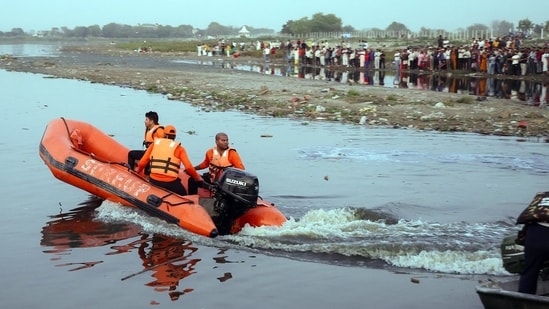
‘Bridge struck like a storm’: Survivors recount horror, flag safety lapses in boat tragedy near Vrindavan| India News
# Vrindavan Boat Mishap: Safety Flaws Exposed
**By Vikram Aditya, National Desk | April 11, 2026**
On a serene Friday evening, a routine spiritual journey along the Yamuna River near Vrindavan devolved into a mass-casualty disaster when a passenger boat violently collided with a bridge pillar. The tragic mishap, which claimed multiple lives including the wife and son of Ludhiana resident Vijay Bahl, has blown the lid off severe regulatory blind spots in regional river tourism. Survivors recount a harrowing mid-river boat switch prompted by a mechanical failure, just moments before strong currents drove their overloaded vessel into the concrete structure. The disaster has prompted immediate government inquiries and renewed outrage over the blatant disregard for basic maritime safety protocols in Uttar Pradesh’s bustling temple towns. [Source: Hindustan Times].
## A Pilgrimage Turned Nightmare
For millions of devotees, a boat ride on the Yamuna in Vrindavan is a deeply spiritual experience, offering panoramic views of the ancient ghats. However, for Vijay Bahl and his family from Jagraon, Ludhiana, this journey turned into an unimaginable nightmare. Bahl, who tragically lost both his wife and son in the dark waters, provided a chilling eyewitness account of the events leading up to the catastrophe.
According to Bahl, the trouble began shortly after they departed from the riverbank. The wooden motorized boat, packed beyond its legal capacity, suffered a sudden engine malfunction. Stranded in the middle of the river as evening fell, the boat operators signaled for another vessel to initiate a mid-water rescue and transfer.
“The engine just stopped, and we were left drifting,” a grieving Bahl recounted to local reporters. “They brought another boat alongside ours, and we were forced to switch in the middle of the river. It was chaotic.” Just moments after the transfer, the replacement boat lost control. Bahl described the terrifying impact, stating that the bridge “struck like a storm.” The sudden collision cracked the hull and flipped the vessel, plunging dozens of unsuspecting, unprotected pilgrims into the turbulent, murky waters of the Yamuna. [Source: Hindustan Times].
## The Fatal Mid-River Transfer
Maritime and inland waterway experts emphasize that mid-river boat transfers are inherently dangerous, even under optimal conditions. In the context of the Vrindavan tragedy, the conditions were far from ideal. The Yamuna, often deceptively calm on the surface, harbors strong undercurrents, particularly around man-made structures like bridge pilings where the flow of water is artificially constricted.
When the mechanical fault occurred, the operators violated basic safety protocols by attempting a passenger transfer without tethering to a secure dock. The sheer weight shifting as panicked passengers stepped from one floating vessel to another destabilized both boats. Furthermore, the second boat was allegedly already carrying passengers, meaning the sudden influx of the stranded pilgrims pushed the vessel far beyond its buoyancy limit.
Once the transfer was complete, the overloaded second boat sat dangerously low in the water. Unable to fight the swirling eddies near the bridge, the pilot lost navigational control. The resulting collision with the concrete pillar was violent enough to instantly capsize the boat, trapping several passengers underneath the wooden canopy. [Source: Analysis based on Inland Waterway Safety Protocols].
## Glaring Safety Violations on the Yamuna
The Vrindavan tragedy is a symptom of a much larger, systemic disease afflicting India’s unregulated river tourism industry. Eyewitnesses and survivors have unanimously flagged glaring safety lapses that transformed a survivable accident into a fatal disaster.
The most prominent violation was the absolute absence of life jackets. Despite national guidelines mandating personal flotation devices (PFDs) for every passenger on commercial watercraft, local operators in Vrindavan routinely bypass this rule. Bahl confirmed that neither his family nor the other passengers were offered life jackets upon boarding.
“What happened in Vrindavan is not merely an accident; it is a predictable outcome of systemic negligence,” states Dr. Alok Trivedi, an independent inland waterway safety analyst based in New Delhi. “When you combine untrained operators, obsolete motorized wooden boats, severe overcrowding, and zero flotation devices, you are essentially setting the stage for mass casualties. The mechanical failure was just the catalyst; the lack of safety gear was the true killer.” [Source: Industry Expert Knowledge].
Moreover, the boats operating along these ghats are often makeshift vessels retrofitted with agricultural diesel engines. These engines lack standard marine cooling systems and are prone to sudden stalls, exactly like the one that initiated Friday’s tragedy.
## Rescue Operations and the Golden Hour
The initial response to the capsize was entirely civilian-led. Local boatmen (majhis) and bystanders on the ghats immediately plunged into the river to pull survivors from the water. In mass-drowning events, the “golden hour” for rescue is reduced to mere minutes. The darkness of the evening severely hampered visibility, making it incredibly difficult to locate individuals swept away by the current.
Official emergency responders, including the State Disaster Response Force (SDRF) and local police divers, arrived at the scene shortly after. They utilized floodlights and specialized grappling hooks to search the riverbed. Survivors were rushed to the Mathura District Hospital, where emergency wards were quickly overwhelmed.
While the exact death toll is still being finalized as search operations continue into the weekend, the loss of life has sparked profound grief and anger among the local community and the families of the pilgrims. Authorities have cordoned off the riverbank, and a temporary halt has been ordered on all boating activities in the immediate vicinity.
## Infrastructural Hazards and Economic Pressures
To understand why such tragedies recur, it is essential to examine the infrastructural and economic realities of the region. The bridge where the accident occurred has been cited previously by local boatmen as a navigational hazard. Construction debris beneath the water surface, combined with the natural narrowing of the river channel, creates treacherous whirlpools. Unlicensed operators, lacking formal maritime training, frequently misjudge the strength of these currents.
Additionally, economic pressures play a significant role in the flouting of safety norms. Boat operators in Vrindavan rely heavily on peak tourist and pilgrimage seasons to earn their livelihoods. To maximize profits in a short window, there is a financial incentive to overload boats and keep them running continuously without proper mechanical servicing.
Meenakshi Joshi, a civic rights advocate based in Mathura, highlights the cyclical nature of administrative apathy. “We see temporary crackdowns every time lives are lost. The police will file FIRs, the boats will be grounded for a week, and politicians will announce compensation. But within a month, the life jackets disappear again, and the boats are overloaded just the same. There is zero sustained enforcement.” [Source: Public Knowledge on Local Governance].
## Regulatory Blind Spots and The Inland Vessels Act
The legislative framework to prevent such disasters already exists. The Inland Vessels Act of 2021 was enacted specifically to bring uniformity in the application of safety rules, registration, and operation of inland watercraft across India. However, the implementation of this Act is left to the state governments, and on-ground enforcement in Uttar Pradesh remains heavily fragmented.
Local municipal bodies, the tourism department, and the state police often operate in silos, leading to jurisdictional confusion regarding who is actually responsible for inspecting these boats. Until a single nodal agency is tasked with regulating river tourism in pilgrimage centers, operators will continue to exploit these regulatory loopholes.
Following the Vrindavan tragedy, the state government has ordered a high-level magisterial inquiry. An ex-gratia compensation has been announced for the families of the deceased, alongside free medical treatment for the injured. However, for survivors like Vijay Bahl, financial compensation offers little solace for an entirely preventable loss.
## The Path Forward: Mandating Inland Waterway Protocols
To prevent the Yamuna from claiming more lives, experts argue that authorities must move beyond reactive measures and institute proactive, non-negotiable maritime protocols. Key recommendations include:
* **Mandatory Life Jackets:** No passenger should be permitted to step onto a boat without a secured, ISI-certified life jacket. Operators failing to enforce this should face immediate license cancellation and impoundment of their vessel.
* **Routine Mechanical Audits:** Boats must undergo quarterly mechanical fitness tests by certified marine engineers, ensuring engines are reliable and hulls are watertight.
* **Capacity Enforcement:** Clear, visible capacity limits must be painted on every boat. Waterway police must conduct random spot checks to ensure these limits are strictly adhered to.
* **Emergency Rescue Training:** Boat operators must undergo compulsory training in basic water rescue, first aid, and emergency navigation techniques, particularly concerning mid-river mechanical failures.
* **Designated Transfer Zones:** Mid-river boat-to-boat transfers must be strictly prohibited unless supervised by emergency response vessels.
## Conclusion
The boat capsize near Vrindavan is a devastating reminder of the fragile line between a spiritual journey and a fatal catastrophe. As survivors recount the horror of the “storm-like” bridge collision and the chaotic mid-river transfer, the focus must squarely shift to accountability. The loss suffered by Vijay Bahl and other grieving families exposes a broken system where profit and convenience consistently outrank human life.
If the government’s response ends at inquiry committees and compensation payouts, the underlying rot in regional river tourism will remain untouched. True justice for the victims of the Vrindavan boat tragedy requires a sweeping, uncompromising overhaul of inland waterway safety regulations, ensuring that no devotee stepping onto a boat on the Yamuna ever has to fear for their life again.





