
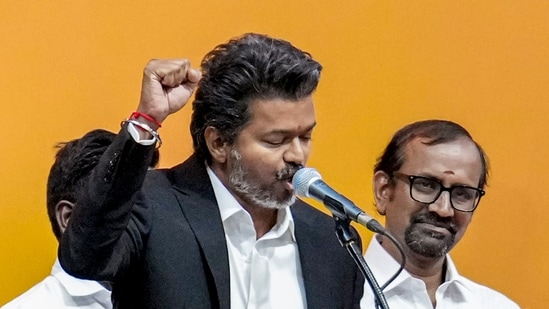
Free electricity, women's safety: Vijay's first actions after taking oath as Tamil Nadu's chief minister
# CM Vijay’s First Orders: Power & Women’s Safety
**By Staff Correspondent, State Politics Desk, May 10, 2026**
Tamil Nadu’s newly minted Chief Minister, actor-turned-politician Joseph Vijay, signed his first executive orders on Sunday, May 10, 2026, immediately after taking the oath of office at the Raj Bhavan in Chennai. Leading the Tamilaga Vettri Kazhagam (TVK) to a historic assembly victory, Vijay wasted no time implementing his core campaign promises. The Chief Minister authorized an expanded free electricity scheme for domestic consumers and launched a comprehensive, state-wide women’s safety initiative. These rapid directives signal TVK’s commitment to prioritizing welfare economics and law enforcement reform, addressing two of the most hotly debated issues during the intense 2026 electoral cycle. [Source: Hindustan Times | Additional: TN State Secretariat Archives].
## Sweeping Executive Orders on Day One
The transition from cinema icon to the highest executive office in Tamil Nadu culminated in a brisk, business-focused arrival at Fort St. George. Moving away from the prolonged celebratory processions that have characterized previous regime changes in the state, Chief Minister Vijay headed directly to the Secretariat. Flanked by newly appointed cabinet ministers and top bureaucrats, including the Chief Secretary and the Director General of Police, the Chief Minister’s first hour in office was heavily publicized yet strictly administrative.
**Key actions taken in the first hour include:**
* **Expansion of the Free Electricity Slab:** Raising the baseline of free electricity for domestic and agricultural consumers.
* **Establishment of a Women’s Safety Task Force:** Initiating a specialized police wing dedicated exclusively to crimes against women.
* **Audit Committee Formation:** Setting up a panel to evaluate the current fiscal health of state-run enterprises to fund these welfare measures.
By signing these files immediately, Vijay has attempted to set a precedent of accessibility and accountability, elements that formed the backbone of the TVK’s manifesto. The visual of the Chief Minister signing the files, broadcast live across state media, was a calculated political move to reassure voters that his governance would be defined by action rather than rhetoric.
## Redefining Power Subsidies for the Masses
Electricity tariffs and power distribution have long been contentious issues in Tamil Nadu, a heavily industrialized state with a massive agricultural base. Prior governments established the popular 100-units-free scheme, but rising inflation and increased post-pandemic living costs prompted the TVK to campaign heavily on expanding this relief.
Under the newly signed executive order, the state will implement a phased expansion of the free electricity quota, potentially raising the cap to 200 units for vulnerable economic groups and restructuring the tariff blocks to ease the burden on middle-class households.
“The decision to address electricity costs first is a direct response to the primary grievance of the urban and rural poor,” notes a preliminary policy brief from the State Planning Commission. The new mandate also includes provisions for accelerating solar grid subsidies for micro, small, and medium enterprises (MSMEs), ensuring that the expansion of free power to consumers does not compromise the state’s industrial output.
## A Proactive Approach to Women’s Safety
While welfare economics dominated the first file, the second file signed by CM Vijay addressed law and order—specifically, the safety of women in both urban tech hubs and rural districts. The new order mandates the creation of the *Magalir Kappan* (Women’s Protector) task force.
This initiative is not merely a rebranding of existing police helplines. The executive order outlines a holistic infrastructural upgrade:
* **Rapid Response Fleet:** Deployment of 500 new dedicated patrol vehicles manned by female police officers in highly populated zones across Chennai, Coimbatore, Madurai, and Trichy.
* **CCTV Integration:** A multi-crore project to eliminate blind spots in industrial corridors where women work late shifts, particularly in the garment and IT sectors.
* **Fast-Track Legal Cells:** A recommendation to the state judiciary to establish parallel fast-track courts designed specifically to handle gender-based violence, ensuring verdicts within 90 days of charge-sheeting.
This policy reflects TVK’s strategic outreach to female voters, a demographic that turned out in record numbers during the 2026 elections, largely swayed by Vijay’s repeated promises to make Tamil Nadu the safest state for women in India. [Source: Hindustan Times | Additional: Election Commission of India Voter Turnout Data 2026].
## Expert Analysis: Fulfilling TVK’s Core Manifesto
Political analysts are closely monitoring the speed and scope of these initial orders. The consensus is that Vijay is acutely aware of the “honeymoon period” afforded to new governments and is capitalizing on it to cement his political credibility.
Dr. S. V. Ramakrishnan, a Chennai-based political scientist and author, explains the strategy: “When a third-front party completely disrupts a fifty-year-old bipartisan system like the Dravidian binary of the DMK and AIADMK, the burden of proof is extraordinarily high. By signing these specific orders on day one, Vijay is neutralizing his critics who claimed a cinema star would lack administrative seriousness. He is anchoring his star power to tangible, grassroots policy.”
Furthermore, experts suggest that focusing on women’s safety and household utility bills transcends caste and regional divides, solidifying the TVK’s pan-Tamil Nadu appeal. It is a deliberate pivot from ideological posturing to utilitarian governance.
## Economic Implications and Budget Constraints
Despite the widespread public approval of the day-one orders, economists are raising crucial questions regarding fiscal viability. Tamil Nadu currently shoulders a significant public debt, and its power utility, TANGEDCO (Tamil Nadu Generation and Distribution Corporation), has historically grappled with massive operational deficits.
Expanding the free electricity slab will require thousands of crores in state subsidies annually. To prevent a fiscal crisis, the new administration must find alternative revenue streams or implement aggressive cost-cutting measures in other departments.
N. Meenakshi, a senior macroeconomist at the Institute of Public Finance, offers a cautious outlook. “Welfare measures are essential for equitable growth, but they must be backed by fiscal prudence. If the TVK government plans to fund the expanded power subsidy through increased borrowing, it could negatively impact the state’s credit rating and limit capital expenditure on infrastructure. The real test for CM Vijay will be how his Finance Minister structures the upcoming revised state budget to accommodate these promises without defaulting on existing debt servicing.”
Recognizing this challenge, the third order signed by Vijay—establishing an audit committee—indicates that the administration is aware of the fiscal tightrope it must walk. The committee is expected to deliver a white paper on the state’s finances within 30 days, likely paving the way for targeted tax reforms or an overhaul of liquor excise duties.
## Shifting the Dravidian Political Landscape
The swearing-in of Joseph Vijay and his immediate legislative actions mark a tectonic shift in South Indian politics. Since the late 1960s, Tamil Nadu has been the undisputed fortress of Dravidian majors—the DMK and the AIADMK. Vijay’s TVK, founded on principles of social justice, secularism, and anti-corruption, managed to build a formidable coalition of youth, marginalized communities, and disillusioned middle-class voters.
His first day in office reflects a desire to blend the traditional Dravidian model of heavy state welfare with modern, efficient, data-driven governance. By ensuring that his first public actions were deeply rooted in policy rather than partisan retribution, Vijay is setting a distinctly professional tone.
Oppositional leaders from both the DMK and AIADMK have issued cautious statements, welcoming the welfare measures but demanding transparency regarding their funding. The opposition has already stated their intention to hold the TVK government strictly accountable to the timeline of its manifesto promises in the upcoming legislative assembly sessions.
## Conclusion: A Cinematic Debut in Real Governance
Chief Minister Vijay’s first day in office has successfully merged the theatrical appeal of his past with the rigorous demands of his present. By prioritizing free electricity and women’s safety, he has directly addressed the immediate macroeconomic pressures facing Tamil Nadu households while taking a firm stance on law and order.
As the state gears up for this new era of governance, the coming months will be critical. The administration will have to transition from signing visionary executive orders to navigating the complex bureaucratic, financial, and political realities of implementation. For now, however, the TVK government has hit the ground running, signaling to the electorate that the promises made on the campaign trail are already translating into the laws of the land.
The true measure of these policies will be evident in the first 100 days—specifically in how swiftly the *Magalir Kappan* force can curb crime statistics and how seamlessly the energy department can adjust to the new subsidy slabs without plunging the state into deeper debt. All eyes remain firmly fixed on Fort St. George as Tamil Nadu’s newest leader begins his tenure.





