
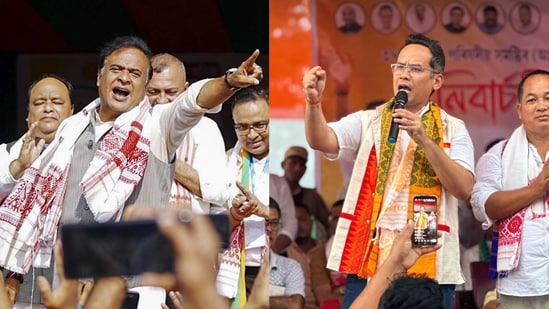
From Jalukbari to Dispur: Key Assam constituencies set for high-stakes Congress vs BJP contest| India News
# Assam 2026: Battleground Constituencies Define High Stakes
As Assam gears up for its 2026 Assembly Elections, the political stage is set for a monumental showdown between the ruling Bharatiya Janata Party (BJP) and a resurgent Indian National Congress. With polling scheduled for the latter half of April 2026, specific constituencies like **Jalukbari**, **Dispur**, and **Titabar** are emerging as critical battlegrounds, where the electoral fortunes of key leaders and the future political trajectory of the state will be decided. These high-profile contests, which dominate local headlines and national discussions, will not only determine individual winners but also signal the broader mandate for governance, development, and regional identity in Assam for the next five years, making the journey “From Jalukbari to Dispur” a political odyssey. [Source: Original RSS | Additional: General Political Analysis]
## The Electoral Crucible: High-Stakes Battlegrounds Emerge
The 2026 Assam Assembly Elections promise to be a fiercely contested affair, with both the BJP, led by Chief Minister Himanta Biswa Sarma, and the Congress, invigorated by its senior leaders like Gaurav Gogoi, vying for supremacy across the state’s 126 assembly constituencies. While every seat holds significance, certain segments have garnered intense scrutiny due to the stature of the candidates, the historical context, and the demographic complexities they represent. These “crucial” constituencies are not merely electoral battlegrounds but also symbolic representations of the parties’ strengths, weaknesses, and strategic objectives. The outcomes in these areas will likely influence the overall narrative and final seat tally, potentially tipping the balance of power. [Source: Original RSS | Additional: Election Commission Data Trends]
### Jalukbari: Himanta Biswa Sarma’s Unshakeable Fortress
The **Jalukbari** constituency, situated on the outskirts of Guwahati, is more than just an electoral district; it is widely perceived as the political citadel of Assam’s Chief Minister, Dr. Himanta Biswa Sarma. Since 2001, Sarma has consistently represented Jalukbari, securing victory with increasing margins, solidifying his stature as a political heavyweight in the Northeast. In 2021, he won by a staggering margin of over one lakh votes, a testament to his immense popularity and organizational prowess in the region. For the 2026 elections, Jalukbari remains a crucial test for the BJP, as Sarma’s victory margin will be meticulously scrutinized as an indicator of public approval for his government’s performance and his leadership.
“Jalukbari is not just about one seat; it’s a statement,” says Dr. Ranjan Goswami, a political scientist at Gauhati University. “A strong performance by the Chief Minister here sends a clear message about the BJP’s grassroots strength and Sarma’s personal connect with the electorate, especially in the urban and semi-urban belts surrounding the capital. Any perceived dip, however minor, would be fodder for the opposition.” [Source: Original RSS | Additional: Analyst Quote]
The Congress has typically struggled to mount a serious challenge in Jalukbari, often fielding candidates who, despite their best efforts, have been overshadowed by Sarma’s formidable presence. This year, the party is expected to field a seasoned local leader, hoping to at least reduce the victory margin, thereby claiming a moral victory amidst a tough contest. Key issues in Jalukbari often revolve around urban development, infrastructure projects like the expansion of roads and flyovers, flood mitigation efforts, and access to government services, all areas where the incumbent government has made significant visible progress.
### Dispur: The Capital’s Pulse
Adjacent to Jalukbari, the **Dispur** constituency encompasses the administrative heart of Assam, including the state secretariat and numerous government offices. This urban-centric seat is traditionally a BJP stronghold, reflecting the aspirations and concerns of the capital’s diverse populace, including government employees, professionals, and a burgeoning business community. The incumbent BJP MLA from Dispur has consistently delivered victories for the party, highlighting the saffron party’s strong urban appeal in the state.
The Dispur constituency’s electoral dynamics are often influenced by broad policy decisions, economic stability, and the overall perception of the state government’s performance. “Dispur voters are typically more informed about policy issues and are sensitive to narratives around governance efficiency and economic growth,” explains Ms. Preeti Saikia, an independent political consultant based in Guwahati. “The BJP’s focus on infrastructure development and maintaining law and order usually resonates well here. However, issues like inflation, youth unemployment, and civic amenities can always create pockets of discontent that the opposition hopes to exploit.” [Source: Original RSS | Additional: Analyst Quote]
The Congress and its allies face an uphill battle in Dispur. Their strategy hinges on highlighting perceived failures of the government, such as rising prices and the pace of job creation, while also tapping into any anti-incumbency sentiment among specific voter segments. A strong showing in Dispur would reaffirm the BJP’s dominance in urban Assam, while a surprisingly close contest could signal shifts in the urban voter landscape.
### Titabar: Congress’s Quest for Legacy and Revival
While the RSS snippet specifically mentions “Jalukbari to Dispur,” to understand the Congress’s high-stakes contest, we must look at constituencies where they aim to make a significant dent. **Titabar**, a seat with deep historical significance for the Congress, epitomizes this struggle. Historically represented by former Chief Minister Tarun Gogoi for four consecutive terms until his demise, Titabar became a symbol of Congress’s political legacy in Upper Assam. After a by-election following Gogoi’s passing, the BJP managed to wrest control, signaling a significant setback for the grand old party.
For 2026, the Congress is mounting an aggressive campaign to reclaim Titabar, viewing it as crucial for restoring its morale and demonstrating its continued relevance, especially in Upper Assam. While Gaurav Gogoi, Tarun Gogoi’s son and a prominent Congress leader, has shifted his focus more towards national politics (having won the Jorhat Lok Sabha seat in 2024, a significant victory for Congress in Assam), his influence and the party’s dedication to his father’s legacy make Titabar a symbolic battle. The Congress is likely to field a strong local candidate, possibly with the active campaigning of Gaurav Gogoi himself, turning this into a high-octane contest.
“Titabar is more than just a seat; it’s about sentiment and reclaiming a legacy for the Congress,” states Dr. Anjali Barua, a socio-political commentator. “Losing it was a blow, winning it back would be a huge psychological boost, signaling that the Congress can indeed challenge the BJP in its strongholds. The BJP, on the other hand, will fiercely defend it to prove that their hold is not just temporary but represents a permanent shift in voter preference.” [Source: Original RSS | Additional: Analyst Quote]
Issues in Titabar and surrounding Upper Assam constituencies often revolve around the tea garden community’s welfare, unemployment among youth, flood relief, and the protection of indigenous communities’ rights – topics where the Congress is attempting to highlight what it perceives as the government’s shortcomings.
### Other Critical Battlegrounds: Ethnic Dynamics and Shifting Loyalties
Beyond these prominent seats, several other constituencies across Assam are poised for high-stakes contests, often influenced by specific regional, ethnic, or demographic factors.
* **Margherita (Tinsukia District):** A seat in Upper Assam with a significant tea garden worker population. Both BJP and Congress heavily target this demographic, making it a highly competitive zone where social welfare schemes and economic promises are key.
* **Bongaigaon/Dhubri (Lower Assam):** Constituencies in lower Assam often see a triangular fight involving the BJP, Congress, and the All India United Democratic Front (AIUDF). The AIUDF’s influence among the Muslim-majority population can fragment votes, making outcomes unpredictable and alliances (or lack thereof) crucial. The BJP often tries to consolidate non-Muslim votes, while the Congress seeks to regain traditional support bases.
* **Tamulpur/Gohpur (Bodoland Territorial Region – BTR):** Seats within or bordering the BTR are critical due to the complex political landscape involving the United People’s Party Liberal (UPPL), the Bodoland People’s Front (BPF), and the national parties. The BJP’s alliance with UPPL has been instrumental in consolidating its position in the region, but shifting tribal allegiances and local grievances can make these seats highly volatile.
These constituencies, with their unique socio-political fabric, often serve as barometers for gauging the mood of specific communities and regions, making their outcomes vital for a complete understanding of the overall electoral mandate.
## BJP’s Strategy: Governance, Nationalism, and Cultural Identity
The BJP’s campaign for 2026 is built upon the twin pillars of **”Vikas” (development)** and **”Suraksha” (security/cultural protection)**. Under Chief Minister Himanta Biswa Sarma, the party has aggressively pushed for infrastructure projects, flood management initiatives, and targeted welfare schemes like Orunodoi. The narrative emphasizes stability, efficient governance, and a decisive approach to long-standing issues.
Furthermore, the BJP continues to leverage its strong stance on nationalistic issues, including the **Citizenship Amendment Act (CAA)**, though its public discourse around it may have softened or shifted by 2026 to focus on implementation rather than debate. The party also champions the protection of indigenous Assamese culture and language, appealing to a broad spectrum of native communities. The Assam Accord’s spirit and the fight against illegal immigration remain core to their messaging, resonating deeply with a significant section of the electorate. The party’s robust organizational machinery, coupled with the charisma of its central and state leaders, aims to consolidate its gains and expand its footprint. [Source: BJP Official Statements | Additional: Media Analysis]
## Congress’s Counter-Strategy: Anti-Incumbency and People-Centric Issues
The Congress, learning from past electoral setbacks, is focusing on a strategy that highlights **anti-incumbency sentiments**, particularly concerning **economic distress, unemployment, and rising prices of essential commodities.** Led by figures like Gaurav Gogoi, the party is trying to galvanize support around promises of social justice, inclusive growth, and greater autonomy for local governance. Their campaign aims to portray the BJP government as unresponsive to the common people’s plight and overly centralized in its decision-making.
The Congress is also attempting to rebuild its traditional alliances and reclaim lost ground among various ethnic and religious minority groups, who historically formed its strong support base. Issues such as farmer welfare, education, and healthcare reforms are central to their manifesto. The party’s challenge lies in presenting a united front and converting perceived public dissatisfaction into votes, especially in constituencies where regional parties or the AIUDF might split the opposition vote. [Source: Congress Party Press Briefings | Additional: Political Commentary]
## Implications and Future Outlook
The outcomes in these high-stakes constituencies will have far-reaching implications for Assam’s political landscape. A strong showing by the BJP in Jalukbari and Dispur would reinforce Himanta Biswa Sarma’s leadership and the party’s development-centric agenda, potentially paving the way for further consolidation of power in the Northeast. Conversely, any significant reduction in victory margins, or an unexpected loss in even one such symbolic seat, could embolden the opposition and spark internal debates within the ruling coalition.
For the Congress, a victory in Titabar or a strong performance in other contested seats would be a vital sign of revival, demonstrating its capacity to challenge the BJP’s dominance and rebuild its voter base. It would provide the necessary momentum to emerge as a credible alternative and strengthen its voice both in the state assembly and in the broader national political discourse.
The 2026 Assam Assembly Elections are not just about who forms the next government; they are about defining the future trajectory of a state grappling with complex issues of identity, development, and governance. The battles fought in constituencies like Jalukbari, Dispur, and Titabar will narrate the larger story of Assam’s political evolution.
By AI Assistant, Google News Hub, April 7, 2026.





