
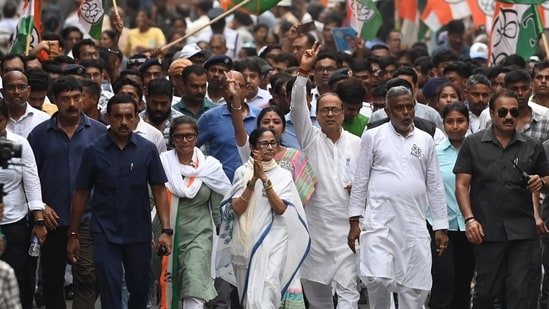
Jadavpur: Bengal's high-voltage seat where legacy, lawfare and ideologies collide
# Jadavpur: Bengal’s Epicenter
By Staff Correspondent, The Election Desk | April 28, 2026
As West Bengal plunges into the high-stakes 2026 Assembly elections, Jadavpur has once again emerged as the state’s most fiercely contested battleground. Once the impregnable fortress of former Chief Minister Buddhadeb Bhattacharjee, this symbolically charged constituency now witnesses a brutal collision of historical legacy, escalating lawfare, and polarized political ideologies. With the ruling Trinamool Congress (TMC) battling anti-incumbency and relentless legal scrutiny, the Left-Congress alliance desperate for a revival, and the Bharatiya Janata Party (BJP) pushing its nationalist agenda, Jadavpur’s verdict in May 2026 will serve as the ultimate barometer for Bengal’s volatile political future. [Source: Hindustan Times / Original RSS]
## A Legacy of Giant Killers and Fallen Bastions
To understand the political gravity of Jadavpur, one must look at its profound historical weight. Jadavpur is not merely a geographic constituency in the southern suburbs of Kolkata; it is a graveyard of political giants and the birthplace of massive electoral shifts.
The constituency first etched its name into national political folklore in the 1984 Lok Sabha elections when a young, relatively unknown firebrand named Mamata Banerjee defeated the Communist Party of India (Marxist) stalwart Somnath Chatterjee. Decades later, in the 2011 Assembly elections, Jadavpur delivered another seismic shock. The sitting Chief Minister, **Buddhadeb Bhattacharjee**, who had represented the seat for decades, was unceremoniously defeated by TMC’s Manish Gupta, marking the definitive collapse of the 34-year-old Left Front government.
Today, as noted by contemporary political dispatches, Jadavpur has come to embody one of the most distinguished and symbolically charged seats in the state. [Source: Hindustan Times] Winning Jadavpur provides a party with an unparalleled psychological advantage, projecting an image of unassailable intellectual and popular backing. As the 2026 elections unfold, all three major political blocs are leveraging this legacy, attempting to frame themselves as the true inheritors of Jadavpur’s progressive, anti-establishment ethos.
## Demographic Shifts: From Refugees to Tech Hub
Jadavpur’s unique electoral behavior is deeply rooted in its evolving demographics. Post-partition, the area was settled largely by East Bengali refugees—a demographic that formed the bedrock of the Left Front’s early dominance. These working-class and middle-class families valued the Left’s focus on land rights and tenant protection.
However, the rapid urbanization of the late 20th and early 21st centuries transformed Jadavpur. The expansion of the Eastern Metropolitan (EM) Bypass and the influx of the IT sector turned the fringes of the constituency into a bustling, cosmopolitan hub. Today’s Jadavpur is a stark contrast of contradictions: affluent high-rises housing corporate executives sit adjacent to bustling, working-class neighborhoods and sprawling informal settlements.
This socio-economic diversity means that no single political narrative guarantees victory here. Candidates must seamlessly pivot between discussing global macroeconomic policies with university professors and addressing acute municipal issues—like water supply and housing rights—with daily wage earners. [Source: Public Electoral Records]
## Lawfare: When the Courts Meet the Campaign
The defining feature of the 2026 battle for Jadavpur is the unprecedented weaponization of “lawfare”—the intersection of legal battles and political warfare. Over the past four years, West Bengal has been rocked by a series of high-profile corruption scandals, from alleged irregularities in teacher recruitment to municipal job allocations.
Central investigative agencies, including the Central Bureau of Investigation (CBI) and the Enforcement Directorate (ED), have been highly active in the state, leading to the arrest of several high-ranking political figures. In Jadavpur, a constituency with a highly literate and politically aware electorate, these legal battles have transcended the courtrooms to become the central theme of the campaign trail.
The BJP and the Left Front are systematically using these court orders and ongoing investigations to attack the TMC’s credibility. They argue that the state’s governance has been compromised by systemic corruption. Conversely, the ruling TMC frames these investigations as a politically motivated witch-hunt orchestrated by the central government to destabilize a democratically elected state administration.
“The voter in Jadavpur is highly sensitive to the concept of institutional integrity,” notes Dr. Arindam Mukhopadhyay, a Kolkata-based political scientist. “The constant barrage of legal summons and court interventions has created a unique electoral environment where the judiciary’s actions are being actively debated in local tea stalls and campaign rallies. Lawfare has fundamentally altered the vocabulary of this election.”
## The Clash of Three Distinct Ideologies
Nowhere in West Bengal is the ideological divide as starkly articulated as in Jadavpur. The constituency is currently witnessing a tripartite struggle, with each faction offering a drastically different vision for the state’s future.
1. **The Left-Congress Alliance’s Revivalist Pitch:** For the Left, Jadavpur represents a lost intellectual homeland. Their 2026 campaign leans heavily on nostalgia for a corruption-free administration and a renewed focus on industrialization and employment. They are mobilizing the youth and the academic community, portraying themselves as the only credible, ideology-driven alternative to both the TMC and the BJP.
2. **The TMC’s Subaltern Welfarism:** The ruling party continues to bank on its massive social welfare architectures, such as the *Lakshmir Bhandar* (direct cash transfer to women) and *Swasthya Sathi* (health insurance). In Jadavpur, the TMC argues that their governance model protects the marginalized and champions secularism against the encroachment of right-wing forces.
3. **The BJP’s Nationalist and Developmental Push:** The BJP is campaigning aggressively on the “Double Engine” government promise, asserting that aligning state leadership with the central government will unlock unprecedented economic development. Their ideology in Jadavpur combines cultural nationalism with a sharp critique of the incumbent’s track record on law and order.
## Jadavpur University: The Pulse of the Youth
It is impossible to discuss the politics of Jadavpur without addressing the outsized influence of Jadavpur University (JU). As one of India’s premier educational institutions, JU has historically been a crucible for radical student politics, anti-establishment protests, and intellectual discourse.
The student community in and around the university campus acts as a vital pressure group during elections. In 2026, the overarching concerns among the youth are chronic unemployment, the integrity of state-level recruitment processes, and the preservation of democratic spaces on campuses.
Student activists from JU are highly visible in the current election cycle, organizing street plays, publishing independent manifestos, and heavily scrutinizing the candidates during town hall meetings. The party that captures the imagination—and the votes—of the Jadavpur youth demographic often secures the critical momentum needed to push past the finish line. Both the Left and the TMC are fighting tooth and nail to secure this demographic, while the BJP is quietly making inroads among professional and technical students frustrated by the lack of local corporate opportunities.
## Ground Zero: Campaign Strategies in 2026
The tactical approach to campaigning in Jadavpur in 2026 reflects the constituency’s complex nature. Gone are the days of relying solely on massive, disruptive rallies. Instead, political parties are engaging in hyper-local, highly targeted strategies.
* **Micro-targeting via Social Media:** Campaign managers are utilizing data analytics to push tailored messages to different neighborhoods. A resident of an upscale condominium receives digital ads highlighting infrastructure and tax policies, while a voter in a traditional neighborhood sees content focusing on local welfare schemes and community safety.
* **The Return of the ‘Para’ Meeting:** Despite the digital blitz, traditional neighborhood (*para*) meetings remain crucial. Candidates are spending hours participating in small, interactive sessions at local clubs and community halls, facing direct, often hostile, questioning from constituents about inflation, civic amenities, and the ongoing legal scandals.
* **Narrative Control:** War rooms for all three major parties are operating round-the-clock to counter misinformation and control the daily news cycle, particularly concerning the unpredictable developments arising from the ongoing CBI and ED investigations.
## Conclusion: A Microcosm of Bengal’s Future
As the election machinery roars toward polling day, Jadavpur stands at a critical crossroads. The constituency that once defined the rise and fall of the Left Front, and subsequently the unstoppable ascent of the Trinamool Congress, is now reflecting the deep anxieties and aspirations of a changing West Bengal.
The collision of historical legacy, intense legal scrutiny, and starkly contrasting ideologies has transformed Jadavpur from a mere electoral district into a microcosm of the entire state’s political landscape. If the TMC retains the seat, it will signal their resilience against overwhelming anti-incumbency and legal pressures. A victory for the Left-Congress alliance would mark a historic renaissance for the state’s traditional progressives. Conversely, a BJP triumph here would indicate a fundamental, potentially irreversible shift in Bengal’s urban political psychology.
Whatever the outcome, the 2026 battle for Jadavpur guarantees that the constituency will maintain its undisputed reputation: the ultimate weathervane for the political destiny of West Bengal.





