
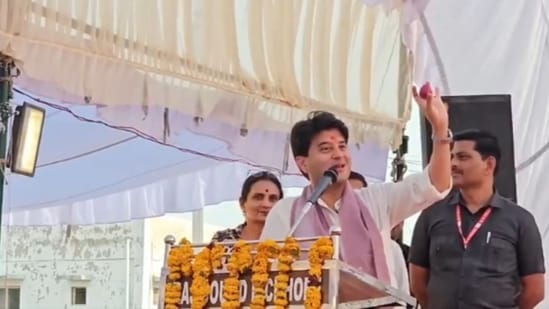
‘Pocket mein pyaaz’: Amid a heatwave, minister Scindia says he doesn't use AC, pulls out an onion
# Scindia’s Onion Hack Amid India Heatwave
**By Siddharth Narayan, National Affairs Desk, April 28, 2026**
On Monday, amid a scorching April heatwave gripping much of the country, Union Minister Jyotiraditya Scindia made headlines by advocating a traditional folk remedy to combat the extreme temperatures: carrying a raw onion in his pocket. Speaking during a public engagement, Scindia casually pulled an onion from his kurta pocket, stating he avoids air conditioning and relies instead on this age-old agrarian wisdom to ward off heatstroke. This remark, emerging as mercury levels routinely cross 44°C (111°F) in several Indian states, has sparked a multifaceted nationwide debate. It bridges the gap between political grassroots messaging, public health science, and the escalating reality of the climate crisis facing the subcontinent in 2026. [Source: Hindustan Times | Additional: IMD Climate Bulletins April 2026].
## The ‘Pocket Mein Pyaaz’ Phenomenon
The incident occurred as the minister was interacting with the public under the relentless summer sun. Addressing the crowd regarding the severe weather, Scindia offered a deeply traditional piece of advice that resonated instantly across rural India. “I look a little young, but my soul is very old,” Scindia remarked with a smile. “Keep an onion in your pocket. Nothing will happen to you.”
He further elaborated that he does not rely on air conditioning to stay cool, a statement that quickly went viral across social media platforms. The visual of a high-ranking Union Minister—and a scion of the erstwhile Gwalior royal family—pulling a humble raw onion from his pocket presented a striking political image. In a country where extreme heat is an annual, and increasingly deadly, occurrence, the reliance on ancestral “nuskhe” (home remedies) is deeply woven into the cultural fabric.
Historically, the belief that carrying an onion can absorb ambient heat and prevent “loo” (the fierce, hot, dry winds of summer in Northern India) has been passed down through generations. However, as extreme weather events become the new normal, the intersection of political messaging and scientific climate adaptation is facing unprecedented scrutiny.
## Medical Science Weighs In: Fact vs. Folk Tale
While Scindia’s anecdote is culturally endearing, medical professionals and public health experts have been quick to clarify the scientific realities of heatstroke prevention. The consensus among the medical community is clear: carrying an onion in your pocket offers absolutely no physiological protection against hyperthermia or heat exhaustion.
Dr. Meera Krishnan, a senior public health researcher and epidemiologist based in New Delhi, emphasizes the importance of science-backed interventions during severe weather alerts. “The idea that an onion acts as a thermal sponge to absorb body heat or deflect hot winds is a widespread myth,” Dr. Krishnan explains. “Heatstroke occurs when the body’s core temperature rises above 40°C due to prolonged exposure to high temperatures or physical exertion, and the body’s sweating mechanism fails. A pocketed vegetable cannot regulate human thermoregulation.”
However, experts do point out a grain of truth hidden within the onion narrative—provided the onion is consumed rather than carried. Raw onions are incredibly rich in water, electrolytes, and quercetin, an antioxidant that naturally acts as an anti-allergen and helps cool the body internally. Consuming onions alongside summer meals helps maintain hydration and sodium levels, which are rapidly depleted through sweating. [Source: Public Health Observations 2026].
## India’s Sizzling Spring: The 2026 Climate Reality
Scindia’s comments arrive against the backdrop of one of the most severe spring heatwaves recorded in recent years. By late April 2026, the India Meteorological Department (IMD) had already issued multiple red and orange alerts across vast swathes of the country, including Odisha, West Bengal, Jharkhand, Uttar Pradesh, and Madhya Pradesh.
Temperatures in several districts have breached the 44°C mark, pushing local governments to alter school timings, issue public health advisories, and brace for power grid fluctuations. The 2026 heatwave is part of a larger, alarming trajectory. Climate scientists note that the frequency, duration, and intensity of heatwaves in India have increased exponentially over the last decade.
Dr. Sameer Patel, a climatologist at the Indian Institute of Tropical Meteorology, notes the urgency of the situation. “We are seeing prolonged dry spells and an increase in ‘warm night’ conditions, which prevents the human body from recovering from daytime heat stress,” he states. “In this critical climate environment, public messaging must prioritize actionable, scientifically proven survival strategies. Anecdotal remedies, while culturally significant, cannot replace rigorous Heat Action Plans (HAPs).”
## The AC Debate and “Cooling Poverty”
Another compelling aspect of Scindia’s interaction was his claim of shunning air conditioning. “I don’t use AC,” the minister stated, presenting himself as resilient and rooted in natural living. This statement inadvertently highlighted the deep socioeconomic divides regarding “cooling poverty” in India.
For a vast majority of the Indian population, air conditioning is not a choice to be shunned, but an inaccessible luxury. As of 2026, despite rapid urbanization and economic growth, AC penetration in Indian households remains below 15%. Millions of citizens—including construction laborers, street vendors, and agricultural workers—endure peak summer temperatures without any access to mechanical cooling.
Urban planners and environmentalists advocate for systemic cooling solutions that do not solely rely on energy-intensive AC units, which ironically contribute to the urban heat island effect and global warming. Innovations in passive cooling, reflective “cool roofs,” urban canopy expansion, and improved cross-ventilation in low-income housing are viewed as essential steps toward climate justice. Scindia’s rejection of the AC resonates with a push toward sustainable living, though critics argue that such choices are only empowering when they are voluntary rather than enforced by poverty.
## Traditional Wisdom That Actually Works
While the pocket onion may fall into the category of placebo, Indian tradition is deeply enriched with highly effective, science-backed methods for beating the heat. Health departments across affected states are actively encouraging citizens to return to these nutritional roots to combat the 2026 heatwave.
Key traditional practices endorsed by modern dieticians include:
* **Hydrating Beverages:** The consumption of *Aam Panna* (a drink made from roasted raw mangoes), *Jaljeera* (cumin-infused water), *Chaas* (buttermilk), and *Sattu* (roasted gram flour mixed with water). These beverages are perfectly formulated to replenish lost sodium, potassium, and magnesium.
* **Earthen Pots (Matkas):** The use of clay pots for storing water utilizes the principle of evaporative cooling, providing naturally chilled water without the need for electricity, while also maintaining an alkaline pH.
* **Breathable Fabrics:** The traditional preference for loose-fitting, light-colored cotton and khadi garments allows for maximum air circulation and sweat evaporation, significantly outperforming synthetic fabrics.
These indigenous practices demonstrate that while some folk remedies are purely anecdotal, much of India’s ancestral wisdom is rooted in profound environmental logic.
## Political Optics in Times of Crisis
Scindia’s interaction must also be analyzed through the lens of political communication. In the high-stakes arena of Indian politics, leaders are constantly seeking ways to bridge the gap between the elite corridors of power and the everyday realities of the masses.
By aligning himself with an “old soul” mentality and championing a rustic remedy, Scindia successfully projected an image of groundedness. Political analyst Rajesh Varma observes, “In times of crisis, whether economic or climatic, politicians often lean into cultural nostalgia. The onion anecdote is a classic populist tool. It signals to rural constituencies that the leader shares their heritage and understands their indigenous ways of life.”
However, Varma also notes the inherent risks in such messaging. “While it makes for an engaging soundbite, the modern electorate is increasingly aware of climate realities. Over-reliance on promoting folk remedies can attract criticism from civil society groups who demand concrete policy action—such as improved public healthcare infrastructure, workplace heat regulations, and subsidized cooling centers—over anecdotal comfort.”
## Conclusion: Navigating the Heat
Union Minister Jyotiraditya Scindia’s ‘pocket mein pyaaz’ moment will likely be remembered as one of the more colorful footnotes of the 2026 heatwave. It is a testament to the enduring power of folklore and the ways in which traditional culture continues to permeate the highest levels of modern Indian discourse.
However, the key takeaway from the escalating heat crisis remains rooted in hard data and proactive governance. As India continues to bear the brunt of rising global temperatures, survival will require a synthesis of the best aspects of traditional wisdom and aggressive, science-based climate action. While keeping an onion in your pocket may provide a sense of cultural comfort, it is hydration, public health infrastructure, equitable access to cooling, and robust Heat Action Plans that will truly save lives in the searing summers to come.





