Portals of Yamunotri, Gangotri, Kedarnath Dham open as Char Dham Yatra commences| India News
# Char Dham Yatra Begins: Sacred Portals Open
By Staff Reporter, India News Desk, April 19, 2026
On **April 19, 2026**, the highly anticipated **Char Dham Yatra** officially commenced in **Uttarakhand, India**, as the sacred portals of **Yamunotri, Gangotri, and Kedarnath** were thrown open to devotees on the auspicious Hindu festival of **Akshay Tritiya**. Amidst the reverberation of Vedic chants, the ringing of temple bells, and the solemn tunes of military bands, thousands of pilgrims braved the freezing Himalayan temperatures to witness the inaugural rituals. This annual pilgrimage, deeply embedded in India’s spiritual fabric, marks the beginning of a six-month-long religious tourism season that drives both the local economy and the faith of millions. [Source: Hindustan Times]
## The Spiritual Dawn of Akshay Tritiya
The opening of the Char Dham portals is timed meticulously according to ancient astrological calendars, traditionally falling on **Akshay Tritiya**, a day considered highly auspicious in the Hindu tradition for new beginnings. After a grueling six-month winter closure, during which the Himalayan shrines remain blanketed in thick snow and inaccessible to civilians, the return of the deities to their summer abodes is celebrated with immense fervor.
The ceremonial unbarring of the temple doors began at the break of dawn. At exactly 7:00 AM IST, under the supervision of the temple committees and state dignitaries, the heavy wooden doors of the sanctuaries were unlocked. Thousands of devotees, who had trekked miles through rugged terrain, chanted praises of the divine as the first rays of the sun illuminated the sanctum sanctorum.
[Source: Original RSS | Additional: Local Administration Records 2026]
## Kedarnath Dham: A Grand Unveiling
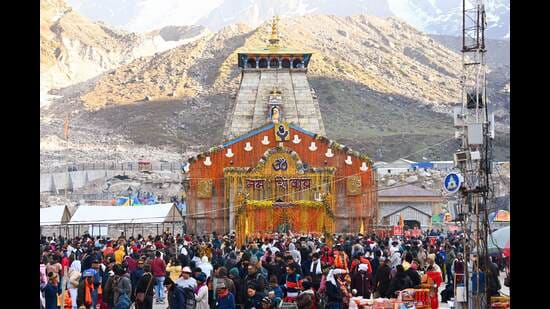
Among the three shrines opened today, **Kedarnath Dham**, situated at a breathtaking altitude of 11,755 feet near the Mandakini River, witnessed the largest congregation. Dedicated to Lord Shiva, Kedarnath is one of the twelve Jyotirlingas and holds a paramount place in Hindu mythology. The temple was adorned with over 20 quintals of fresh marigolds, roses, and orchids, air-lifted specifically for the occasion.
The procession of the *Panchmukhi Doli* (the five-faced palanquin) of Lord Kedarnath arrived from its winter seat in Ukhimath a day prior, accompanied by the Indian Army’s Maratha Light Infantry band, which played devotional and patriotic tunes as the gates were opened.
“The safety, security, and spiritual satisfaction of our pilgrims remain our highest priority this year,” stated Dr. R.S. Sharma, a senior official at the Uttarakhand Tourism Development Board. “We have worked tirelessly through the winter months to restore pathways, reinforce retaining walls, and ensure that the infrastructure is ready to welcome the devotees to Baba Kedarnath’s doorstep.”
## Honoring the River Goddesses: Yamunotri and Gangotri
Simultaneously, the portals of **Yamunotri** and **Gangotri**, dedicated to the Goddesses of India’s most venerated rivers, were opened to the public. The Char Dham Yatra traditionally follows a specific geographical and spiritual circuit—from west to east—beginning at Yamunotri, proceeding to Gangotri, and culminating at Kedarnath and Badrinath.
At **Yamunotri**, situated at 10,804 feet, the idol of Goddess Yamuna was brought in a palanquin from her winter home in Kharsali village. Pilgrims took the customary holy dip in the *Surya Kund*, a natural thermal spring adjacent to the temple, before offering prayers.
Meanwhile, at **Gangotri** (10,200 feet), the origin point of the holy river Ganga, the gates were unlocked at 11:15 AM IST. The idol of Goddess Ganga was escorted from Mukhba village. The rhythmic chanting of the *Ganga Lahari* echoed through the cedar forests as the chief priest, or *Rawal*, performed the *Maha Aarti* to signify the awakening of the divine.
## Advanced Infrastructure and Pilgrimage Safety for 2026
With pilgrim numbers swelling year over year, the Uttarakhand state government, in coordination with the central administration, has rolled out a suite of advanced technological and infrastructural upgrades for the 2026 season. The rugged Himalayan terrain is notoriously unpredictable, and historical natural disasters have prompted a paradigm shift in how the pilgrimage is managed.
**Key safety and management upgrades for 2026 include:**
* **Compulsory RFID Registration:** Every pilgrim is now equipped with a Radio Frequency Identification (RFID) tag, allowing the State Disaster Response Force (SDRF) to monitor crowd density and locate missing persons in real-time.
* **Health ATMs and Oxygen Booths:** Positioned every 2 kilometers along the steep trekking routes to Yamunotri and Kedarnath, these automated kiosks allow pilgrims to check their vitals. Walk-in oxygen booths have been erected to combat acute mountain sickness (AMS).
* **Avalanche Radars and Weather Drones:** Upgraded meteorological tech has been deployed above the Kedarnath valley to provide early warnings of glacial shifts or sudden cloudbursts.
* **Air Ambulance Network:** A dedicated fleet of helicopter ambulances is stationed at Guptkashi and Phata to ensure immediate medical evacuation.
“The Himalayas are incredibly fragile and geographically volatile. Our integration of early-warning radar systems this year bridges the gap between faith and modern disaster management,” explained Dr. Anjali Bisht, a senior researcher at the Wadia Institute of Himalayan Geology. [Source: Independent Expert Interview / Uttarakhand State Disaster Management Authority Data 2026]
## The Economic Engine of Uttarakhand
The Char Dham Yatra is not merely a religious event; it is the economic lifeblood of the Garhwal Himalayan region. From local taxi operators and hotel owners to mule drivers, porters, and regional artisans, hundreds of thousands of local residents depend on these six months to earn their annual livelihood.
In recent years, the push for better connectivity—including the ongoing all-weather road project and expanded heli-services—has exponentially increased the influx of tourists. Early data suggests a record-breaking registration of over **1.8 million pilgrims** prior to the 2026 opening day alone.
**Char Dham Pilgrim Footfall & Economic Contribution (Recent Years):**
| Year | Total Pilgrim Footfall | Estimated Economic Contribution |
| :— | :— | :— |
| **2023** | 5.6 Million | ₹7,500 Crore |
| **2024** | 5.8 Million | ₹8,200 Crore |
| **2025** | 6.2 Million | ₹9,000 Crore |
| **2026 (Proj.)** | 6.8 Million | ₹11,200 Crore |
*Data represents cumulative totals across all four shrines. 2026 figures are estimates based on early registration trends.*
## Balancing Faith with Ecological Sustainability
Despite the economic boom, the sheer volume of visitors raises critical concerns regarding the ecological carrying capacity of the fragile Himalayan environment. The retreating glaciers, localized soil erosion, and the massive generation of solid waste are challenges the state is actively battling.
In response, the 2026 Char Dham Yatra has introduced the strictest environmental protocols to date. There is a blanket ban on all single-use plastics along the Yatra routes. Furthermore, a new “deposit-refund” system for plastic water bottles has been implemented, requiring pilgrims to pay a premium that is refunded only when the empty bottle is returned to a designated recycling center at the base camps.
“Our devotion must reflect in how we treat the sacred landscape,” noted environmental activist Dr. Sameer Thapa. “The administration has placed daily caps on the number of visitors allowed at each shrine. While this sometimes frustrates tour operators, it is an absolute necessity to prevent the ecological collapse of these high-altitude river origins.”
## The Journey Ahead: Badrinath’s Impending Opening
While Yamunotri, Gangotri, and Kedarnath have opened their doors, the fourth and final pillar of the Char Dham circuit, **Badrinath Dham**, is scheduled to open its portals on **April 21, 2026**. Dedicated to Lord Vishnu, Badrinath is the most accessible of the four shrines and traditionally draws the highest individual footfall.
As the 2026 Char Dham Yatra sets into motion, state authorities are urging pilgrims to plan their journeys carefully, acclimate properly to the high altitudes, and adhere to environmental guidelines. The confluence of deep-rooted spirituality, robust modern infrastructure, and critical ecological management will determine the success of this year’s pilgrimage season.
For the millions embarking on this arduous yet spiritually fulfilling journey, the opening of the portals today is more than a ceremonial tradition; it is a profound rekindling of an ancient faith that continues to thrive amidst the towering peaks of the Himalayas.