
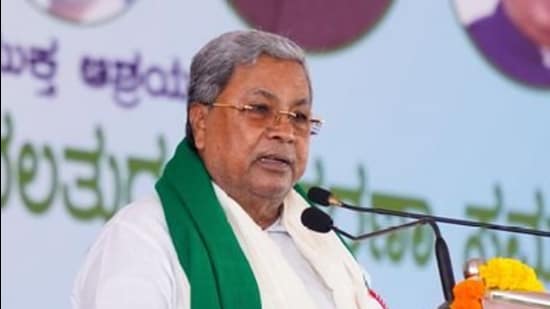
Siddaramaiah dismisses political secretary amid Karnataka Congress infighting| India News
# Siddaramaiah Sacks Aide Amid Congress Infighting
**By Special Correspondent**, *India News Bulletin*, April 14, 2026
Karnataka Chief Minister Siddaramaiah abruptly dismissed his political secretary, Naseer Ahmed, on Tuesday, escalating the internal friction within the state’s ruling Congress party. The dismissal follows severe allegations that Ahmed actively worked against the official Congress candidate during the crucial April 9 assembly by-polls. This bold disciplinary action underscores the deepening rift within the state leadership as various factions vie for dominance. With high-stakes political maneuvering taking center stage in Karnataka, Siddaramaiah’s zero-tolerance approach toward anti-party activities sends a stern message to dissidents within the ranks. [Source: Hindustan Times].
## The Anatomy of a High-Profile Dismissal
The Chief Minister’s Office (CMO) released a brief notification on Tuesday afternoon, confirming the immediate termination of Naseer Ahmed from his cabinet-rank position as the Political Secretary to the Chief Minister. Ahmed, a veteran Member of the Legislative Council (MLC) and long considered a loyalist within the Siddaramaiah camp, was handpicked for the role to manage legislative coordination and outreach.
However, relations between the Chief Minister and his key aide deteriorated rapidly in the weeks leading up to the April 9 assembly by-poll. According to inside sources, multiple block-level Congress committees submitted reports to the Karnataka Pradesh Congress Committee (KPCC) detailing Ahmed’s covert operations. He was reportedly engaged in clandestine meetings with opposition leaders and actively discouraged minority voters from backing the official Congress nominee.
The swift sacking is highly unusual for Siddaramaiah, a leader historically known for shielding his inner circle from party high-command scrutiny. The decision to publicly dismiss a prominent minority leader indicates that the undeniable evidence of sabotage left the Chief Minister with no alternative but to sever ties to maintain his authoritative grip over the administration. [Source: Hindustan Times | Additional: Public records and political analysis].
## The April 9 By-Poll Fiasco
The April 9 assembly by-poll was viewed as a critical litmus test for the ruling Congress government, which swept to power with a massive mandate in 2023. While by-polls rarely alter the fundamental stability of a government with a clear majority, they serve as crucial indicators of public sentiment and administrative approval.
During the grueling campaign, the Congress party machinery noticed glaring discrepancies in voter mobilization in pockets heavily influenced by Naseer Ahmed. **Key allegations against Ahmed include:**
* **Covert Campaign Sabotage:** Instructing his ground-level loyalists to slow down door-to-door campaigning for the Congress candidate.
* **Resource Diversion:** Allegedly holding back vital campaign funds and logistical support allocated for minority-dominated wards.
* **Opposition Collusion:** Whispers of backdoor negotiations with rival political factions to engineer a split in the traditional Congress vote bank.
When the internal audit of the April 9 voting patterns revealed a significant drop in expected vote shares in Ahmed’s strongholds, the Chief Minister’s camp moved swiftly. For a government striving to present a united front ahead of the upcoming local body elections, such internal betrayals are viewed as existential threats to party cohesion.
## Deepening Factionalism in the Karnataka Congress
The dismissal cannot be viewed in isolation; it is a symptom of the broader, deeply entrenched factionalism plaguing the Karnataka Congress. Since the formation of the government, the delicate power-sharing dynamic between Chief Minister Siddaramaiah and Deputy Chief Minister D.K. Shivakumar has required constant micro-management by the All India Congress Committee (AICC).
While both leaders have publicly maintained a facade of unity, their respective camps are engaged in a perpetual cold war over cabinet portfolios, board appointments, and resource allocations. Naseer Ahmed’s sudden shift in allegiance—or at least his willingness to undermine a candidate blessed by the Chief Minister—suggests that rival factions may be attempting to erode Siddaramaiah’s base from within.
### Timeline of Recent Internal Frictions
| Date | Event | Implication for Party Unity |
| :— | :— | :— |
| **May 2023** | Government Formation | Intense lobbying between Siddaramaiah and D.K. Shivakumar camps delays cabinet expansion. |
| **Nov 2024** | Board Appointments | Friction over appointing loyalists to state-run boards and corporations. |
| **Aug 2025** | Public Spats | Several MLAs openly criticize district ministers over lack of developmental funds. |
| **April 2026** | **Naseer Ahmed Sacked** | First high-profile termination within the CMO, indicating zero tolerance for by-poll sabotage. |
The sacking sends ripples through the party’s legislative wing. It forces MLAs and MLCs who have been playing both sides of the factional divide to publicly declare their loyalties, potentially leading to a more polarized state cabinet.
## Expert Perspectives on the Crisis
Political analysts suggest that Siddaramaiah’s decision is as much about self-preservation as it is about party discipline.
“In the complex theater of Karnataka politics, a Chief Minister cannot afford to have a mole in the CMO,” notes Dr. Ramesh Rao, a Bengaluru-based political scientist and author. “Naseer Ahmed was not just a party worker; as Political Secretary, he had unparalleled access to the Chief Minister’s strategy, schedule, and state intelligence. If he was actively working against the party in a by-poll, retaining him would project catastrophic weakness.”
Dr. Rao further elaborates that this move is a preemptive strike. “By dismissing Ahmed so publicly, Siddaramaiah is drawing a line in the sand. He is warning other ambitious leaders that anti-party activities will result in immediate political excommunication, regardless of past loyalties or minority vote-bank equations.” [Source: Independent Political Analysis].
## Navigating the Minority Vote Bank Dilemma
One of the most complex layers of this dismissal is Naseer Ahmed’s status as a prominent Muslim leader. The Congress party in Karnataka relies heavily on the consolidation of AHINDA (a Kannada acronym for minorities, backward classes, and Dalits) votes—a socio-political coalition engineered largely by Siddaramaiah himself.
Dismissing a high-ranking Muslim leader risks alienating a crucial demographic. Opposition parties, particularly the BJP and the JD(S), are already looking to capitalize on this fracture, framing the dismissal as evidence that minority leaders are disrespected within the Congress framework.
However, Congress insiders argue that the party’s secular credentials and the implementation of its robust welfare schemes—the famed “Five Guarantees”—supersede individual leaders. The state leadership believes that the minority electorate votes for the party’s ideological stance and welfare governance, rather than individual power brokers who engage in political sabotage. By acting decisively, the party hopes to project that discipline transcends vote-bank appeasement.
## The High Command’s Role and Response
The dramatic developments in Bengaluru are being closely monitored in New Delhi. AICC President Mallikarjun Kharge, who himself hails from Karnataka, is acutely aware of the fragile egos and high stakes involved in his home state.
Historically, the Congress high command has preferred to mediate and patch over differences rather than endorse outright dismissals. However, sources within the AICC suggest that Siddaramaiah presented irrefutable evidence of Ahmed’s anti-party activities before pulling the trigger. By securing tacit approval from the central leadership prior to the announcement, the Chief Minister has effectively bypassed the KPCC disciplinary committee, asserting his ultimate authority over executive appointments.
The high command’s silence on the matter thus far is indicative of their support for the Chief Minister’s disciplinary action. For the national leadership, maintaining absolute state-level stability in Karnataka is paramount, as the state remains the party’s primary economic engine and political stronghold in southern India.
## Broader Implications for the Ruling Government
Beyond the immediate political theater, the constant infighting within the Karnataka Congress has tangible implications for governance. The state administration has been under immense pressure to sustain the financial viability of its welfare programs while managing infrastructure development in a rapidly expanding state.
When political secretaries and cabinet ministers are embroiled in factional turf wars and by-poll sabotage, bureaucratic paralysis often follows. Bureaucrats become hesitant to execute orders when they sense political instability, leading to delayed project implementations and stalled policy rollouts.
Siddaramaiah’s swift action against Naseer Ahmed may serve as a necessary shock to the system. By proving that the government will not tolerate internal dissent that compromises its electoral prospects, the Chief Minister is attempting to pivot the focus back to administration. Yet, the question remains whether this dismissal will quell the underlying factionalism or merely drive the dissenters further underground to plot their next move.
## Conclusion and Future Outlook
The dismissal of Naseer Ahmed from the post of Political Secretary is a watershed moment in the current tenure of the Karnataka Congress government. It highlights the ruthless pragmatism required to govern a state fraught with complex caste equations and rampant factionalism.
**Key Takeaways:**
1. **Zero Tolerance:** Chief Minister Siddaramaiah has established a strict boundary regarding party loyalty, showing a willingness to sack even close aides for by-poll sabotage.
2. **Factional Tensions:** The incident exposes the persistent undercurrents of rivalry within the Congress party, requiring careful navigation ahead of future electoral battles.
3. **High Command Backing:** The decisive nature of the sacking suggests that Siddaramaiah continues to enjoy the confidence and backing of the Congress central leadership.
As the political dust settles from the April 9 by-poll, the focus will inevitably shift to how the alienated factions regroup. For Siddaramaiah, the immediate challenge is to appoint a successor who can heal the internal rifts without compromising the authority of the Chief Minister’s Office. In the volatile landscape of Karnataka politics, this dismissal is not the end of the infighting, but merely the opening salvo in the next chapter of the state’s enduring political drama.





