
West Bengal election 2026 LIVE: After Modi’s Kolkata visit, Mamata vows to ‘conquer Delhi’, target 'BJP brokers'| India News
# WB Polls: Modi Campaigns as Phase 1 Hits 92%
By Political Correspondent, National Elections Desk, April 24, 2026
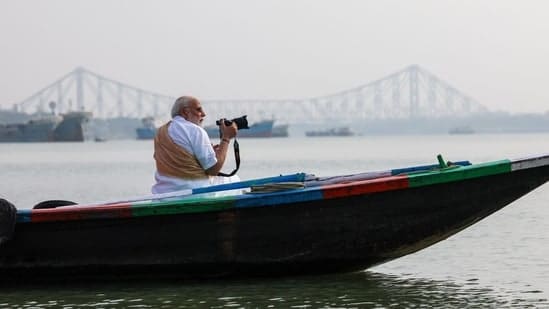
Prime Minister Narendra Modi navigated the Hooghly River on a specially chartered boat on Friday morning, waving to thousands of enthusiastic voters lining the ghats of Howrah ahead of the crucial second phase of the West Bengal Assembly Elections scheduled for April 29. The intense, high-visibility campaigning follows a historic mandate on Thursday, where the first phase of voting concluded with a staggering, record-breaking voter turnout of over 92%. The high-stakes battle between the incumbent All India Trinamool Congress (AITC) and the Bharatiya Janata Party (BJP) has electrified the state, with both factions viewing this unprecedented democratic participation as an indicator of an impending electoral wave in their favor. [Source: Hindustan Times].
## Modi’s Riverine Outreach: Symbolism on the Hooghly
In a departure from traditional roadshows, Prime Minister Modi’s decision to campaign via the Hooghly River serves as a masterstroke in political optics. Escorted by river police and flanked by local BJP leadership, the Prime Minister’s boat journey covered key constituencies along the twin cities of Kolkata and Howrah. The visual of the Prime Minister connecting with riverine communities, ferry commuters, and thousands gathered at prominent spots like the Belur Math and Dakshineswar ghats underscores the BJP’s strategy to intertwine cultural reverence with grassroots political outreach.
“The river Hooghly is the lifeline of Bengal’s culture and commerce. By campaigning on these waters, the BJP is attempting to visually bridge the gap between Delhi and the deepest cultural roots of the Bengali electorate,” notes Dr. Subrata Mitra, a senior political analyst at the Centre for Eastern Indian Studies. [Source: Independent Political Analysis].
The Howrah and Hooghly districts, slated to vote in the critical second phase on April 29, are historically highly industrialized belts that have recently struggled with economic stagnation. By waving to the masses from the river, the Prime Minister reinforced the BJP’s central campaign promise: the revitalization of Bengal’s lost industrial glory and the promise of “double-engine” growth, leveraging parallel leadership at both the state and central levels.
## Decoding the 92% Phenomenon
The most defining storyline of the 2026 Assembly elections thus far is the astounding 92% voter turnout recorded during Thursday’s first phase. In India’s electoral history, numbers crossing the 85% threshold generally indicate deep voter polarization, massive anti-incumbency, or highly successful grassroots mobilization by the ruling establishment.
According to official data released by the Election Commission of India (ECI), rural constituencies witnessed an exceptionally high footfall, particularly among female voters. [Source: Hindustan Times / ECI Guidelines].
**Comparative Voter Turnout (West Bengal Assembly Elections)**
| Election Year | Phase 1 Turnout | Overall State Turnout | Key Driving Factor |
| :— | :— | :— | :— |
| 2016 | 84.22% | 83.02% | TMC Welfare Expansion |
| 2021 | 84.63% | 81.70% | High-intensity BJP vs TMC clash |
| **2026** | **92.15%** | **TBD (Phase 2 pending)** | **Hyper-mobilization / Women Voters** |
Political observers are split on how to interpret this tidal wave of voters. “A 92% turnout is practically unheard of in modern democratic exercises of this scale. It points to a highly aware electorate that views this election as an existential choice. For the TMC, this could be the ultimate validation of their direct cash transfer schemes. For the BJP, it could signal a silent, overwhelming desire for a regime change,” explains Rithika Sen, an independent election observer based in Kolkata.
## The TMC’s Bastion Defense
For Chief Minister Mamata Banerjee and the All India Trinamool Congress (AITC), the 2026 election is a battle for absolute survival and regional supremacy. Serving her third consecutive term, Banerjee faces natural anti-incumbency, alongside aggressive opposition narratives targeting alleged administrative corruption and local-level syndicate raj.
However, the TMC’s counter-strategy relies heavily on its robust network of welfare schemes. Initiatives like *Lakshmir Bhandar* (direct cash transfers to women), *Swasthya Sathi* (health insurance), and *Kanyashree* (education for girls) have created a massive, loyal vote bank of rural women. The AITC leadership was quick to claim the 92% turnout as a victory march for the state’s women protecting their ‘Didi’ (elder sister) against what they term as “outsider political forces.”
Banerjee herself held three massive rallies in the South 24 Parganas district on Friday, fiercely criticizing the BJP’s central leadership for utilizing federal agencies to intimidate state officials ahead of the polls. The TMC’s narrative remains deeply rooted in Bengali sub-nationalism, portraying the party as the sole protector of the state’s inclusive cultural ethos against the BJP’s pan-India ideological machinery.
## BJP’s “Asal Paribartan” Push
Conversely, the BJP has poured unprecedented resources into West Bengal for the 2026 cycle. Recognizing the state as the final frontier in Eastern India, the saffron party has aggressively promoted its vision of *Asal Paribartan* (Real Change).
The BJP’s campaign has relentlessly highlighted issues of governance, alleged extortion, and the lack of organized sector jobs for the youth. By strategically parading national heavyweights, including PM Modi, Home Minister Amit Shah, and party president J.P. Nadda across the state, the BJP has sought to project a highly coordinated, formidable alternative to the TMC’s regional dominance.
Furthermore, the implementation of the Citizenship Amendment Act (CAA) remains a critical undercurrent in border districts. The BJP has leveraged this to consolidate the Matua community and other refugee voters, promising security and formalized integration into the Indian mainstream.
## The Role of the Election Commission and Security Forces
An essential factor contributing to the historic Phase 1 turnout—and a major focus for Phase 2 on April 29—is the unprecedented security blanket thrown over the state. In stark contrast to the drawn-out eight-phase election of 2021, the 2026 elections were condensed into just two phases. This structural change required a mammoth logistical deployment by the Election Commission of India.
Over 900 companies of Central Armed Police Forces (CAPF) have been deployed across the state to ensure a conducive environment for voters. [Source: Ministry of Home Affairs / ECI]. The relatively peaceful conduct of Phase 1, despite the high-tension political climate, has bolstered voter confidence. Quick Response Teams (QRTs), drone surveillance over sensitive polling booths, and strict restrictions on political gatherings near polling perimeters successfully curbed the sporadic violence that has historically marred West Bengal’s electoral landscape.
The ECI’s stringent measures have drawn mixed reactions. While the opposition has praised the central forces for neutralizing local political intimidation, the ruling TMC has frequently accused the CAPF of overstepping boundaries and influencing voters in rural booths—allegations the ECI has categorically dismissed.
## Conclusion and Future Outlook
As West Bengal braces for the second and final phase of voting on April 29, the political temperature remains at a boiling point. The staggering 92% turnout in Phase 1 has effectively torn up the traditional electoral calculus, leaving psephologists and political strategists guessing.
Prime Minister Narendra Modi’s picturesque, yet highly calculated boat ride along the Hooghly serves as the perfect metaphor for this election: a turbulent, high-stakes navigation through deep and unpredictable political waters. Whether this historic mobilization of voters signifies a reaffirmation of Mamata Banerjee’s sweeping welfare state or a decisive pivot toward the BJP’s promise of centralized development will only be revealed on counting day.
Until then, all eyes remain fixed on the vibrant, fiercely contested battleground of West Bengal, as the electorate prepares to write the next critical chapter in Indian political history.





