
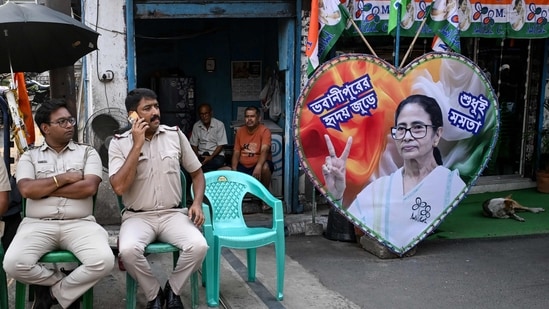
West Bengal government formation LIVE: New Bengal CM to take oath on May 9 as Mamata refuses to resign
# BJP Sweeps Bengal: CM Suspense Amid TMC Standoff
**By Political Correspondent, National News Desk | May 06, 2026**
The Bharatiya Janata Party (BJP) has secured a historic and unprecedented mandate in the April 2026 West Bengal assembly elections, winning a staggering 207 out of 294 seats. This landmark victory paves the way for the saffron party to form its first-ever government in the eastern state, decimating the ruling All India Trinamool Congress (TMC). However, a profound constitutional crisis has erupted in Kolkata. Incumbent Chief Minister Mamata Banerjee has sensationally refused to submit her resignation, alleging severe electoral irregularities. As the state waits for a peaceful transition of power, intense suspense continues over the BJP’s Chief Ministerial pick, with the official oath-taking ceremony expected to take place in the coming days. [Source: Hindustan Times].
## A Historic Mandate for the Saffron Party
The political landscape of West Bengal has undergone a seismic shift, rewriting the electoral geography of eastern India. In an election cycle that witnessed fierce grassroots campaigning, deeply polarized rhetoric, and record-breaking voter turnout, the BJP captured 207 seats in the 294-member legislative assembly. This comfortably surpasses the halfway mark of 148, granting the party an absolute and unchallenged majority.
The All India Trinamool Congress, which has governed the state with an iron grip for 15 years since unseating the Left Front in 2011, has been reduced to a mere 78 seats. [Source: Hindustan Times]. This result completely reverses the trajectory of the 2021 assembly polls—where the TMC secured 215 seats—marking a decisive end to the Mamata Banerjee era.
The magnitude of the victory highlights a massive consolidation of anti-incumbency votes. For the BJP, the journey in West Bengal has been one of exponential, albeit turbulent, growth. From securing just three assembly seats in 2016, to establishing a formidable opposition presence with 77 seats in 2021, the leap to 207 seats in 2026 represents the culmination of a decade-long strategic project orchestrated by the party’s central leadership. Jubilant crowds have gathered outside the BJP headquarters in Kolkata’s Hastings area and the national headquarters in New Delhi, celebrating what is being hailed as one of the party’s most significant electoral conquests.
## The Constitutional Crisis: Mamata’s Defiance
Despite the clear and overwhelming mandate delivered by the electorate, a bizarre and tense constitutional standoff currently grips Kolkata. Ordinarily, parliamentary democracy conventions dictate that an outgoing Chief Minister submits their resignation to the Governor immediately upon the declaration of electoral defeat to facilitate a smooth transfer of power.
However, Mamata Banerjee has surprisingly held back her resignation. According to internal party sources and preliminary press briefings from Kalighat, the TMC leadership is drafting an emergency petition alleging widespread tampering of Electronic Voting Machines (EVMs) and undue, partisan influence by central security forces deployed during the multi-phase elections.
“This is a highly unusual and precarious scenario in Indian political history,” notes Dr. Rajat Sen, a senior constitutional expert at the National University of Juridical Sciences (NUJS), Kolkata. “While a defeated Chief Minister cannot cling to power indefinitely once the Election Commission notifies the final tally, the refusal to tender a formal resignation forces the Raj Bhavan into a proactive role. If the delay extends beyond a reasonable timeframe, Governor C.V. Ananda Bose will be constitutionally obligated under Article 164 to dismiss the incumbent cabinet to pave the way for the newly elected majority.” [Source: Independent Constitutional Analysis].
## The Race for the Chief Minister’s Chair
As the Trinamool Congress contemplates its immediate legal and political options, the BJP is embroiled in intense internal deliberations over who will lead the state apparatus. Having fought the election without declaring a Chief Ministerial face—relying instead on Prime Minister Narendra Modi’s national appeal—the central leadership in New Delhi has now dispatched senior observers to Kolkata to gauge the mood of the newly elected legislative bloc.
Recent reports hint at a few key frontrunners dominating the internal discourse, notably **Suvendu Adhikari** and **Agnimitra Paul**. [Source: Hindustan Times].
Adhikari, the outgoing Leader of the Opposition who famously defeated Banerjee in the high-stakes Nandigram battle in 2021, remains the strongest contender. His aggressive grassroots mobilization, deep understanding of rural Bengal’s political machinery, and ability to match the TMC’s organizational muscle are credited as cornerstones of the BJP’s 2026 success.
Conversely, Agnimitra Paul represents the rising women leadership within the state unit. As a prominent legislator and general secretary, she is seen as a unifying, modern face acceptable to various urban and semi-urban constituencies. Her elevation would also serve as a powerful messaging tool for the BJP, countering the TMC’s historically strong grip on women voters. Other dark horse candidates from the Rashtriya Swayamsevak Sangh (RSS) background, including state president Sukanta Majumdar, are also reportedly being vetted by the central parliamentary board.
## Unpacking the Saffron Surge: Key Electoral Factors
Several critical, intersecting factors converged to produce this historic electoral outcome. Over the last five years, the TMC government battled severe, compounding anti-incumbency fueled by multiple high-profile corruption scandals. The unearthing of the multi-crore school jobs scam, municipal recruitment irregularities, and the subsequent arrests of senior ministers created an unshakable public narrative of systemic administrative rot. The BJP successfully weaponized these issues, running a relentless campaign promising a corruption-free administration.
Furthermore, shifting demographic alignments played a pivotal role. The BJP’s sustained ideological campaign focusing on state security, border infiltration, and the localized implementation of the Citizenship Amendment Act (CAA) resonated strongly in the bordering districts of North Bengal and the Matua-dominated pockets of South Bengal.
A critical turning point was the alienation of the female electorate. The widespread civic protests in Sandeshkhali and other rural belts over the last two years significantly eroded Mamata Banerjee’s image as the ultimate protector of women’s rights in the state. The BJP’s targeted outreach programs—promising enhanced security and direct economic benefits—successfully breached the TMC’s most reliable vote bank.
**2026 West Bengal Assembly Election: Seat Share Breakdown**
| Political Party | Seats Won (2026) | Change from 2021 |
| :— | :— | :— |
| **Bharatiya Janata Party (BJP)** | **207** | **+130** |
| All India Trinamool Congress (TMC)| 78 | -137 |
| Left Front-Congress Alliance | 7 | +7 |
| Others/Independents | 2 | 0 |
*[Source: Election Commission Data / Hindustan Times]*
## The Fall of the Trinamool Fortress
The defeat marks a bitter chapter for Mamata Banerjee, arguably one of the most formidable mass leaders in contemporary Indian politics. Having built her career on street-fighting politics and anti-establishment crusades, leading to the historic ouster of the 34-year-old Left Front regime in 2011, she now faces her own electoral eclipse.
Political analysts suggest that internal factionalism significantly contributed to the TMC’s downfall. The prolonged, often public power struggle between the party’s old guard—loyal directly to Banerjee—and the younger faction led by her nephew, Abhishek Banerjee, created immense organizational confusion. This internal friction resulted in ticket distribution anomalies, alienated local workers, and prevented the party from presenting a cohesive front against the highly disciplined BJP election machinery.
## Ramifications for National Politics
The ripple effects of the 2026 West Bengal election will extend far beyond the state’s geographic borders, fundamentally altering the national political calculus. For the BJP, capturing Bengal has long been the elusive “holy grail” of its eastern expansion strategy. Winning 207 seats not only provides a massive psychological boost to the party’s national cadres but also secures a critical mass of legislative power that will influence future Rajya Sabha elections.
Conversely, this serves as a devastating blow to the national opposition bloc. Mamata Banerjee has consistently been a crucial, if volatile, anchor for anti-BJP coalitions at the national level. Her comprehensive defeat diminishes the opposition’s national bargaining power.
“The fall of the TMC in Bengal is a watershed moment for the Indian republic,” explains political analyst Sunita Rao. “It effectively removes one of the most vocal, aggressive regional satraps from the national chessboard. This victory gives the BJP unprecedented political capital, severely demoralizing regional forces attempting to build a united front.” [Source: Independent Political Analysis].
## Security Concerns and Transition of Power
Given West Bengal’s deeply tragic history of post-election violence—most notably seen in the aftermath of the 2021 assembly elections—maintaining strict law and order during this tense transition period is the absolute priority for authorities. Following the declaration of results and amid the ongoing constitutional stalemate, the Ministry of Home Affairs (MHA) has extended the deployment of over 400 companies of the Central Armed Police Forces (CAPF). Their primary objective is to secure counting centers, sensitive booths, and prevent retaliatory clashes between jubilant BJP workers and despondent TMC cadres.
Governor C.V. Ananda Bose has issued a stern public warning against any attempts to disrupt public peace, indicating that any breakdown in law and order will be met with immediate and strict constitutional remedies. While sporadic, isolated incidents of political skirmishes have been reported from historically volatile districts like Birbhum, Cooch Behar, and South 24 Parganas, the massive security blanket has thus far prevented large-scale unrest.
Simultaneously, the BJP central leadership has explicitly instructed its newly elected legislators and ground workers to completely avoid aggressive victory processions in sensitive zones. Instead, the party has directed its cadres to organize localized, peaceful “thanksgiving” meetings to maintain calm while the administrative transition is finalized.
## Conclusion: A New Era for Bengal
As the first week of May 2026 unfolds, West Bengal stands at the precipice of a brand new political era. The immediate focus of the nation remains sharply fixed on resolving the constitutional impasse created by Mamata Banerjee’s refusal to step down. Legal and constitutional experts widely expect that the Governor will intervene within the next 24 to 48 hours to formally dismiss the outgoing administration and officially invite the BJP to stake its claim to form the government.
Once the leadership question is resolved and the Chief Minister is announced, the BJP will face the monumental task of transitioning from a fierce, disruptive opposition to a stable, effective administration. Fulfilling the lofty manifesto promises of building a “Sonar Bangla” (Golden Bengal), comprehensively cleaning up systemic corruption, reviving the state’s dormant industrial sector, and delivering on job creation will test the mettle of the new government from day one. For now, India watches with bated breath as the final, historic act of this electoral drama plays out on the streets of Kolkata.





