What next as Modi govt's amendment to women's quota law fails Lok Sabha test: The two other bills, and BJP's options now| India News
# Women Quota Amendment Fails Lok Sabha Test
**By Senior Political Correspondent, India Policy Review | April 18, 2026**
In a massive legislative roadblock for the ruling National Democratic Alliance (NDA), the Modi government’s proposed amendment to the landmark Women’s Reservation Law failed to pass a crucial Lok Sabha floor test on Saturday morning. Unable to secure the requisite two-thirds special majority required for a constitutional amendment, the bill fell through amid fierce opposition pushback and strategic abstentions from key regional allies. Following the dramatic defeat, Parliamentary Affairs Minister Kiren Rijiju confirmed the government would immediately withdraw two accompanying bills, stating the triad of legislation was “intrinsically interrelated.” This rare parliamentary defeat for Prime Minister Narendra Modi’s administration raises pressing questions about the future of gender parity in Indian politics, the stability of coalition dynamics, and the BJP’s electoral strategy moving forward. [Source: Hindustan Times]
## The Floor Defeat: A Mathematical Miscalculation
The failure of the amendment marks a watershed moment in the 18th Lok Sabha. Constitutional amendments in India require a special majority—specifically, a majority of the total membership of the House and a majority of not less than two-thirds of the members present and voting. While the Bharatiya Janata Party (BJP) remains the single largest party, the altered dynamics of the Modi 3.0 coalition government mean the ruling party no longer commands the sheer arithmetic dominance it enjoyed between 2014 and 2024.
When the voting concluded, the electronic scoreboards in the new Parliament building reflected a stark reality. The opposition INDIA bloc voted uniformly against the amendment, citing unresolved issues regarding social justice quotas. Crucially, regional NDA partners expressed deep reservations, leading to highly damaging abstentions. Without the buffer of a brute majority, the amendment collapsed on the floor, forcing the government to recalibrate its entire legislative agenda for the ongoing session. [Source: Hindustan Times | Additional: Parliamentary Proceedings Record, April 2026]
## The Three “Intrinsically Interrelated” Bills
To understand the magnitude of this legislative collapse, one must examine the triad of bills introduced by the government. The primary bill that failed was intended to amend the **Nari Shakti Vandan Adhiniyam** (Women’s Reservation Act), which was historically passed in September 2023 to grant 33% reservation for women in the Lok Sabha and state legislative assemblies.
However, the 2023 law was entirely contingent on the completion of the next decadal Census and a subsequent delimitation exercise (the redrawing of constituency boundaries). The government’s new amendment sought to alter this prerequisite timeline, attempting to implement a phased rollout of the quota.
Because of this timeline shift, the government introduced two companion bills:
1. **The Delimitation Commission (Mandate Adjustment) Bill, 2026**: Designed to establish the parameters for constituency reorganization before the full Census data was historically published.
2. **The Representation of the People (Electoral Parity) Bill**: Intended to manage the rotational mechanism of reserved seats for women in the interim period.
Following the defeat of the primary amendment, Kiren Rijiju officially pulled the plug on the companion bills. “The government recognizes the mandate of the House. Because these three bills were intrinsically interrelated and designed to work as a unified framework for women’s empowerment, it is structurally unviable to proceed with the remaining two,” Rijiju stated to the press outside Parliament. [Source: Hindustan Times]
## The Root of the Conflict: OBC Quotas and Delimitation Anxiety
The government’s defeat was not born of a sudden opposition to women’s empowerment, but rather deep-rooted political anxieties regarding social justice and regional representation. The opposition’s primary grievance has remained remarkably consistent since 2023: the demand for a specific sub-quota for Other Backward Classes (OBCs) within the 33% women’s reservation.
“You cannot have true representation if the most marginalized women are structurally excluded from the reservation,” noted Dr. Meenakshi Iyer, a senior political analyst specializing in electoral reforms. “The INDIA bloc leveraged the government’s lack of a supermajority to draw a hard line. No OBC sub-quota, no amendment.”
Furthermore, the companion delimitation bill sparked intense fear among Southern states. Southern regional parties, including critical NDA allies like the Telugu Desam Party (TDP), have long expressed anxiety that a delimitation exercise based on recent population metrics would severely penalize Southern states for successfully controlling their population growth, effectively shifting political power and parliamentary seats toward the more populous Northern states. The prospect of the amendment triggering a premature delimitation process resulted in fractured support from within the ruling coalition itself. [Additional: Expert Analysis on Demographics and Delimitation 2026]
## Coalition Pressures in Modi 3.0
Saturday’s events underscore the profound shift in New Delhi’s political ecosystem following the 2024 general elections. During its first two terms, the Modi government passed complex and controversial legislation—from the abrogation of Article 370 to the original Women’s Reservation Act—with relative ease, backed by an absolute single-party majority.
Today, the reliance on coalition partners like the TDP and the Janata Dal (United) requires a consensus-building approach that the BJP is still mastering. The failure of this amendment suggests that back-channel negotiations failed to alleviate the regional and caste-based concerns of the BJP’s own allies. Political insiders note that pushing a constitutional amendment without absolute certainty of the floor numbers was a high-risk gamble by the parliamentary affairs managers—one that ultimately backfired.
## The Opposition’s Coordinated Victory
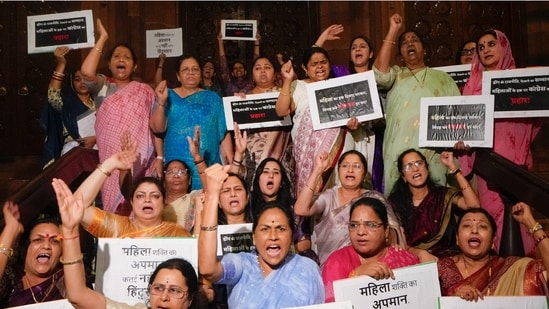
For the INDIA bloc, halting the amendment is being celebrated as a massive moral and strategic victory. Opposition leaders addressed the media shortly after the vote, framing their opposition not as a rejection of women’s rights, but as a defense of marginalized communities and federalism.
They argued that the government was attempting to use a noble cause—women’s representation—as a Trojan horse to push through a highly controversial delimitation agenda that would disenfranchise the South. By maintaining a united front and capitalizing on the NDA’s internal anxieties, the opposition has successfully stalled a major pillar of the BJP’s mid-term legislative agenda.
“The government thought they could bypass the legitimate demands of the OBC community by rushing this amendment,” an opposition spokesperson stated. “The floor of the Lok Sabha has reminded them that consensus, not unilateral bulldozing, is the foundation of democracy.” [Additional: Political Statements Record, April 2026]
## What Next? The BJP’s Available Options
With the ambitious three-bill framework discarded, the Modi government faces a narrow set of choices moving forward.
**1. Return to the Original Timeline:**
The most likely scenario is that the government falls back on the original provisions of the 2023 Nari Shakti Vandan Adhiniyam. This means abandoning the fast-track plan and waiting for the official decadal Census (which has faced unprecedented delays) to be completed, followed by a constitutionally mandated Delimitation Commission. This pushes the implementation of the women’s quota well past the upcoming state elections, likely deferring it to the 2029 or even 2034 General Elections.
**2. Send to a Joint Parliamentary Committee (JPC):**
To save face and keep the legislative momentum alive, the government could redraft the bills and immediately refer them to a JPC. This would allow for extensive consultation with opposition parties and regional allies to negotiate an acceptable middle ground—perhaps guaranteeing a freeze on total seat allocations to appease Southern states, or reconsidering the OBC sub-quota.
**3. Piecemeal Electoral Reforms:**
Rather than a sweeping constitutional amendment, the government might attempt to introduce smaller, non-constitutional electoral reforms requiring only a simple majority. However, this would not fulfill the core promise of legally mandated gender parity in the legislature.
## Implications for Women Voters
The most tragic casualty of this political maneuvering is the delayed empowerment of female voters and political aspirants. The promise of 33% reservation was hailed as a historic milestone in 2023, generating immense goodwill among female voters—a demographic that has heavily favored the BJP in recent electoral cycles.
The failure of the April 2026 amendment sends a frustrating signal to grassroots women leaders who were preparing for imminent electoral opportunities. It highlights a bitter reality of Indian policymaking: even universally lauded reforms can become collateral damage when entangled with the complex fault lines of caste dynamics and regional power struggles.
## Conclusion
The defeat of the Modi government’s amendment to the women’s quota law is more than a mere procedural hiccup; it is a defining moment of the current parliamentary term. By confirming the withdrawal of the “intrinsically interrelated” companion bills, Minister Kiren Rijiju has acknowledged the stark limits of executive power in an era of coalition dependence. [Source: Hindustan Times]
As the dust settles in the Lok Sabha, the BJP must now return to the drawing board. Whether they choose the path of broad-based consensus building or resign themselves to the painfully slow timeline of the 2023 Act, the immediate dream of rapid, revolutionary gender parity in the Indian parliament has been decisively put on hold. All eyes will now turn to how the Prime Minister responds to this challenge, and whether a genuinely inclusive compromise can be forged from the ashes of this weekend’s legislative failure.