
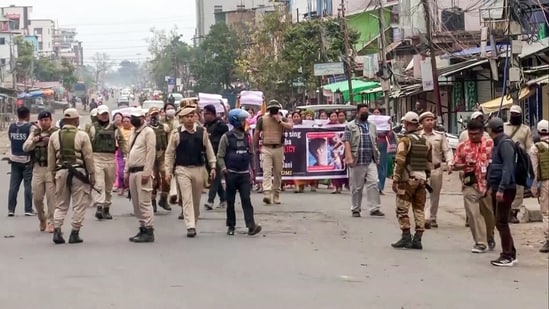
21 injured in fresh clashes in Manipur's Bhishnupur, two vehicles set ablaze| India News
# 21 Injured in Fresh Manipur Clashes in Bishnupur
**By Special Correspondent, National News Desk**
**Published: April 15, 2026**
Tensions resurfaced in Manipur’s Bishnupur district on Wednesday afternoon, leaving at least 21 people injured and two vehicles destroyed by fire. The latest unrest erupted when groups of local residents intercepted three private vehicles carrying state police personnel dressed in civilian clothing. Mistaking the plainclothes officers for armed miscreants amidst the region’s highly fragile security environment, paranoid crowds confronted the convoy. What began as a tense verbal standoff rapidly escalated into a physical altercation, prompting district authorities to deploy rapid response teams, fire tear gas, and enforce strict crowd-control measures to restore order in the highly sensitive northeastern state [Source: Hindustan Times].
## The Anatomy of the Escalation
The incident underscores the deeply entrenched paranoia that continues to dictate daily life in Manipur nearly three years after widespread ethnic violence first fractured the state in May 2023. According to preliminary reports, the confrontation occurred along a critical arterial route in Bishnupur, a district that has historically served as a geographical and cultural fault line between the central valley and the surrounding hill ranges.
Law enforcement personnel, reportedly traveling on an undisclosed administrative assignment, were moving in three unmarked private vehicles. They were not wearing their official uniforms, a tactical decision often made to maintain a low profile in volatile areas. However, local civilian defense committees—informal groups of residents who have taken it upon themselves to monitor vehicular movement in their neighborhoods—flagged the convoy down.
When the occupants failed to immediately produce recognizable identification or adequately explain their presence, panic ensued. The locals, operating under the constant fear of sudden incursions by armed groups, reacted defensively. The mob quickly swelled in numbers, completely surrounding the vehicles. In the ensuing chaos, clashes broke out between the plainclothes police and the civilians. Before official reinforcements could secure the perimeter, two of the three private vehicles were overturned and set ablaze.
## Immediate Response and Medical Status
The district administration’s response was swift, necessitated by the rapid deterioration of law and order. Heavily armed units from the Central Armed Police Forces (CAPF) and the Manipur State Police were immediately dispatched to the site. To disperse the agitated crowds and prevent the violence from spilling over into neighboring localities, security forces employed standard non-lethal crowd-control tactics, including the deployment of tear gas and baton charges.
Medical emergency services reported that 21 individuals sustained injuries during the skirmish. The injured comprise a mix of local civilians and the plainclothes police officers who were inside the vehicles.
* **Nature of Injuries:** Most injuries reported are non-life-threatening, primarily consisting of blunt force trauma, lacerations, and respiratory distress caused by the inhalation of tear gas.
* **Medical Care:** The injured were swiftly transported to the Bishnupur District Hospital and primary health centers in the vicinity. Four individuals requiring specialized care for severe lacerations were transferred to advanced medical facilities in Imphal.
* **Current Situation:** As of late Wednesday evening, local authorities have imposed Section 144 of the CrPC, prohibiting the assembly of four or more persons, to prevent further retaliatory violence.
## The Persistent Trust Deficit Between Civilians and the State
The root cause of Wednesday’s violence cannot be viewed in isolation. It is a direct symptom of the severe trust deficit that continues to plague Manipur. In post-conflict zones, the presence of unidentified men in unmarked vehicles is a known catalyst for public panic.
Over the past few years, civilians across various districts in Manipur have organized vigilante checkpoints. These grassroots security measures were born out of a collective perception that formal state security apparatuses were either inadequate, overstretched, or fundamentally biased. Consequently, any movement of personnel that circumvents standard, highly visible security protocols is met with extreme suspicion.
“The incident in Bishnupur is a textbook example of how communication gaps and deep-seated paranoia can inadvertently ignite violence in regions experiencing prolonged sociopolitical stress,” explains Dr. Meenakshi Baruah, a prominent geopolitical analyst specializing in Northeast Indian affairs and internal security dynamics. “When civilians feel compelled to act as border guards within their own state, the psychological threshold for violence drops significantly. A simple misunderstanding regarding plainclothes officers can escalate into a riot within minutes.” [Source: Independent Expert Analysis, 2026].
## Security Protocols: The Risks of Covert Operations
The deployment of plainclothes officers in volatile zones presents a complex operational dilemma for law enforcement agencies. On one hand, unmarked vehicles and civilian clothing allow intelligence operatives and administrative personnel to move without drawing the attention of armed insurgent groups. On the other hand, in a deeply polarized society where rumors spread rapidly, such tactics can trigger the exact unrest they aim to avoid.
Security experts argue that incidents like the one in Bishnupur necessitate an immediate overhaul of Standard Operating Procedures (SOPs) for the movement of security personnel.
**Recommended SOP Revisions for Sensitive Zones:**
| Operational Aspect | Current Practice | Proposed Protocol |
| :— | :— | :— |
| **Identification** | Kept concealed until challenged. | Officers must carry prominent, universally recognized digital and physical ID cards verified by local command centers. |
| **Convoy Movement** | Use of private vehicles without prior notification. | Mandatory pre-clearance with local community leaders or local uniformed police stations before transit through civilian buffer zones. |
| **De-escalation** | Reactive use of force or reliance on reinforcements. | Specialized training in verbal de-escalation and crisis negotiation with civilian defense committees. |
The failure to communicate the movement of these plainclothes officers to the local uniformed police stations—a protocol meant to prevent friendly fire and civilian panic—is currently the subject of an internal departmental inquiry.
## Historical Backdrop: A Fragile Peace Disrupted
To comprehend the sheer volatility of Bishnupur, one must contextualize it within Manipur’s broader historical landscape. The state witnessed unprecedented ethnic clashes beginning in May 2023, fundamentally altering its demographic and administrative geography. The violence resulted in widespread displacement, the creation of rigid “buffer zones” between different communities, and the heavy militarization of civilian spaces.
While the large-scale violence of 2023 and 2024 eventually subsided, yielding to a tense and heavily policed peace by 2025, the underlying structural issues remain largely unresolved. Sporadic outbreaks of violence, such as Wednesday’s clash, highlight the precariousness of this peace. Bishnupur, sharing borders with multiple hill districts, has frequently been a flashpoint.
The central and state governments have spent the last three years attempting to bridge the divide through Unified Command structures and peace committees. However, the psychological scars of the conflict mean that reconciliation remains a distant reality. Communities remain highly insular, and the economy has suffered immense setbacks due to frequent highway blockades, internet shutdowns, and the stalling of cross-border trade.
## Socio-Economic Ramifications of Prolonged Unrest
Every fresh outbreak of violence, no matter how localized, sends shockwaves through Manipur’s already fragile economy. The burning of vehicles and the subsequent imposition of curfews disrupt vital supply chains. Bishnupur is a crucial transit route for agricultural produce and essential commodities.
When clashes occur, transport unions frequently suspend operations, leading to an immediate spike in the prices of basic goods in local markets. Furthermore, the persistent threat of violence takes a heavy toll on the educational sector. Schools and colleges are forced to shut down during flare-ups, severely impacting the academic progress and mental health of the youth.
“We are constantly living on the edge,” stated a local trader from Bishnupur, requesting anonymity for safety reasons. “We had hoped that 2026 would bring normalcy, but incidents like these remind us that the fire has not been extinguished; it is merely smoldering beneath the surface. Our businesses cannot survive this perpetual state of emergency.”
## Government Interventions and the Path Forward
In the aftermath of the Bishnupur incident, the Ministry of Home Affairs (MHA) has reportedly requested a detailed briefing from the state administration regarding the breakdown in security protocols. To prevent a ripple effect across other districts, additional companies of the Rapid Action Force (RAF) have been placed on high alert.
However, security deployments are merely band-aids on a deeper wound. Sustainable peace in Manipur requires moving beyond militarized crowd control to addressing the fundamental crisis of governance and trust.
**Key Interventions Required:**
* **Community Policing Initiatives:** Rebuilding trust requires transparent interactions. Law enforcement must integrate community leaders into their security planning, ensuring that civilian checkpoints do not operate in a vacuum but in coordination with local authorities.
* **Strict Accountability:** The internal inquiry into why plainclothes officers were moving in private vehicles without local coordination must be transparent. Holding the administrative machinery accountable is crucial to regaining public faith.
* **Psychological Rehabilitation:** The state must invest heavily in trauma counseling and psychological rehabilitation for communities that have lived in a state of high alert for years.
## Conclusion
The clash in Manipur’s Bishnupur district on Wednesday, which left 21 injured and two vehicles ablaze, is a stark reminder of the enduring volatility in the region. What started as a misidentification of plainclothes police officers quickly unraveled into a chaotic confrontation, fueled by years of mistrust, fear, and unresolved grievances [Source: Hindustan Times].
While security forces have successfully stabilized the immediate situation, the underlying currents of paranoia remain dangerously active. For true normalcy to return to Manipur, both the state apparatus and the civil society must engage in a grueling, transparent, and empathetic process of rebuilding trust. Until the residents feel intrinsically secure in their homes and on their roads, the shadow of sudden violence will continue to loom large over the northeastern state.





