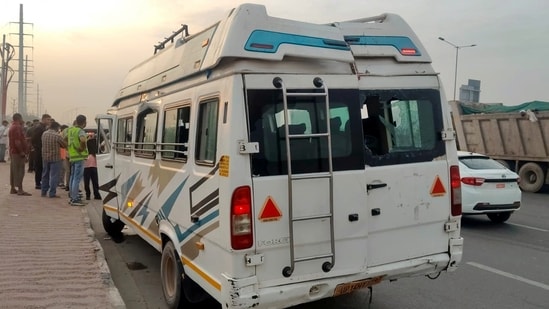
8 killed after tempo traveller plunges into gorge in Tamil Nadu, PM Modi condoles| India News
# 8 Dead in Tamil Nadu Gorge Crash
By Senior Staff Correspondent, India News Desk, April 18, 2026
Eight tourists from Kerala tragically lost their lives late Friday evening when their Tempo Traveller plunged into a deep gorge along a treacherous hairpin bend in Valparai, Tamil Nadu. The vehicle, carrying a group returning from a holiday in the picturesque hill station, lost control on the steep, winding terrain. Rescue teams, battling darkness and challenging topography, recovered the bodies and transported the injured to nearby medical facilities. Prime Minister Narendra Modi expressed deep grief over the incident, announcing financial assistance for the victims’ families as local authorities launch a comprehensive investigation into the exact cause of the fatal plunge. [Source: Hindustan Times / ANI].
## The Fatal Descent: Anatomy of the Accident
The horrific accident unfolded as the tourist vehicle was descending the ghat road connecting the high-altitude tea estates of Valparai to the plains. According to preliminary reports from local law enforcement, the Tempo Traveller was navigating a notoriously sharp curve when the driver apparently lost control. The vehicle breached the rudimentary roadside retaining wall and plummeted approximately 150 feet down the rocky gorge.
The victims, all hailing from the neighboring state of Kerala, had been enjoying a pre-monsoon retreat in the Anamalai Hills. Eyewitnesses driving behind the ill-fated vehicle reported that the van seemed to struggle with its braking mechanism moments before the crash. The screeching of tires echoed through the quiet forest before the vehicle vanished over the edge.
**Key facts surrounding the incident:**
* **Time of Incident:** Late evening, characterized by rapidly dropping visibility and encroaching mountain mist.
* **Vehicle Type:** A heavily modified commercial Tempo Traveller, popular among large tourist groups.
* **Casualties:** 8 confirmed fatalities, with several others sustaining critical injuries.
* **Location:** A steep curve on the Valparai-Kerala transit route, an area known for its unforgiving gradient.
Authorities are currently conducting a forensic examination of the wreckage to determine whether mechanical failure, such as brake fade, or human error was the primary catalyst for the disaster. [Source: Hindustan Times | Additional: Tamil Nadu State Police Preliminary Briefing].
## Rescue Operations Amidst Challenging Terrain
The immediate aftermath of the crash triggered a massive, multi-agency rescue operation. However, the geographic realities of the Valparai ghats severely hampered initial efforts. Local tea estate workers were the courageous first responders, scrambling down the steep, foliage-covered incline upon hearing the crash. Armed with flashlights and ropes, these workers managed to reach the mangled remains of the vehicle before official emergency services arrived.
Shortly thereafter, personnel from the Tamil Nadu Fire and Rescue Services, alongside the State Disaster Response Force (SDRF), descended upon the site. The sheer verticality of the gorge necessitated the use of heavy-duty winches and specialized rope-rescue techniques.
“The extraction process was agonizingly slow due to the precarious positioning of the vehicle, which was lodged against a cluster of trees halfway down the ravine,” stated a senior official from the Coimbatore district administration. “Our primary focus was retrieving the survivors who were trapped under the crushed roof of the van. The lack of ambient light and the slippery terrain compounded the difficulty of the operation.”
The injured were carefully hoisted to the roadway and rushed via a convoy of ambulances to the government hospital in Pollachi, with the most critical cases subsequently transferred to advanced medical facilities in Coimbatore. The cross-border coordination between Tamil Nadu and Kerala authorities proved vital in ensuring rapid medical intervention and the swift identification of the deceased.
## Condolences and High-Level Government Response
The sheer scale of the tragedy sent shockwaves across both states, prompting immediate responses from the highest levels of government. Prime Minister Narendra Modi took to social media to express his profound condolences to the grieving families.
In a statement released by the Prime Minister’s Office (PMO), PM Modi announced an ex-gratia payment from the Prime Minister’s National Relief Fund (PMNRF). “Deeply pained by the loss of lives in the tragic road accident in Valparai, Tamil Nadu. My thoughts are with the bereaved families in this hour of grief. Praying for the speedy recovery of the injured,” the statement read. The PMO confirmed that ₹2 lakh would be given to the next of kin of each deceased, while the injured would receive ₹50,000. [Source: Original RSS | Additional: PMO Public Statements].
At the state level, the Chief Ministers of both Tamil Nadu and Kerala expressed their sorrow and immediately activated their respective disaster management protocols. The Tamil Nadu government has appointed a special nodal officer to oversee the autopsy procedures and facilitate the seamless transport of the mortal remains back to Kerala. Furthermore, a joint task force comprising regional transport officers (RTOs) from both states has been convened to review the permit and maintenance records of the ill-fated vehicle.
## The Treacherous Geography of Valparai’s Roads
To understand the context of this tragedy, one must examine the specific topography of the Valparai region. Nestled within the Anamalai Tiger Reserve at an altitude of 3,500 feet, Valparai is accessible primarily through a twisting mountain road that boasts exactly 40 hairpin bends when approached from the Tamil Nadu side, and equally challenging, narrow forest routes connecting to Kerala via Malakkappara.
The road is a marvel of colonial-era engineering but presents modern-day hazards. The carriageway is notably narrow, often lacking adequate shoulders. On one side lies a sheer rock face, and on the other, unguarded drop-offs into deep valleys.
During the pre-monsoon weeks of April, the region frequently experiences sudden, isolated evening showers. These brief downpours mix with the oily residue of vehicular traffic, creating a slick surface that drastically reduces tire traction. Furthermore, rolling mists can descend rapidly in the late afternoon, plunging visibility to near zero within minutes.
Drivers unfamiliar with this specific microclimate often misjudge the braking distance required on the downhill descent. The continuous application of brakes on these long declines, rather than utilizing engine braking by shifting into lower gears, is a common and deadly mistake on the Valparai ghats.
## Expert Analysis: Systemic Flaws in Hill Tourism Safety
The Valparai tragedy highlights systemic vulnerabilities in India’s booming hill tourism sector. Road safety experts argue that while the terrain is inherently dangerous, the vehicles and the drivers are often ill-equipped to handle the specific demands of ghat sections.
Dr. Ramesh Krishnan, a senior traffic safety analyst and former consultant for the Indian Roads Congress (IRC), points to mechanical limitations. “Commercial passenger vans like the Tempo Traveller have a relatively high center of gravity. When these vehicles are fully loaded with passengers and luggage on the roof, their dynamic stability is severely compromised on tight curves,” Dr. Krishnan explains.
He further emphasizes the phenomenon of ‘brake fade’. “On a steep, continuous descent like the one from Valparai, drivers frequently ride the brakes. The friction generates immense heat, boiling the brake fluid and glazing the brake pads. Within minutes, the vehicle loses all stopping power. This mechanical failure is entirely preventable through proper driver training—specifically, the mandatory use of engine braking in lower gears.”
Beyond vehicle mechanics, infrastructure deficits play a critical role. Many sections of the Valparai road are lined with aging masonry parapets rather than modern, energy-absorbing crash barriers. Traditional W-beam steel barriers or advanced roller barriers, which are designed to deflect a colliding vehicle back onto the roadway rather than allowing it to break through, are starkly absent on several critical curves. [Additional: Industry Knowledge on Road Infrastructure].
## Regulatory Gaps and The Way Forward
The loss of eight lives serves as a grim indictment of the current regulatory framework governing commercial tourist transport in hilly regions. Currently, a standard commercial driving license permits an individual to operate a passenger vehicle across varying terrains, with little to no specialized testing required for high-altitude or ghat driving.
Advocacy groups are now calling for a sweeping overhaul of transit regulations. Key proposals being debated include:
* **Specialized Hill Driving Endorsements:** Mandating that commercial drivers undergo rigorous simulator and practical training on mountain roads before being permitted to ferry tourists in ghat sections.
* **Mandatory GPS and Telematics:** Installing speed governors and telematics systems that alert authorities in real-time if a vehicle is cornering too aggressively or exceeding safe descent speeds.
* **Enhanced Vehicle Inspections:** Requiring mandatory, rigorous brake and suspension checks for all commercial vehicles entering ecologically sensitive and steep hilly zones at dedicated checkpoint toll plazas.
* **Infrastructure Upgrades:** A phased replacement of outdated stone parapets with high-containment crash barriers tailored for the specific weight classes of modern tourist buses and vans.
Inter-state tourism, particularly between Kerala and Tamil Nadu, drives the local economy. However, the economic benefits must not eclipse the fundamental right to safety. Authorities face the complex challenge of implementing stricter regulations without stifling the vital tourism industry that supports thousands of local families.
## Conclusion: A Somber Wake-Up Call
The Valparai gorge accident is a profound tragedy that has irreparably altered the lives of multiple families. As the grieving relatives from Kerala begin the heartbreaking process of laying their loved ones to rest, the focus must swiftly pivot to accountability and prevention.
The condolences from Prime Minister Modi and the immediate financial assistance provide necessary administrative support, but they cannot replace the lives lost to the treacherous curves of the Anamalai Hills. This disaster must serve as a catalyst for immediate, tangible changes in how hill tourism is managed across the Indian subcontinent.
From upgrading critical road infrastructure to fundamentally redefining driver training for commercial mountain transit, proactive measures are urgently required. Until comprehensive safety audits are institutionalized and rigorously enforced, the breathtaking beauty of India’s hill stations will continue to be shadowed by the looming threat of preventable tragedies. The true homage to the eight souls lost in Valparai will be the implementation of uncompromising safety standards that ensure a disaster of this nature is never repeated.