
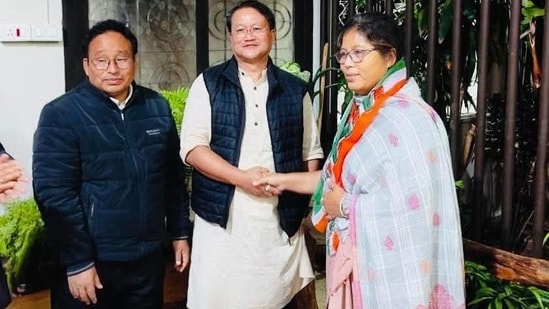
BJP minister Nandita Gorlosa joins Congress day before Assam nomination deadline; to contest from Halflong| India News
Haflong’s Electoral Shift BJP Selects New Face
The political landscape of Haflong, the scenic district headquarters of Dima Hasao, is witnessing a significant churn as the Bharatiya Janata Party (BJP) has opted for a fresh face, Rupali Langthasa, sidelining sitting MLA Nandita Gorlosa. This decision, part of a broader strategy by the party to introduce new candidates in several constituencies, has sparked considerable discussion among local political observers and the electorate alike. The move highlights the intricate calculations and evolving dynamics at play in the upcoming elections across Assam.
Nandita Gorlosa, who has represented the Haflong constituency with the BJP ticket, had been a prominent voice for the Dima Hasao district. Her tenure saw various developmental initiatives being championed, aiming to address the unique challenges and aspirations of the region’s diverse communities. From infrastructure projects to social welfare schemes, Gorlosa’s presence in the assembly was often linked to the forward momentum of the hill district. For many constituents, her denial of a ticket came as an unexpected turn, prompting questions about the criteria behind the party’s selection process. Local party workers and supporters had anticipated her renomination, given her active engagement and established connect with the voters. Her political journey in Haflong had woven her into the fabric of local governance and community representation.
Stepping into this politically charged environment is Rupali Langthasa, the BJP’s chosen candidate. While perhaps a newer face to the mainstream electoral battle in Haflong compared to her predecessor, Langthasa brings her own set of strengths and a potentially different appeal to the electorate. Her selection is indicative of the BJP’s strategic thinking to possibly inject new energy, address potential anti-incumbency sentiments, or align with shifting demographic preferences within the constituency. Local reports suggest Langthasa has been active in community work and party organizational roles, quietly building a base that the central leadership has now recognized as a potent force. Her background and community ties will be crucial in mobilizing support in a constituency known for its complex ethnic and cultural tapestry.
The BJP’s decision to drop several sitting legislators, including Gorlosa, is not an isolated incident but rather a calculated political maneuver witnessed across various states in India. Parties often undertake internal surveys to gauge public sentiment, evaluate incumbent performance, and identify potential voter fatigue. The aim is to mitigate any anti-incumbency wave by fielding candidates perceived as fresh, dynamic, or possessing a stronger local appeal. This strategy, while sometimes risky, is designed to keep the electoral battleground vibrant and to present an image of a party committed to rejuvenation and responsiveness. In Haflong’s context, it could mean a focus on issues that a new candidate might champion more effectively or connecting with segments of the population that feel underrepresented.
For the average resident of Haflong, a constituency that includes diverse communities like Dimasas, Hmars, Khasis, and others, this change poses both opportunities and uncertainties. Voters will now scrutinize Rupali Langthasa’s vision for Haflong, comparing it with the legacy of Nandita Gorlosa and the promises of other contending parties. The political discourse will likely shift towards issues of tribal rights, sustainable development, connectivity, and employment opportunities, all critical in a district like Dima Hasao. The challenge for Langthasa will be to quickly build rapport with an electorate that might have been accustomed to the previous leadership, while also consolidating her own support base. For the BJP, the move is a gamble that hinges on the new candidate’s ability to galvanize voters and the party’s organizational strength to back her fully.
This electoral development in Haflong is more than just a change of candidate; it reflects the ongoing evolution of political strategies in the Northeast. Omni 360 News is closely monitoring how this decision will resonate with the voters and shape the eventual outcome in this crucial hill constituency, providing a ground-level perspective on these significant shifts. The coming weeks will undoubtedly see intensified campaigning as Rupali Langthasa seeks to win the trust of Haflong, while other parties aim to capitalize on any perceived disgruntlement. The intricate dance of democracy continues, with each strategic move having profound implications for the local populace.
Key Takeaways:
* The BJP has replaced sitting Haflong MLA Nandita Gorlosa with Rupali Langthasa.
* This is part of a broader BJP strategy to field new candidates, possibly to counter anti-incumbency or introduce fresh leadership.
* Nandita Gorlosa had an established tenure focused on local development in Dima Hasao.
* Rupali Langthasa, the new candidate, will need to quickly build rapport and articulate her vision to Haflong’s diverse electorate.
* The decision underscores the strategic calculations within political parties ahead of elections, with local sentiment and community dynamics playing a vital role in Haflong’s unique political landscape.





