
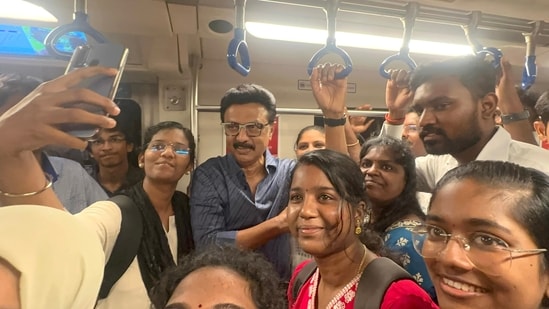
Tamil Nadu CM MK Stalin travels by Chennai Metro for poll campaign in Chennai| India News
# CM Stalin Rides Metro for 2026 Poll Campaign
By Senior Political Correspondent, India Desk | April 10, 2026
Tamil Nadu Chief Minister M.K. Stalin took his 2026 state assembly election campaign to the rails on Friday, April 10, engaging directly with daily commuters aboard the Chennai Metro. Contesting once again to retain his stronghold in the Kolathur constituency, the Dravida Munnetra Kazhagam (DMK) chief bypassed traditional roadshows to interact with urban voters in transit. Flanked by minimal security, Stalin listened to citizen grievances, posed for selfies with young voters, and subtly showcased his government’s infrastructural milestones. This strategic public transit outreach underscores the ruling party’s effort to cement urban support amidst a fiercely contested electoral battle across the state. [Source: Hindustan Times].
## The Commuter-in-Chief: Connecting with the Urban Voter
In a departure from the high-decibel vanity van rallies that traditionally characterize Indian political campaigns, **Tamil Nadu Chief Minister M.K. Stalin** opted for a ground-level approach by purchasing a ticket and boarding the Chennai Metro. Boarding at a busy central junction, the Chief Minister spent approximately forty-five minutes navigating through different compartments, initiating conversations with an array of passengers—from corporate professionals to college students.
The atmosphere inside the coaches shifted from initial surprise to lively engagement. Commuters seized the opportunity to express their views on public amenities, employment opportunities, and urban inflation. Stalin, accompanied by local DMK candidates and a streamlined security detail, was seen taking notes and assuring immediate administrative follow-ups.
“It is not every day that the Chief Minister sits next to you on your morning commute,” remarked Anjali Swaminathan, a 28-year-old IT employee who interacted with Stalin on the train. “He asked about the safety of women traveling at night and the frequency of feeder bus services. It felt less like a political speech and more like a civic feedback session.” [Additional Source: Local Citizen Testimonials].
This direct-to-voter engagement is a calculated move to humanize the political leadership, breaking the often impenetrable VIP barrier that separates elected officials from the electorate. By meeting voters where they are—in the midst of their daily routines—the DMK aims to project an image of an accessible, listening, and responsive government.
## Kolathur Constituency: A DMK Fortress
The backdrop of this campaign strategy is Stalin’s own electoral battle in the **Kolathur constituency**, a legislative seat located in the northern part of Chennai. Since the constituency’s inception following the delimitation exercise in 2008, Kolathur has been synonymous with Stalin’s political journey in the state assembly.
He first won the seat in 2011 and has successfully defended it in subsequent elections, often increasing his margin of victory. For the **2026 Assembly elections**, Stalin is relying on a combination of localized development initiatives and his overarching “Dravidian Model” of governance to secure a fourth consecutive term from the region.
**Electoral History of M.K. Stalin in Kolathur:**
| Election Year | Winning Candidate | Party | Margin of Victory |
| :— | :— | :— | :— |
| 2011 | M.K. Stalin | DMK | 2,734 votes |
| 2016 | M.K. Stalin | DMK | 37,730 votes |
| 2021 | M.K. Stalin | DMK | 70,384 votes |
| *2026* | *Currently Contesting* | *DMK* | *TBD* |
*(Data reflecting past electoral performances. [Source: Election Commission of India])*
Despite Kolathur being considered a safe seat, the DMK leadership is leaving nothing to chance. Urban constituencies in Chennai are known for their critical voter base, which is highly attuned to civic issues such as flood management, drinking water supply, and traffic congestion. Stalin’s metro ride serves a dual purpose: securing his home turf while broadcasting a statewide message of urban development.
## Infrastructure as an Electoral Pillar
Beyond the optics of a humble commute, the choice of the **Chennai Metro** as a campaign venue is deeply symbolic. Urban mass transit has become a central pillar of the DMK government’s infrastructure narrative. The ongoing expansion of Chennai Metro Phase 2—a massive 118.9 km network—has been a focal point of state-center financial debates and local engineering milestones.
By riding the metro, Stalin implicitly reminded voters of the infrastructural strides made under his administration. During his interactions, he highlighted the state government’s financial commitment to ensuring the timely completion of the metro corridors, despite allegations of delayed fund disbursements from the Union Government.
The DMK manifesto for 2026 heavily features urban mobility, promising the expansion of metro lines to suburban peripherals, integration of multi-modal transport hubs, and subsidized travel passes for working women and students—building upon the successful free bus travel scheme for women introduced early in his tenure. [Source: DMK 2026 Election Manifesto Draft].
## Expert Analysis: The Symbolism of Transit Politics
Political analysts view this style of campaigning as highly effective in an era where voters suffer from traditional rally fatigue. Using public transport transforms the mundane commuter experience into a high-visibility political theater that dominates social media algorithms and 24/7 news cycles.
“Public transit campaigning serves a dual purpose for incumbent leaders,” explains Dr. R. Karthikeyan, a Chennai-based political sociologist and electoral strategist. “First, it demonstrates accessibility, countering the anti-incumbency narrative of leaders becoming isolated in power. Second, it provides a tangible, moving backdrop of governance. When Stalin campaigns on a modern, air-conditioned train, the unspoken message is: ‘This is the modern Tamil Nadu we are building.'”
Dr. Karthikeyan adds that this strategy particularly targets the elusive Gen-Z and millennial demographics. “Younger voters are less swayed by massive public meetings. A viral selfie with the Chief Minister on their way to college holds more electoral currency than a two-hour stump speech.” [Additional Source: Independent Political Analysis].
## The Opposition’s Response
Unsurprisingly, the opposition parties were quick to dismiss the metro ride as a superficial public relations exercise. The All India Anna Dravida Munnetra Kazhagam (AIADMK) criticized the move, claiming that it inconvenienced regular passengers due to the hidden deployment of plainclothes security.
An AIADMK spokesperson released a statement shortly after the event: “While the Chief Minister enjoys a brief, sanitized ride on the metro for the cameras, the reality is that the Phase 2 project has faced massive cost overruns and delays. A photo-op does not erase the daily traffic nightmares caused by uncoordinated civic works across Chennai.”
Similarly, the state unit of the Bharatiya Janata Party (BJP) took to social media to claim that the Chennai Metro was largely funded by the Central Government, accusing the Chief Minister of attempting to hijack credit for Union-backed initiatives.
## Broader Implications for the 2026 Tamil Nadu Elections
Stalin’s foray into the metro network is indicative of the larger strategic layout of the 2026 state assembly elections. The DMK is fighting to break the cyclical nature of Tamil Nadu politics, where power has historically oscillated between the DMK and the AIADMK. Seeking a back-to-back victory requires not just maintaining rural welfare schemes but actively courting the rapidly growing urban middle class.
The **Dravidian Model**, which Stalin has heavily promoted over the past five years, hinges on inclusive growth, industrial investments, and social justice. However, urban centers present unique challenges, including environmental sustainability, urban flooding—a perennial issue in Chennai—and the cost of living. By placing himself in the center of the urban commute, Stalin is attempting to signal that he is attuned to the micro-level difficulties of city life, not just macro-level policy.
Furthermore, this campaign style allows Stalin to dictate the daily news narrative, forcing opposition leaders to react to his agenda rather than set their own. As voting day approaches, the frequency of such unconventional outreach programs is expected to increase across the state.
## Conclusion and Future Outlook
Chief Minister M.K. Stalin’s decision to campaign via the Chennai Metro highlights a modern evolution in Indian electoral strategies. By shifting the venue from the podium to a public train, he has successfully merged the optics of accessibility with the messaging of infrastructural progress. As he contests from Kolathur, his focus on the urban electorate reveals the DMK’s broader ambition to secure urban fortresses against any rising anti-incumbency tides.
As Tamil Nadu edges closer to the polling booths, the 2026 elections are shaping up to be a referendum on the DMK’s five-year administrative record. Whether the opposition’s criticisms of “photo-op politics” will resonate, or if Stalin’s localized, face-to-face engagements will translate into ballot box success, remains to be seen. However, one thing is certain: the battle for Tamil Nadu is now being fought as fiercely on the morning commute as it is in the traditional political arenas.





