
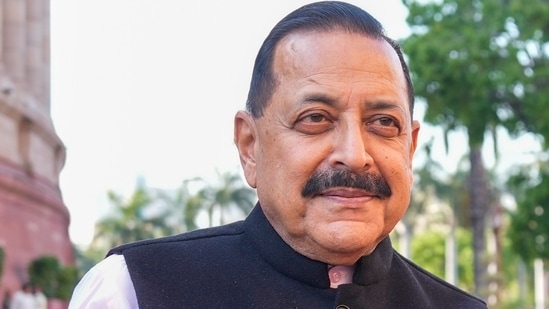
Union minister Jitendra Singh congratulates ISRO on successful completion of IADT-02 Gaganyaan test| India News
# ISRO Aces Gaganyaan IADT-02 Test
By Science Correspondent, Space & Science Desk | April 10, 2026
Union Minister of State for Space Dr. Jitendra Singh congratulated the Indian Space Research Organisation (ISRO) on Friday, April 10, 2026, following the flawless execution of the Integrated Air Drop Test-02 (IADT-02). Conducted at the Satish Dhawan Space Centre (SDSC) in Sriharikota, the crucial trial validated the complex parachute deployment sequence necessary for the safe recovery of the Gaganyaan crew module. This landmark achievement directly paves the way for India’s highly anticipated inaugural manned spaceflight, demonstrating critical safety redundancies and cementing the reliability of indigenous atmospheric re-entry technologies.
## Decoding the IADT-02 Milestone
The Integrated Air Drop Test is a non-negotiable prerequisite in human spaceflight, designed to simulate the final, most perilous phase of a spacecraft’s journey: atmospheric deceleration and oceanic splashdown. During the IADT-02, an unpressurized, fully instrumented mock-up of the **Gaganyaan Crew Module (CM)**, matching the exact mass and aerodynamic profile of the actual flight module, was hoisted by an Indian Air Force heavy-lift helicopter to an altitude of roughly 4.5 kilometers before being released into a free-fall.
As the multi-ton module plummeted toward the Bay of Bengal, a meticulously timed sequence of pyrotechnic mortars fired, deploying a succession of parachutes to arrest the module’s velocity. Unlike standard drop tests, IADT-02 was specifically engineered to test **off-nominal conditions**, simulating potential sensor failures and asymmetrical aerodynamic loads to ensure the autonomous recovery algorithms could adapt in real-time.
“The success of IADT-02 proves that our deceleration architecture is not just functional, but resilient against the unpredictable variables of atmospheric re-entry,” noted Dr. Rajesh Menon, an independent aerospace deceleration specialist. “When human lives are aboard, the margin for error is absolute zero. Today’s test confirmed that ISRO’s redundant safety protocols operate exactly as mathematically modeled.”
## Union Minister Lauds Indigenous Innovation
Following the successful splashdown and retrieval of the test module, Union Minister Dr. Jitendra Singh took to public platforms to commend the dedication of the ISRO engineering teams. He emphasized that the Gaganyaan program is the crown jewel of India’s *Atmanirbhar Bharat* (Self-Reliant India) initiative, as the vast majority of the mission’s critical components—from the launch vehicle to the environmental control systems—are domestically designed and manufactured.
The Minister’s remarks highlighted the collaborative ecosystem driving the mission. The parachute deceleration system is a joint triumph between ISRO and the **Aerial Delivery Research and Development Establishment (ADRDE)**, a premier laboratory under the Defence Research and Development Organisation (DRDO).
[Source: Original RSS via Hindustan Times | Additional: Public records of ISRO-DRDO Gaganyaan collaborations up to April 2026]
## From August 2025 to April 2026: The Evolutionary Leap
The execution of IADT-02 builds directly upon the foundational data gathered during the preceding test. **The IADT-02 follows the successful completion of the first such test (IADT-01) conducted on August 24, 2025, at the Satish Dhawan Space Centre.**
While IADT-01 was fundamentally a proof-of-concept for the basic parachute deployment sequence under ideal weather conditions, IADT-02 raised the stakes significantly. Engineers introduced simulated anomalies into the test parameters. By intentionally delaying the deployment of specific pilot chutes and testing the system’s response to induced lateral spin, ISRO gathered invaluable telemetry on the structural integrity of the main parachute canopies under elevated stress loads.
The telemetry data harvested from the August 2025 test allowed software engineers to refine the firing algorithms of the pyrotechnic deployment mortars, ensuring a smoother transition between the drogue and main parachute phases. This iterative testing philosophy is a hallmark of ISRO’s cautious, data-driven approach to human spaceflight.
## Anatomy of the Gaganyaan Deceleration System
To understand the complexity of the IADT-02 test, one must examine the intricate choreography of the Gaganyaan Crew Module Deceleration System (CMDS). The system comprises a network of **10 distinct parachutes**, woven from highly durable, custom-engineered Kevlar and specialized nylon blends designed to withstand immense kinetic friction and thermal shock.
The deceleration sequence tested during IADT-02 unfolds in four critical stages:
1. **Apex Cover Separation:** Two protective covers are jettisoned using redundant apex cover separation parachutes.
2. **Drogue Deployment:** Twin drogue parachutes deploy to stabilize the module’s attitude and rapidly bleed off the initial supersonic re-entry velocity.
3. **Pilot Parachute Firing:** Three pilot chutes are fired to extract the massive main canopies.
4. **Main Canopy Inflation:** Three main parachutes—each large enough to cover a small residential building—inflate in a reefed (staged) manner to prevent the fabric from tearing under the sudden aerodynamic braking force.
“The reefing mechanism is a marvel of textile engineering,” explained Dr. Anita Desai, an aerospace policy analyst. “By allowing the main canopies to inflate gradually rather than instantaneously, ISRO protects both the structural integrity of the parachute and the physiological well-being of the astronauts inside, keeping deceleration G-forces within survivable human limits.”
## The Indian Navy’s Vital Role in Recovery
The successful completion of IADT-02 is not solely an ISRO victory; it heavily relies on the operational readiness of the Indian Armed Forces. The ultimate goal of the parachute system is to deliver the crew module to a precise splashdown corridor in the Bay of Bengal or the Arabian Sea.
During the April 2026 test, Indian Navy vessels and Marine Commando (MARCOS) divers were pre-positioned at the calculated drop zone. This allowed the joint recovery teams to practice approaching the module, stabilizing it using specialized buoyancy bags to prevent capsizing in rough swells, and executing the rapid extraction of simulated crew members. The integration between ISRO’s telemetry tracking and the Navy’s oceanic recovery protocols proved seamless, fulfilling a major requirement for the upcoming uncrewed orbital missions.
## Crew Readiness and Vyomanaut Training
As hardware tests like IADT-02 check off crucial boxes on ISRO’s manifest, parallel progress continues at the **Astronaut Training Facility (ATF)** in Bengaluru. The selected Indian Air Force test pilots—officially designated as *Vyomanauts*—are currently undergoing advanced mission-specific training.
Their rigorous curriculum includes centrifuge G-force acclimatization, zero-gravity parabolic flight simulations, and extensive time in the Gaganyaan crew module simulator. The successful validation of the parachute recovery system during IADT-02 provides a significant psychological boost to the crew, cementing their confidence in the spacecraft’s life-saving escape and recovery architecture. Furthermore, the Environmental Control and Life Support System (ECLSS), another critical domestic development, has recently completed continuous 100-hour closed-loop testing, ensuring breathable air and thermal regulation for the crew during their projected three-day orbital mission.
## Gaganyaan’s Upcoming Mission Manifest
With the IADT-02 test successfully concluded, ISRO is rapidly accelerating toward the final phases of the Gaganyaan program. The immediate roadmap involves translating these atmospheric drop tests into full-fledged orbital validation flights.
| Mission Phase | Expected Timeline | Primary Objective |
| :— | :— | :— |
| **G1 (Uncrewed)** | Late 2026 | Launch of uncrewed module to a 400 km Low Earth Orbit (LEO) using the LVM3 rocket, followed by safe re-entry and splashdown. |
| **G2 (Uncrewed)** | Early 2027 | Second uncrewed flight carrying *Vyommitra* (ISRO’s humanoid robot) to monitor physiological parameters, radiation, and ECLSS performance. |
| **H1 (Crewed)** | Mid 2027 | The historic inaugural crewed flight, carrying 2 to 3 Indian astronauts into space for a multi-day mission. |
[Source: Public ISRO Mission Manifest Projections, 2026]
The data accrued from IADT-02 will be directly hardcoded into the flight computers of the G1 uncrewed mission. Should the G1 and G2 missions replicate the success of today’s drop test, India is securely on track to become only the fourth nation in history—after the Soviet Union/Russia, the United States, and China—to independently launch humans into space.
## Conclusion: Approaching the Final Frontier
The successful execution of the Integrated Air Drop Test-02 on April 10, 2026, represents far more than an engineering triumph; it is a definitive statement of India’s maturing space capabilities. Union Minister Jitendra Singh’s commendations reflect a broader national pride in an agency that continuously achieves world-class technological feats on a fraction of the budget of its global counterparts.
By flawlessly validating the complex parachute deployment systems, ISRO has effectively neutralized one of the most critical risks associated with human spaceflight. As the focus now shifts toward the launchpad and the imminent G1 orbital mission, the Gaganyaan program stands not just as a symbol of scientific prowess, but as an imminent reality that will soon carry Indian astronauts into the cosmos aboard an Indian-built spacecraft.





