
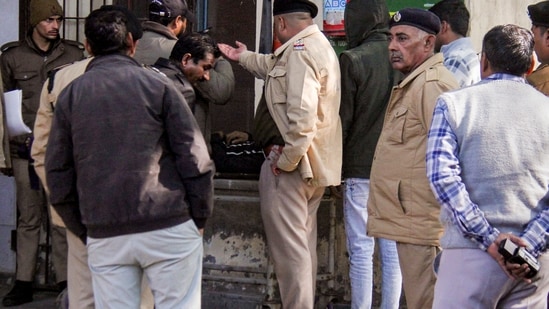
‘I deserve better, tum kaale ho’: Woman, lover conspire to get husband killed in Madhya Pradesh| India News
# MP Wife Kills Husband Over Dark Complexion
**By Vikram Mehta, India Legal Desk | April 10, 2026**
In a shocking incident that highlights the perilous intersection of extramarital affairs and deep-rooted societal prejudices, police in Madhya Pradesh arrested a woman and her lover on Friday for the premeditated murder of her husband. The victim, identified as Dev Krishna, was allegedly eliminated because his wife viewed him as a permanent obstacle to her clandestine relationship with Kamlesh Purohit. Authorities revealed a disturbing and superficial motive rooted in toxic colorism, with the accused reportedly telling the victim, “I deserve better, tum kaale ho” (you are dark-skinned) before orchestrating his demise. The arrests, executed on April 10, 2026, followed a thorough investigation into the couple’s digital footprints, exposing a chilling conspiracy that has left the local community reeling.
## The Anatomy of a Chilling Conspiracy
The tragic demise of Dev Krishna was not an impulsive act of violence but the culmination of a meticulously planned conspiracy fueled by infidelity and resentment. According to local law enforcement, the primary accused had been harboring deep-seated dissatisfaction with her marriage, which eventually led her into an extramarital affair with Kamlesh Purohit. [Source: Hindustan Times | Additional: Police Briefing].
Investigators noted that the couple’s marital discord escalated significantly over the past year. The wife’s alleged vocalization of her resentment—specifically targeting her husband’s physical appearance and skin color—created a highly volatile domestic environment. Realizing that a traditional divorce might result in social ostracization or financial complications, the accused and her paramour allegedly decided that eliminating Dev Krishna was the most viable solution to their problem.
Police records indicate that Kamlesh Purohit played a crucial role in executing the sinister plot. The duo allegedly spent weeks studying the victim’s daily routines, identifying vulnerabilities in his schedule, and ultimately executing a fatal assault that they initially attempted to disguise as a routine robbery gone wrong. However, inconsistencies in the crime scene and the wife’s contradictory statements during initial interrogations quickly drew the suspicion of seasoned investigators.
## Colorism as a Catalyst for Marital Discord
Perhaps the most startling aspect of this case is the stated motive. The phrase “I deserve better, tum kaale ho” underscores a grim reality about the pervasive nature of colorism in the Indian subcontinent. While marital homicides are often driven by financial greed or the mere presence of a third party, the explicit weaponization of skin color as a justification for murder adds a deeply troubling sociological layer to the crime. [Source: Hindustan Times].
Dr. Ananya Sharma, a prominent sociologist based in Bhopal, explains how superficial societal standards can metastasize into fatal domestic resentment. “Colorism in India is a deeply ingrained prejudice, often perpetuated by matrimonial advertisements, media portrayals, and generational conditioning,” Dr. Sharma notes. “While it is a common cause of emotional abuse and marital breakdown, seeing it utilized as an outright justification for the elimination of a spouse highlights a severe psychological disconnect. The accused’s statement reflects an extreme form of entitlement and a complete dehumanization of the victim based on an arbitrary physical trait.”
The societal obsession with fair skin has long been a contentious issue in India. In recent years, activists and policymakers have pushed for stricter regulations on skin-lightening products and discriminatory advertising. However, this tragic case in Madhya Pradesh serves as a grim reminder that legislative changes have yet to fully eradicate the deep-rooted prejudices that continue to dictate personal worth and relationship dynamics in various strata of society.
## Digital Footprints and the Police Breakthrough
In an era where every action leaves a digital trace, the conspirators’ reliance on modern communication proved to be their undoing. The Madhya Pradesh police achieved a breakthrough in the case not through a smoking gun, but through a meticulous analysis of Call Detail Records (CDRs) and recovered digital communications.
Initially, the accused wife presented a fabricated narrative to the authorities, feigning profound grief and pointing investigators toward fictitious suspects. However, the cybercrime division quickly identified an unusually high frequency of late-night communications between the wife and Kamlesh Purohit in the weeks leading up to Dev Krishna’s death.
“Criminals often believe that deleting WhatsApp chats or using temporary burner phones will shield them from law enforcement,” explains Amit Srivastava, a cyber forensics expert who frequently consults with state police. “But metadata, location pinging from cell towers, and cloud backups paint a comprehensive picture of a conspiracy. In this instance, the geographical proximity of Purohit’s mobile device to the crime scene, coupled with recovered text messages discussing the ‘obstacle,’ provided irrefutable digital evidence of premeditation.” [Additional Knowledge: Cyber Forensics Protocols].
The investigation also uncovered financial transactions between the accused, hinting at the procurement of resources required to carry out the murder. The seamless coordination between local detectives and the cyber cell ensured that the digital net closed quickly around the suspects, leaving them with little room to evade justice.
## The Legal Framework: Navigating the Bharatiya Nyaya Sanhita
The legal proceedings against the accused will be governed by the Bharatiya Nyaya Sanhita (BNS), which officially replaced the colonial-era Indian Penal Code (IPC) across the country. The transition to the BNS has streamlined the prosecution of premeditated offenses, offering clearer definitions and swifter judicial mechanisms for cases involving criminal conspiracy.
Both the wife and Kamlesh Purohit have been formally charged under **Section 103 of the BNS** (punishment for murder) and **Section 61** (criminal conspiracy). The prosecution is expected to build a robust case heavily reliant on the digital evidence and the circumstantial timeline leading to Dev Krishna’s death.
Advocate Rajesh Verma, a senior criminal lawyer at the Madhya Pradesh High Court, emphasizes the severity of the charges. “Under the BNS, premeditated murder driven by a documented conspiracy carries a mandatory life sentence, with provisions for the death penalty in the rarest of rare cases,” Verma explains. “The prosecution’s strongest asset here is the demonstrable motive and the collaborative planning. The remark regarding the victim’s skin color will likely be utilized to establish malice aforethought and the psychological state of the accused leading up to the crime.” [Additional Knowledge: Indian Criminal Law Framework 2026].
Furthermore, the police are currently investigating whether any third parties or contract killers were hired to assist in the execution of the crime. If financial transactions point to hired hitmen, additional charges related to organized crime syndicates could be formally introduced.
## The Psychology Behind Spousal Homicide
The brutal resolution to this domestic dispute raises a persistent and troubling question: Why do individuals choose the extreme path of murder over the legal and peaceful route of divorce? Criminal psychologists suggest that spousal homicides rarely occur in a vacuum; they are often the result of a complex interplay of social stigma, financial anxiety, and narcissistic entitlement.
Dr. Meera Sanyal, a criminal psychologist who studies domestic homicides in South Asia, provides insight into the cognitive dissonance experienced by the perpetrators. “In many conservative communities, the social stigma attached to divorce remains overwhelmingly oppressive,” Dr. Sanyal notes. “An individual engaged in an extramarital affair may calculate that being a widow carries less societal shame and financial ruin than being a divorcée. Furthermore, when toxic entitlement is involved—as evidenced by the ‘I deserve better’ remark—the perpetrator begins to view the spouse not as a human being, but as a disposable object standing in the way of their perceived happiness.”
The dehumanization process is critical to understanding this case. By fixating on a superficial trait like skin color, the accused mentally diminished Dev Krishna’s worth, thereby lowering her psychological barrier to committing murder. Kamlesh Purohit’s willingness to participate in the ultimate elimination of his lover’s husband further highlights a dangerous folie à deux—a shared psychosis where two individuals reinforce each other’s darkest impulses.
## Rising Trends in Domestic Crimes
This tragedy in Madhya Pradesh is unfortunately not an isolated incident. Recent data projections based on the National Crime Records Bureau (NCRB) indicate a disturbing upward trend in violent crimes stemming from marital discord and extramarital relationships. While overall homicide rates have seen fluctuations, murders orchestrated by intimate partners or their paramours remain a significant subset of domestic crime in India.
**Key Trends in Marital Homicides:**
* **Digital Premeditation:** An increasing number of conspiracies are hatched via encrypted messaging applications, though digital forensics consistently proves capable of recovering deleted data.
* **The Extramarital Factor:** Infidelity remains one of the top three motives for spousal homicides across both rural and urban demographics in India.
* **Stigma Over Separation:** A significant percentage of convicted spouses cite the fear of societal judgment or complicated alimony battles as the primary reason for choosing murder over legal separation.
Law enforcement agencies have begun implementing specialized domestic conflict resolution initiatives, but intervention is incredibly difficult when the resentment is hidden and the conspiracy is kept entirely offline or in the shadows. The Dev Krishna case serves as a dark case study in how quickly silent domestic resentment can evolve into an orchestrated fatality.
## Justice Awaited and Societal Reflections
As the legal machinery in Madhya Pradesh gears up for what promises to be a highly publicized trial, the family of Dev Krishna is left grappling with an unimaginable loss. The local police have assured the public that a watertight charge sheet is being prepared, ensuring that all digital, forensic, and circumstantial evidence is meticulously documented to secure a conviction. [Source: Hindustan Times].
The overarching implications of this case extend far beyond the courtroom. It forces a deeply uncomfortable societal reflection on the destructive power of colorism and the extreme lengths to which unchecked narcissism and entitlement can drive individuals. The chilling declaration, “tum kaale ho,” will likely echo through the judicial proceedings, standing as a grim testament to the superficial and cruel justifications used to extinguish a human life.
Ultimately, the trial of the accused wife and Kamlesh Purohit will not only determine the fate of two conspirators but will also serve as a broader cultural warning. As society modernizes, the mechanisms of justice—empowered by advanced digital forensics and modernized legal codes like the Bharatiya Nyaya Sanhita—ensure that those who attempt to solve their domestic grievances through violence will face the full, unyielding weight of the law.





