
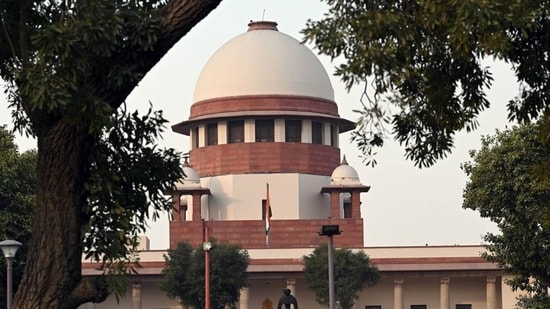
‘ ₹15,000 dete raho, khush raho’: SC refuses husband's divorce plea after living separately for 16 years| India News
# SC Rejects Divorce After 16 Years Apart
**By Legal Affairs Correspondent, India Justice Chronicle | April 10, 2026**
On Friday, April 10, 2026, the Supreme Court of India dismissed a husband’s plea for divorce despite a 16-year continuous separation from his wife. In a candid courtroom exchange, the bench remarked, “₹15,000 dete raho, khush raho” (keep paying ₹15,000 and stay happy), emphasizing that a prolonged physical separation does not automatically guarantee the dissolution of a Hindu marriage. The ruling highlights the persistent legal friction between the doctrine of an irretrievable breakdown of marriage and the statutory requirements for divorce when one spouse remains open to reconciliation or opposes the separation. [Source: Hindustan Times].
## The Courtroom Exchange: ‘Shanti Se Baithe Raho’
The proceedings in the apex court brought to the forefront the deeply human and frequently contentious nature of Indian family law. The husband approached the Supreme Court seeking the dissolution of his marriage, citing that he and his wife had been living entirely separate lives for over a decade and a half. His legal counsel argued that the marriage was functionally dead, devoid of any emotional or physical bond, and thus qualified as an irretrievable breakdown.
However, the Supreme Court bench remained unswayed by the sheer duration of the separation. Noting the wife’s ongoing resistance to the divorce petition and her reliance on the monthly maintenance provided by the husband, the court delivered a uniquely pragmatic directive. Advising the husband to maintain the status quo, the bench colloquially stated that he should continue paying the mandated ₹15,000 monthly maintenance and sit peacefully (“shanti se baithe raho”).
This oral observation, while delivered with a touch of judicial informality, underscores a rigid judicial philosophy: the courts will not readily dissolve a marriage if doing so leaves the dependent spouse socially or financially vulnerable, or if the statutory grounds for contested divorce (such as cruelty, adultery, or desertion) are not sufficiently proven to override the opposing spouse’s will. [Source: Original RSS / Hindustan Times].
## The Legal Dilemma: Duration vs. Reconciliation
At the heart of this matter lies a complex legal dilemma that has plagued Indian family courts for decades: is a long separation enough to end a marriage? Under the Hindu Marriage Act, 1955, “irretrievable breakdown of marriage” is not explicitly recognized as a statutory ground for divorce. Marriages can legally be dissolved either through mutual consent or on specific fault-based grounds.
When one party refuses to consent, the other must prove a fault. In cases where neither cruelty nor definitive desertion can be proven to the court’s satisfaction—but the couple simply cannot live together—the legal system often traps them in a state of marital limbo.
While a landmark 2023 Supreme Court Constitution Bench ruling (*Shilpa Sailesh vs. Varun Sreenivasan*) established that the apex court *can* invoke its inherent powers under Article 142 of the Constitution to grant a divorce on the grounds of irretrievable breakdown, this power is entirely discretionary. The court must be convinced that the marriage is beyond any salvageable state and that granting the divorce serves the ends of absolute justice. In this recent April 2026 case, the court actively chose not to exercise this extraordinary power.
## Financial Security and the Significance of ₹15,000
The court’s explicit mention of the ₹15,000 maintenance amount shines a light on the socioeconomic realities intertwined with Indian marriages. For many women in India, marriage is not merely an emotional partnership but a fundamental source of social standing and financial security.
**Key factors influencing the refusal to divorce:**
* **Economic Vulnerability:** Even with a mandated maintenance, divorced women often face severe economic downgrades. The ₹15,000 (roughly $180 USD) awarded in this case is a modest sum, subject to inflation, yet it represents a crucial lifeline.
* **Social Stigma:** In many traditional communities, the stigma attached to the label of a “divorcée” remains potent. Wives may prefer the title of a separated spouse over a divorced one to maintain societal respect and familial integration.
* **Strategic Leverage:** In some instances, withholding consent for divorce is a legal strategy used to negotiate better alimony or property settlements.
By tethering the husband’s marital status to his financial obligation (“₹15,000 dete raho”), the Supreme Court reinforced the patriarchal protective mechanism embedded in Indian family law, which prioritizes the economic safeguarding of the wife over the individual liberty of the husband to exit a defunct union.
## Expert Perspectives on the Court’s Stance
Legal scholars and family law practitioners are divided on the implications of such rulings. While some view it as a necessary protection for vulnerable women, others see it as a violation of personal autonomy.
“This judgment underscores a conservative streak in the judiciary’s approach to family law,” says Dr. Vikram Mathur, a senior family law scholar and professor in New Delhi. “While the 2023 Article 142 ruling gave hope that dead marriages could be buried with dignity, this 2026 observation proves that the Supreme Court will not mechanically apply the breakdown theory. If the court feels the wife is being unjustly discarded without adequate holistic security, they will force the legal fiction of the marriage to continue.”
Conversely, Meera Singhal, a senior advocate specializing in matrimonial disputes, notes the practical wisdom in the court’s stance. “A 16-year separation is tragic, but the court looks at the power dynamics. If a man can unilaterally walk away from a marriage just by waiting out the clock, it leaves many homemakers utterly destitute. The directive to keep paying ₹15,000 is the court’s way of saying: your financial and moral obligations do not vanish simply because you lost interest in the relationship.” [Additional Source: General Legal Context Analysis].
## Comparing Legal Approaches to Divorce
To understand the court’s reluctance, one must look at how the law handles different types of marital dissolution.
| Type of Divorce | Legal Basis | Court’s Discretion |
| :— | :— | :— |
| **Mutual Consent** | Section 13B of Hindu Marriage Act. Both parties agree. | Minimal. Granted after a statutory cooling-off period (which can be waived). |
| **Fault-Based** | Section 13. Cruelty, adultery, desertion, etc. | High. The petitioner must provide hard evidence of the fault. |
| **Irretrievable Breakdown** | Article 142 of the Constitution. | Absolute. Used sparingly to do “complete justice,” usually when both parties want out but are trapped by technicalities, or when one party’s refusal is deemed malicious. |
In the present case, the husband’s inability to secure a fault-based decree in the lower courts, combined with the Supreme Court’s refusal to invoke Article 142, leaves him legally bound to the marriage.
## The Social Implications of Lingering Marriages
The existence of “dead letter” marriages—unions that exist on paper but lack any functional reality—takes a severe psychological toll on both parties. For the husband in this scenario, moving on with a new legal family is impossible. Any subsequent relationship could be legally classified as adulterous, and children born from such a relationship would face complex legal hurdles regarding legitimacy and inheritance.
For the wife, while she retains the legal status and the ₹15,000 monthly maintenance, she remains tethered to a partner who has actively sought to sever ties for 16 years. Psychologists note that prolonged matrimonial litigation often breeds deep-seated vindictiveness, preventing both individuals from achieving emotional closure.
The Law Commission of India has repeatedly recommended making the “irretrievable breakdown of marriage” an explicit statutory ground for divorce (most notably in its 71st and 217th reports). However, consecutive governments have hesitated to amend the Hindu Marriage Act, fearing a backlash from traditionalists and concerns that it would lead to a surge in men abandoning their wives without cause.
## Future Outlook: A Need for Legislative Reform?
As the judiciary continues to balance the scales of justice on a case-by-case basis, the clarion call for definitive legislative reform grows louder. The Supreme Court’s mandate for the husband to “stay happy” while paying maintenance reflects a judicial band-aid on a legislative gaping wound.
Until the Parliament steps in to clearly define the parameters under which a truly dead marriage can be unilaterally dissolved—while simultaneously ensuring bulletproof financial safeguards for dependent spouses—similar cases will continue to flood the apex court.
### Key Takeaways
1. **Duration is Not Determinative:** A 16-year separation is not a guaranteed ticket to a divorce in India if one spouse contests it.
2. **Maintenance is Paramount:** The courts heavily prioritize the financial security of the dependent spouse, as seen by the strict enforcement of the ₹15,000 monthly maintenance.
3. **Article 142 is Discretionary:** The Supreme Court will only use its special constitutional powers to dissolve a marriage if it deems the dissolution equitable to both parties, not merely as an escape route for an estranged spouse.
Ultimately, the April 2026 ruling serves as a stark reminder to couples and legal practitioners alike: in the realm of Indian matrimonial law, escaping a broken marriage requires more than just time and distance; it requires an equitable settlement that satisfies the profound moral conscience of the court.





