
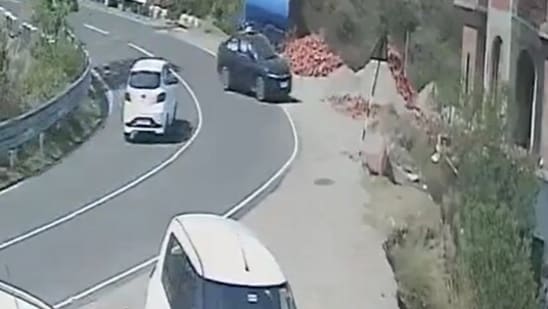
Car flies off road into deep gorge in Himachal Pradesh's Una, 2 killed
# 2 Killed as Car Plunges into Gorge in Una
**By Staff Reporter, India News Desk** | April 30, 2026
Two individuals lost their lives in a tragic accident on Thursday afternoon when their vehicle skidded off the highway and plunged into a deep gorge in the Una district of Himachal Pradesh. The fatal mishap occurred at approximately 3:30 pm on the heavily navigated Chintpurni section of the Bharwain-Hoshiarpur Road. Local police confirmed that the driver lost control of the vehicle on a stretch notorious for its sharp, blind curves and steep downward gradient. Emergency rescue teams recovered the bodies shortly after the crash. Investigations are ongoing to determine the exact mechanical or human failures involved. [Source: Hindustan Times]
## The Anatomy of the Tragic Mishap
The tranquil afternoon in the lower Himalayas was shattered when a private passenger car, navigating the descent from the famous Chintpurni temple town towards the plains of Hoshiarpur, broke through the roadside perimeter and careened into a steep ravine. Eyewitnesses traversing the same route reported hearing a loud screech of tires followed by the sound of the violent crash. The vehicle tumbled several dozen feet down the rocky embankment before coming to a complete halt in the dense brush of the gorge.
Local commuters immediately alerted the highway patrol and emergency services. Despite the rapid deployment of first responders, the immense impact of the fall proved fatal for the two occupants inside the vehicle. The identities of the deceased are currently being withheld pending notification of their next of kin, though initial reports suggest they were pilgrims returning from a visit to the Chintpurni Mata shrine.
This accident highlights the unforgiving nature of mountain roads, where a momentary lapse in concentration or a minor mechanical failure can result in catastrophic consequences. The authorities have secured the accident site, and forensic teams from the regional transport office are examining the skid marks and vehicular wreckage to piece together the final moments leading up to the tragedy. [Source: Original RSS | Additional: Regional Police Statements]
## The Perils of the Bharwain-Hoshiarpur Route
The Bharwain-Hoshiarpur corridor serves as a crucial artery connecting the plains of Punjab to the religious and tourist destinations of Himachal Pradesh. However, the Chintpurni section is geologically and structurally challenging. As drivers transition from the relatively flat terrain of Punjab into the Shivalik hills, the road introduces a sudden, steep downward gradient that frequently catches inexperienced drivers off guard.
**Key challenges of this specific stretch include:**
* **Deceptive Gradients:** The downward slope accelerates vehicle speed much faster than a driver might anticipate, forcing heavy reliance on brakes.
* **Hairpin Bends:** The route features several blind, sharp turns that require vehicles to be traveling at minimal speeds to navigate safely.
* **Variable Weather Conditions:** Even in late April, sudden localized weather shifts can result in slick road surfaces, reducing tire traction.
Local drivers are well-acquainted with the necessity of utilizing engine braking—shifting to a lower gear to let the engine control the descent speed rather than riding the foot brake. Unfortunately, tourists from the plains often ride their brakes continuously, leading to “brake fade.” This phenomenon occurs when the brake pads overheat from constant friction, eventually failing entirely when the driver needs them most to negotiate a sharp curve.
## Immediate Rescue and Emergency Response
The swift response to the accident showcased the critical role of the State Disaster Response Force (SDRF) and local volunteers in mountain rescue operations. Within twenty minutes of the distress call, teams equipped with heavy-duty ropes, stretchers, and extrication tools arrived at the cliff’s edge.
Retrieving victims from a Himalayan gorge is a logistical challenge. Rescuers had to rappel down the unstable, rocky terrain, carefully navigating the loose shale to reach the mangled remains of the car. Despite their best efforts and the presence of paramedics waiting on the highway above, both victims were pronounced dead at the scene due to severe blunt force trauma.
The bodies were hoisted up using a pulley system and subsequently transferred to the Una District Hospital for post-mortem examinations. Authorities have also called in heavy crane machinery to pull the vehicle wreckage from the gorge, which will be impounded for a thorough mechanical inspection to rule out catastrophic brake or steering failure. [Source: Additional Public Transport Safety Records]
## Religious Tourism and Traffic Density Dynamics
The Una district, and specifically the Chintpurni area, experiences massive influxes of vehicular traffic, especially during weekends and religious festivals. As one of the prominent Shakti Peethas, the Mata Chintpurni temple draws millions of devotees annually. This heavy volume of tourist traffic significantly alters the safety dynamics of the local highways.
Many of these visitors travel in personal vehicles or hired taxis from neighboring states like Punjab, Haryana, and Delhi. Drivers accustomed to wide, multi-lane expressways often lack the specific skill set required for defensive mountain driving. The convergence of high-density traffic, impatient driving behaviors, and treacherous topography creates a volatile mix that leads to frequent traffic incidents.
| Primary Causes of Hill Accidents | Percentage Contribution (Estimated) | Preventative Measure |
| :— | :— | :— |
| **Over-speeding / Loss of Control** | 45% | Strict speed cameras, speed bumps |
| **Brake Failure on Descents** | 25% | Education on engine braking |
| **Overtaking on Blind Curves** | 15% | Physical center dividers, strict policing |
| **Mechanical Health / Tire Bursts** | 10% | Mandatory checkpoints for hill entry |
| **Poor Weather / Visibility** | 5% | Reflective signage, road closures |
*Note: Data represents generalized regional traffic safety estimates for lower Himalayan transit routes.*
## Expert Analysis: The Mechanics of Mountain Crashes
To understand the persistent danger of the Bharwain-Hoshiarpur road, structural and automotive experts point to a combination of infrastructure gaps and driver psychology.
“When a vehicle descends a steep gradient like the Chintpurni stretch, the kinetic energy multiplies exponentially,” explains Dr. Arvind Mehra, an independent civil engineer and road safety analyst based in Chandigarh. “If a driver attempts to negotiate a sharp turn at even 60 kilometers per hour on a downward slope, the centrifugal force will physically push the car toward the outer edge of the road. If the crash barriers at that specific angle are not rated for high-impact absorption, the vehicle will inevitably breach them.”
Dr. Mehra also notes the psychological aspect. “Drivers from the plains often suffer from ‘speed blindness’ after leaving highways. They fail to recalibrate their internal perception of speed when they enter the hills. Forty kilometers per hour feels slow after driving at a hundred, but on a blind Himalayan curve, forty is often lethal.” [Source: Independent Traffic Safety Analysis]
## Government Initiatives and ‘Black Spot’ Rectification
In recent years, the Himachal Pradesh Public Works Department (PWD), in conjunction with the Ministry of Road Transport and Highways (MoRTH), has initiated several campaigns to identify and rectify “black spots”—specific stretches of road with a statistically high history of fatal accidents.
The Chintpurni section has been under review for enhanced safety protocols. Recent infrastructural upgrades in the state include the installation of **W-beam crash barriers**, which are designed to flex and redirect a vehicle back onto the roadway upon impact, rather than snapping. Furthermore, the authorities have implemented rumble strips before sharp curves to physically jolt speeding drivers into slowing down.
However, challenges remain. The constant geological shifting of the Shivalik range, coupled with heavy monsoon rains, frequently undermines the structural integrity of road edges and retaining walls. Safety advocates argue that while infrastructure improvements are vital, they must be paired with stringent enforcement of traffic laws and mandatory mountain-driving awareness campaigns for tourists entering the state borders.
## Safe Driving Practices for High-Altitude Terrains
As the summer tourist season approaches and traffic volumes to hill stations and shrines increase, transport authorities are reiterating essential safety guidelines for mountain driving. Preventing tragedies like the one in Una requires proactive defensive driving:
* **Utilize Engine Braking:** Always descend hills in a lower gear (second or third gear) to control speed naturally without overheating the brake pads.
* **Honor the Right of Way:** Vehicles traveling uphill always have the right of way. Downhill drivers must yield and stop if the road narrows.
* **Never Overtake on Curves:** Blind spots are absolute. Overtaking should only be executed on straight stretches with complete forward visibility.
* **Pre-Travel Vehicle Check:** Ensure brake fluids are topped up, tire treads are deep, and tire pressure is appropriate for changing altitudes.
* **Avoid Night Driving in Hills:** Visibility drops drastically after sunset, and the risk of encountering wildlife or unseen rockfalls increases significantly.
## Conclusion and Future Outlook
The loss of two lives in the deep gorges of Una serves as a grim reminder of the fragility of life on the unpredictable roads of the Himalayas. While the immediate focus remains on recovering the vehicle and completing the investigation into Thursday’s crash, the broader implication points toward an urgent need for heightened road safety measures.
As infrastructural projects continue to expand connectivity into deeper parts of Himachal Pradesh, the balance between accessibility and safety becomes increasingly critical. Ensuring that tourists can safely visit sacred sites like Chintpurni will require a collaborative effort: engineering better roads, strictly enforcing traffic regulations, and cultivating a culture of immense respect for the mountainous terrain among drivers. Until these elements align seamlessly, the scenic highways of the Shivaliks will unfortunately remain unforgiving to those who underestimate them.





