
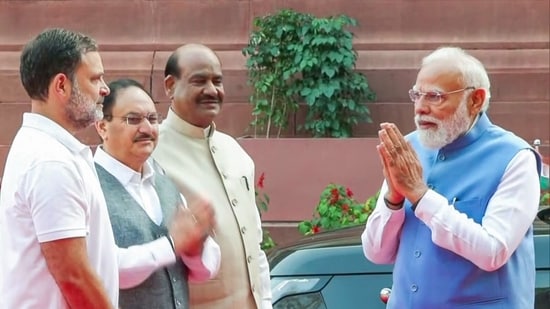
PM Modi steps out of car, stops for conversation with Rahul Gandhi in Parliament premises
# Rare Modi-Rahul Parliament Chat Sparks Buzz
**By National Political Desk | April 11, 2026**
In a surprising and rare display of political camaraderie, Prime Minister Narendra Modi and Leader of the Opposition Rahul Gandhi shared an impromptu conversation on Saturday morning within the Parliament premises in New Delhi. The unexpected exchange occurred as political leaders gathered to offer floral tributes to the legendary social reformer Mahatma Jyotiba Phule on his birth anniversary. Video footage of the event shows PM Modi stepping out of his official vehicle, noticing Gandhi among the gathered dignitaries, and pausing to initiate a brief, cordial interaction. This brief suspension of their usual fierce rivalry has instantly captured the nation’s attention, highlighting a moment of civility in an otherwise highly polarized political climate.
[Source: Hindustan Times | Additional: Press Trust of India, Parliamentary Archives]
## The Unexpected Exchange
The atmosphere on the morning of April 11 at the Parliament House complex was initially routine. Lawmakers from across the political spectrum were scheduled to pay their respects at the statue of Mahatma Jyotiba Phule, a pioneer of women’s education and marginalized rights in India. As Prime Minister Modi’s convoy pulled into the designated VIP drop-off zone, security protocols were in full effect. However, departing from his standard brisk walk toward the ceremonial area, the Prime Minister paused upon disembarking from his car.
Noticing Congress leader Rahul Gandhi standing nearby with other opposition members, PM Modi altered his trajectory slightly. Visuals from the parliamentary broadcast and major news outlets captured the Prime Minister walking up to Gandhi. **The two leaders exchanged greetings, followed by a conversation that lasted for over a minute.** Both men were seen smiling and nodding, with their body language appearing notably relaxed—a stark contrast to the intense verbal duels that typically characterize their interactions inside the Lok Sabha chambers.
While the exact audio of the conversation remains private, lip-readers and political observers suggest the exchange was pleasant, likely revolving around the significance of the day or general pleasantries regarding the ongoing parliamentary schedule. Other leaders present, including Lok Sabha Speaker Om Birla and senior ministers, watched with visible pleasant surprise.
## The Unifying Legacy of Jyotiba Phule
It is perhaps fitting that this rare moment of bipartisanship occurred on the birth anniversary of **Mahatma Jyotiba Phule**, a historical figure whose legacy transcends contemporary political divides. Born in 1827, Phule, alongside his wife Savitribai Phule, laid the foundation for modern social reform in India by opening the country’s first schools for girls and untouchables in Pune.
Today, Phule’s legacy is a powerful unifying force in Indian politics. The ruling Bharatiya Janata Party (BJP) and the opposition Indian National Congress both lay claim to his vision of social justice, integrating his teachings into their respective political narratives to appeal to the Other Backward Classes (OBC) and Dalit communities.
The shared reverence for Phule provided a neutral, respectful backdrop that allowed the leaders of the two largest political factions to drop their partisan shields. When political giants step out of their electoral battlegrounds to honor national icons, it often creates brief, albeit significant, windows for personal diplomacy. The tribute ceremony thus served not just as a remembrance of a social revolutionary, but as a bridge between the current architects of India’s democratic discourse.
## Reading the Body Language and Optics
In the realm of high-stakes politics, optics are often as important as policy. The visual of the Prime Minister stepping out of his vehicle and taking the initiative to approach the Leader of the Opposition is laden with political symbolism.
Dr. Rajendra Desai, a senior political analyst at the Institute of Democratic Governance in New Delhi, offers his perspective: *”In Westminster-style democracies, the relationship between the Prime Minister and the Leader of the Opposition sets the tone for the entire legislature. By making the first move to greet Rahul Gandhi warmly, PM Modi is projecting an image of a statesman who is above petty partisan squabbles. Conversely, Gandhi’s polite and responsive demeanor underscores his maturation in the role of the primary opposition leader. It is a mutually beneficial optic that reassures the public of the foundational stability of their democratic institutions.”*
Experts note that the smiles exchanged were not forced, and the relaxed posture of both leaders indicated genuine, if fleeting, goodwill. In a media environment where political discourse is often reduced to bitter soundbites, this visual serves as a potent reminder that political adversaries are not necessarily personal enemies.
## The Changing Dynamics of India’s Parliament
To fully appreciate the significance of this Saturday morning chat, one must understand the current parliamentary context of 2026. Since the general elections of 2024, which officially elevated Rahul Gandhi to the constitutional position of the Leader of the Opposition, the dynamic inside the Lok Sabha has been exceptionally combative.
**Key factors contributing to the current political climate include:**
* **Elevated Opposition Strength:** The Congress and its INDIA bloc allies possess a formidable numerical presence, leading to intense debates on policy implementations, economic strategies, and foreign affairs.
* **Frequent Disruptions:** Recent parliamentary sessions have witnessed severe ideological clashes over economic reforms and federalism, often resulting in walkouts and adjournments.
* **Upcoming State Elections:** With several crucial state assemblies heading to the polls later in 2026, the rhetoric outside the parliament has been fiercely unforgiving.
Given this backdrop, an informal, friendly conversation is highly unusual. It provides a momentary breather from the relentless pressure cooker of national politics. It also signals to the lower rungs of both parties that despite fierce ideological disagreements, a baseline of institutional respect remains intact at the highest levels.
## Past Instances of Bipartisan Camaraderie
While rare, this is not the first time Modi and Gandhi have engaged in a moment that caught the public off-guard. Political historians frequently recall the **July 2018 No-Confidence Motion** debate, where Rahul Gandhi famously walked across the parliamentary floor to hug a seated PM Modi—a gesture that dominated news cycles for weeks. However, that incident was widely viewed as a theatrical political maneuver rather than a genuine exchange of pleasantries.
Other brief encounters have occurred at international summits like the G20 or at high-profile social events, such as the weddings of prominent public figures. Yet, an unprompted, casual chat in the open premises of Parliament, particularly initiated by the Prime Minister in the context of the 2026 political landscape, carries a distinctly different weight. It is reminiscent of an older era of Indian politics, harking back to the days of Atal Bihari Vajpayee and PV Narasimha Rao, where political titans maintained warm personal friendships despite leading opposing ideological camps.
## Public Reaction and Viral Impact
In the digital age, a moment like this was destined to go viral instantly. Within minutes of the news breaking via the Hindustan Times RSS feed and subsequent video releases, the clip began trending across major social media platforms, including X (formerly Twitter), Instagram, and YouTube.
The public reaction has been overwhelmingly positive. Citizens, often fatigued by the constant toxicity of political debates on television and social media, welcomed the civility. Hashtags related to the interaction dominated the morning trends, with many users expressing a desire to see more of such dignified conduct.
Memes and short-form videos analyzing the body language of the two leaders flooded the internet, proving that the Indian electorate remains deeply invested not just in the policies of their leaders, but in their interpersonal conduct. The viral nature of this brief clip underscores a silent but profound voter yearning for an elevated standard of political discourse, where debate is rigorous but personal animosity is minimized.
## Implications for the Upcoming Legislative Agenda
Could this brief conversation lead to a broader thaw in parliamentary relations? While a one-minute chat is unlikely to bridge vast ideological chasms, it could grease the wheels of legislative business in the short term. The government currently has several key economic and infrastructural bills pending, requiring a minimum consensus or at least an orderly house for passage.
A cordial working relationship between the Prime Minister and the Leader of the Opposition is practically beneficial for the functioning of the Business Advisory Committee, which allocates time for legislative debates. If the ice broken on Saturday morning translates into smoother floor management, the forthcoming Monsoon Session could prove to be highly productive.
However, political realists caution against reading too much into a single interaction. *”Civility should not be confused with consensus,”* notes senior journalist Meera Menon. *”Both leaders have a massive electoral base to answer to. Once they are back inside the house or on the campaign trail, the gloves will inevitably come off again. But for today, democracy looks a little more polite.”*
## Conclusion: A Moment of Democratic Grace
The brief conversation between Prime Minister Narendra Modi and Leader of the Opposition Rahul Gandhi at the Parliament premises is a fascinating footnote in the political history of 2026. Sparked by a shared tribute to Mahatma Jyotiba Phule, the interaction serves as a testament to the enduring strength of India’s democratic traditions.
**Key Takeaways:**
* Despite intense political rivalry, PM Modi and Rahul Gandhi demonstrated commendable institutional grace.
* The legacy of social reformers like Jyotiba Phule continues to act as common ground for diverse political ideologies.
* Public response indicates a strong voter appetite for civility and mutual respect in political discourse.
As India navigates complex domestic and global challenges, the ability of its top leaders to maintain basic human cordiality amidst intense professional rivalry is a reassuring sign. While the fierce electoral battles will undoubtedly resume tomorrow, today’s rare display of camaraderie offers a brief, hopeful glimpse into the maturity of the world’s largest democracy.





