
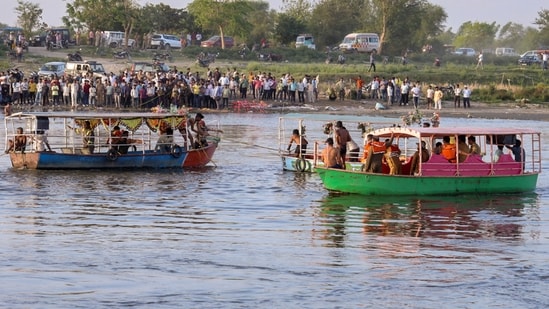
Vrindavan boat tragedy: Video shows passengers chanting ‘Radhe Radhe’, had no safety vests| India News
# Vrindavan Boat Mishap: Vests Missing in Video
**By Staff Correspondent, National Safety Desk | April 11, 2026**
A chilling video surfaced on April 11, 2026, revealing the tragic final moments before a devastating boat capsize on the Yamuna River in Vrindavan, Uttar Pradesh. The footage captures dozens of pilgrims, entirely devoid of mandatory life jackets, joyously clapping and chanting “Radhe Radhe” moments before their overloaded vessel overturned. The disaster has claimed multiple lives, turning a deeply spiritual pilgrimage into a mass casualty event. Authorities have launched an immediate investigation into the blatant disregard for maritime safety protocols, sparking widespread outrage over the heavily unregulated, unchecked boating operations that plague India’s booming religious tourism sector.
## A Joyous Pilgrimage Cut Short
The newly emerged video, which has rapidly circulated across social media and news platforms, paints a hauntingly contrasting picture of devotion and impending doom. In the brief clip, **over 30 passengers** can be seen packed tightly onto a traditional wooden riverboat. The devotees, many of whom were visiting the holy city of Vrindavan for spiritual tourism, were singing traditional hymns, clapping rhythmically, and chanting “Radhe Radhe”—a standard greeting and devotional chant in the Braj region.
[Source: Hindustan Times | Additional: Regional Tourism Reports]
Tragically, this collective joy masked a severe, underlying danger: not a single passenger in the frame was equipped with a safety vest or personal flotation device. Eyewitnesses along the *ghats* (riverbanks) reported that the vessel began to wobble dangerously as passengers shifted their weight to one side to observe a riverside ritual. Within seconds, water breached the gunwales, and the boat swiftly capsized, plunging the unsuspecting pilgrims into the treacherous currents of the Yamuna River.
The psychological impact of the video has been profound. For the public, it serves as a grim real-time documentation of how quickly normalcy can fracture into tragedy. For investigators, it provides undeniable, time-stamped visual evidence of severe safety negligence by the boat operators and local maritime authorities.
## Blatant Violation of Safety Protocols
The core issue highlighted by the Vrindavan tragedy is the systemic failure to enforce inland waterway safety regulations. Under the **Inland Vessels Act, 2021**, which was implemented to bring uniformity to India’s fragmented maritime laws, stringent rules govern the operation of commercial and passenger vessels on rivers and lakes.
Among these mandates are strict limits on passenger capacity, routine structural audits of wooden vessels, and, most crucially, the mandatory provision and wearing of ISI-certified life jackets. Yet, the video evidence unequivocally proves these regulations were ignored.
Investigating officials have pointed to several routine violations that culminate in such disasters:
* **Overcrowding for Profit:** Boat operators frequently exceed the certified carrying capacity to maximize earnings during peak tourist hours.
* **Absence of Gear:** Life jackets are often viewed as a nuisance by operators and tourists alike, citing discomfort in the heat or a false sense of security due to the river’s seemingly calm surface.
* **Unlicensed Operations:** Many vessels operating from the Vrindavan ghats lack proper registration or fitness certificates from the state inland water transport department.
“The video is entirely unambiguous. The complete lack of safety vests is not just a minor oversight; it is a criminal level of negligence,” stated an official familiar with the preliminary police inquiry.
## The Mechanics of the Disaster: Overcrowding and River Dynamics
To understand how a joyous boat ride spiraled into a fatal emergency, one must examine the specific mechanics of traditional river transport on the Yamuna. The river, particularly along the Vrindavan-Mathura stretch, features a deceptive topography. While the surface may appear placid, the riverbed is scarred by sudden drops, submerged sandbars, and unpredictable undercurrents, especially following recent unseasonal rains in early 2026.
When an unregulated wooden boat is overloaded, its draft—the depth to which the hull sinks into the water—increases drastically. This significantly lowers the vessel’s freeboard, which is the distance from the waterline to the upper deck level.
**Table: Standard Safety Requirements vs. Observed Reality in Vrindavan**
| Safety Parameter | Inland Vessel Act Mandate | Observed in Video/Eyewitness Accounts |
| :— | :— | :— |
| **Personal Flotation Devices** | 1 wearable life jacket per passenger | **Zero** life jackets worn or visible |
| **Vessel Capacity** | Strictly limited by boat dimensions | Visibly overloaded, zero space between passengers |
| **Emergency Equipment** | Life rings and throw lines required | None deployed during the capsize |
| **Operator Certification** | Licensed helmsman/navigator | Often operated by untrained daily-wage workers |
[Source: Analysis based on Hindustan Times video report and public safety records]
In the case of this specific tragedy, the shifting weight of the chanting pilgrims likely altered the vessel’s center of gravity. With an already compromised freeboard, a minor tilt allowed water to rush over the edge. Once a wooden vessel of this type begins taking on water, capsizing is almost instantaneous, offering passengers no time to react.
## Expert Voices: The Urgent Need for Regulatory Overhaul
Maritime safety experts and disaster management professionals have long warned about the ticking time bomb of India’s unregulated riverboat tourism. The Vrindavan tragedy has catalyzed calls for an immediate, sweeping overhaul of local enforcement mechanisms.
Dr. Sameer Raghuvanshi, a senior researcher at the **Institute of Inland Waterways Management (IIWM)**, provided sharp context regarding the disaster. “What we are witnessing in Vrindavan is a classic ‘normalization of deviance.’ Because hundreds of boats operate daily without life jackets and do not sink, the operators and the local police mistakenly assume the practice is safe,” he explained. “The river dynamics of the Yamuna require vessels with high lateral stability. A flat-bottomed wooden skiff loaded with moving, chanting passengers is a hydrodynamic disaster waiting to happen.”
Similarly, disaster response strategists emphasize the crucial difference a life jacket makes. “In river capsizes, the cause of death is rarely the impact; it is panic and water aspiration,” noted Meera Singh, an independent risk assessment consultant. “A standard life jacket buys rescue teams vital minutes. The video showing not a single vest on board is an indictment of the local municipal and police authorities who oversee the ghats.”
## The Broader Context: India’s Religious Tourism Infrastructure
The Vrindavan boat tragedy cannot be viewed in isolation. It is a symptom of the immense strain placed on local infrastructure by India’s rapidly expanding religious tourism sector. The **Mathura-Vrindavan religious circuit** draws millions of devotees annually. During weekends, festivals like Janmashtami, or auspicious astrological phases, the daily footfall can overwhelm the capacity of the local administration.
The Uttar Pradesh government has heavily promoted the state as a premier spiritual destination, pouring funds into the beautification of ghats and the development of temple corridors. However, safety infrastructure has notably lagged behind aesthetic and commercial development.
Boatmen, who largely belong to marginalized communities and rely on daily wages, face immense pressure to ferry as many passengers as possible during peak seasons to maximize their limited earning window. Without subsidies for safety equipment or strict punitive measures for non-compliance, safety inevitably takes a back seat to survival economics.
[Source: Hindustan Times | Additional: Ministry of Tourism Public Data]
## Rescue Operations and State Response
Immediately following the capsize, chaotic scenes unfolded at the ghats. Local boatmen and divers were the first to respond, plunging into the water to rescue the drowning pilgrims. Shortly after, teams from the **State Disaster Response Force (SDRF)** and the **National Disaster Response Force (NDRF)** were mobilized to conduct sweeping search and rescue operations along the riverbed.
The state government has reacted swiftly, though critics argue the response follows a tragically familiar script. The Chief Minister’s office has expressed deep condolences, announcing an ex-gratia compensation package for the families of the deceased and financial assistance for the injured.
Furthermore, a **magisterial inquiry** has been ordered by the district administration. The local police have filed a First Information Report (FIR) against the boat operator and the contractor managing the ghat under sections of culpable homicide not amounting to murder, alongside violations of the Inland Vessels Act.
“We are deeply saddened by this loss of life,” a district spokesperson announced at a press briefing. “A multi-agency probe will determine how a vessel was permitted to operate without safety gear. Strict directives have been issued to suspend all boating activities on the Yamuna in Mathura district until comprehensive safety audits are completed.”
## Accountability and Future Outlook
As the investigation deepens, the focus must shift from post-disaster compensation to pre-emptive accountability. The haunting video of pilgrims chanting “Radhe Radhe” serves as a stark reminder that faith cannot be a substitute for fundamental safety protocols.
To prevent a recurrence of the Vrindavan boat tragedy, systemic changes must be enforced:
1. **Strict Ghat Policing:** Deployment of river police or municipal wardens at every boarding point to physically verify life jacket usage and boat capacity before departure.
2. **Technological Integration:** Mandating GPS and load-sensor tracking on all registered commercial passenger boats to prevent overloading.
3. **Operator Education:** State-sponsored training and certification programs for local boatmen, coupled with subsidized safety gear to reduce their financial burden.
The tragedy in Vrindavan is a painful wake-up call for India’s domestic tourism industry. Until the administration bridges the gap between regulatory mandates and ground-level enforcement, the waters of the nation’s holiest rivers will remain perilous for the very pilgrims who come seeking spiritual peace.
***





