
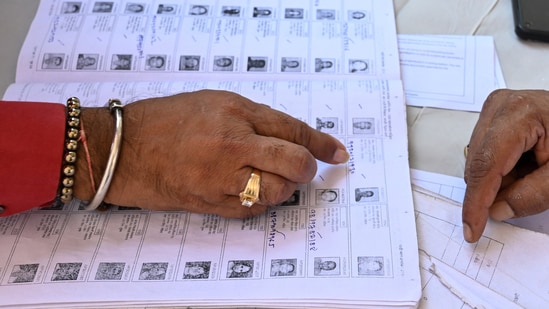
Supreme Court says voting, contesting polls not fundamental rights: ‘It’s well settled'| India News
# SC Rules Voting Not Fundamental Right
By Special Correspondent, Legal Affairs Desk, April 11, 2026
On Saturday, the Supreme Court of India definitively reiterated that the right to vote and the right to contest elections are statutory rights, not fundamental rights guaranteed under Part III of the Constitution. A division bench comprising Justices BV Nagarathna and R Mahadevan dismissed a petition challenging electoral protocols, clarifying that electoral participation exists strictly within the boundaries established by legislative statutes. This ruling reaffirms a long-held constitutional doctrine, underscoring that the entire electoral process in India is a creature of statute subject to parliamentary regulation and not an inherent constitutional liberty. [Source: Hindustan Times]
## The Core of the Supreme Court’s Ruling
The recent observation by the division bench of **Justices BV Nagarathna and R Mahadevan** has brought the fundamental nature of democratic rights back into the national spotlight. While hearing a plea related to election-related grievances and candidate rights, the bench firmly stated that electoral rights exist “only to the extent provided by law.”
In legal jurisprudence, this distinction is paramount. A fundamental right, such as the freedom of speech and expression (Article 19) or the right to life and personal liberty (Article 21), is considered inherent and is heavily protected against state overreach. Any citizen can directly approach the Supreme Court under Article 32 or High Courts under Article 226 to enforce these rights.
Conversely, the right to vote and the right to stand for public office are derived entirely from the **Representation of the People Act (RPA), 1951**. The bench emphasized that because these rights are created by a specific statute, they are bound by the limitations, qualifications, and disqualifications embedded within that very statute. The Supreme Court noted that this legal position is “well settled” and has been the guiding principle for Indian courts for decades. [Source: Hindustan Times | Additional: Supreme Court Judgments Database]
## Decoding Statutory vs. Fundamental Rights
To fully grasp the implications of the Supreme Court’s April 2026 observations, one must understand the hierarchy of rights within the Indian legal framework. The classification dictates how the courts interpret restrictions placed upon citizens.
* **Fundamental Rights:** Enshrined in Part III of the Constitution, these are basic human rights guaranteed to citizens (and sometimes non-citizens). They are subject only to “reasonable restrictions” explicitly mentioned in the Constitution.
* **Constitutional Rights:** Rights that are mentioned in the Constitution but do not fall under Part III. For example, **Article 326** guarantees universal adult suffrage, meaning every citizen above 18 has the right to be registered as a voter. However, it is a constitutional right, not a fundamental one.
* **Statutory Rights:** Rights granted by an ordinary law passed by the Parliament or a state legislature. They can be altered, amended, or completely taken away by amending the parent statute.
Because voting and contesting elections are governed by the RPA 1951, Parliament has the ultimate authority to dictate the terms of electoral participation. If voting were a fundamental right, any legislative attempt to restrict it—such as barring individuals with certain criminal convictions from voting or contesting—would face intense constitutional scrutiny and could potentially be struck down as a violation of basic liberties.
## Historical Precedents Reinforcing the Doctrine
The statement by Justices Nagarathna and Mahadevan that this matter is “well settled” refers to a rich history of electoral jurisprudence in India. The Supreme Court has consistently refused to elevate voting to the status of a fundamental right.
One of the most cited precedents is the landmark 1982 case of ***Jyoti Basu vs Debi Ghosal***. In this judgment, the Supreme Court unequivocally declared: *”A right to elect, fundamental though it is to democracy, is, anomalously enough, neither a fundamental right nor a common law right. It is pure and simple, a statutory right.”*
This legal philosophy was further solidified in cases such as:
1. **NP Ponnuswami v. Returning Officer (1952):** The Supreme Court held that the right to vote or stand as a candidate for election is not a civil right but is a creature of statute or special law and must be subject to the limitations imposed by it.
2. **Javed v. State of Haryana (2003):** The Court upheld a Haryana state law that disqualified persons with more than two children from contesting local panchayat elections, reiterating that the right to contest is a statutory right subject to legislative conditions.
3. **Rajbala v. State of Haryana (2015):** The apex court upheld the validity of laws imposing minimum educational qualifications to contest local body elections, once again leaning on the premise that contesting elections is not a fundamental constitutional guarantee.
By invoking this settled law in 2026, the current bench effectively signals to litigants that the judiciary will not entertain Public Interest Litigations (PILs) that attempt to bypass statutory election laws by claiming fundamental rights violations. [Additional: Indian Constitutional Law Records]
## Lawful Restrictions on Electoral Participation
Understanding the statutory nature of these rights explains why certain demographics in India cannot currently vote or run for office. The Representation of the People Act, 1951, outlines specific disqualifications designed to maintain the integrity of the electoral process.
For instance, **Section 62(5) of the RPA** strictly prohibits individuals confined in a prison—whether under a sentence of imprisonment, transportation, or otherwise, or in the lawful custody of the police—from casting a vote. If the right to vote were recognized as a fundamental right under Part III, a blanket ban on prisoners voting would likely be challenged as disproportionate and unconstitutional. However, because it is a statutory right, the courts have historically respected the legislature’s prerogative to set this boundary.
Similarly, **Section 8 of the RPA** outlines disqualifications for contesting elections. Individuals convicted of certain offenses and sentenced to imprisonment for two years or more are disqualified from contesting elections for the duration of their sentence and for a further six years upon their release. The Supreme Court’s April 2026 observation fortifies the legal foundation that allows these restrictions to exist without violating the core of the Constitution.
## Expert Perspectives on Electoral Jurisprudence
Legal scholars and constitutional experts have weighed in on the significance of the judiciary repeatedly clarifying this distinction. The consensus is that while the right to participate in a democracy is philosophically fundamental, regulating it via statutes is a practical necessity.
**Dr. Ananya Desai**, a Senior Advocate and Constitutional Scholar, explains: *”The bench led by Justices Nagarathna and Mahadevan hasn’t rewritten the law; they have simply reinforced a crucial boundary between inherent human liberties and state-facilitated democratic processes. Making voting a fundamental right would open a Pandora’s box of litigation against reasonable logistical and ethical restrictions imposed by the Election Commission and Parliament.”*
Similarly, **Vikram Rao**, Director of the Centre for Electoral Studies, points out the balance required in electoral laws. *”If the right to contest were fundamental, efforts to decriminalize politics by barring convicted politicians would be nearly impossible to implement. The statutory nature of the right allows Parliament the agility to amend laws, like introducing strict disqualification norms, to preserve the sanctity of the Parliament and state legislatures.”* [Additional: Expert Legal Analysis]
## Implications for Ongoing Electoral Reforms
The Supreme Court’s firm stance carries significant weight for ongoing debates regarding electoral reforms in India as of mid-2026. Several civic groups and Non-Governmental Organizations (NGOs) frequently petition the judiciary seeking expanded voting rights, including:
* **Voting Rights for Under-trial Prisoners:** Activists argue that since under-trials are presumed innocent until proven guilty, depriving them of the vote under Section 62(5) is unjust.
* **Remote Voting for Domestic Migrants:** With millions of internal migrants unable to return to their home constituencies to vote, there are ongoing petitions to mandate the Election Commission to implement Remote Voting Machines (RVMs).
* **NRI Voting Rights:** Petitions seeking more accessible voting mechanisms for Non-Resident Indians beyond the current proxy voting or physical presence requirements.
Because the Supreme Court has reiterated that voting is purely a statutory right, the judiciary’s ability to mandate these changes via judicial activism is highly constrained. The message from the bench is clear: any expansion, modification, or modernization of voting rights must come through legislative amendments to the Representation of the People Act by the Parliament, rather than through judicial decrees based on fundamental rights claims.
## Conclusion: Key Takeaways and Future Outlook
The observation by Justices BV Nagarathna and R Mahadevan on April 11, 2026, serves as a vital reminder of the structural separation of powers in India’s democratic framework. By reaffirming that the rights to vote and contest elections are statutory rather than fundamental, the Supreme Court has preserved the legislature’s authority to govern the mechanics of Indian democracy.
**Key Takeaways:**
* Voting and contesting elections are governed by the Representation of the People Act, 1951.
* The Supreme Court cannot strike down electoral restrictions using Part III (Fundamental Rights) as the primary benchmark.
* Parliament retains the exclusive power to expand or restrict electoral participation, provided the laws do not violate other broad constitutional mandates.
Looking forward, this judgment dictates the strategy for legal activists and civil society organizations. Rather than approaching the Supreme Court with fundamental rights petitions to alter electoral laws, advocates for electoral reform must channel their efforts toward parliamentary lobbying and legislative advocacy. The rules of the democratic game remain, definitively, in the hands of the lawmakers.





